


Xing Tian : The Chinese Warrior Who Fought Without a Head
At a glance
| Description | |
|---|---|
| Origin | Chinese Mythology |
| Classification | Gods |
| Family Members | N/A |
| Region | China |
| Associated With | War, Combat, Defiance, Endurance, Resistance |
The Mythlok Perspective
In Mythlok’s Perspective, Xing Tian represents something far more compelling than physical invincibility: the refusal to let defeat define existence. While many mythological warriors are remembered for the battles they win, Xing Tian is remembered for the battle he refused to abandon. His story also invites comparison with figures such as Prometheus, whose defiance challenged divine authority. Both demonstrate that resistance can become more powerful than victory itself. Xing Tian’s greatest legacy is not his survival without a head, but his determination to keep fighting.
Xing Tian
Introduction
Xing Tian (刑天, Xíngtiān) is one of the most extraordinary figures in Chinese mythology, remembered for continuing to fight even after losing his head. His story is a striking account of defiance, resilience and an unwillingness to accept defeat. Unlike traditional mythological warriors whose legends celebrate military victories, Xing Tian is remembered for what he did after losing his greatest battle.
His story appears in the Shan Hai Jing (山海經), commonly translated as the Classic of Mountains and Seas, an ancient Chinese text containing accounts of legendary rulers, supernatural beings, strange creatures and sacred landscapes. More specifically, Xing Tian appears in Chapter 7, known as the Classic of Regions Beyond the Seas: West. The text describes his struggle against a supreme divine ruler, his decapitation and his extraordinary transformation.
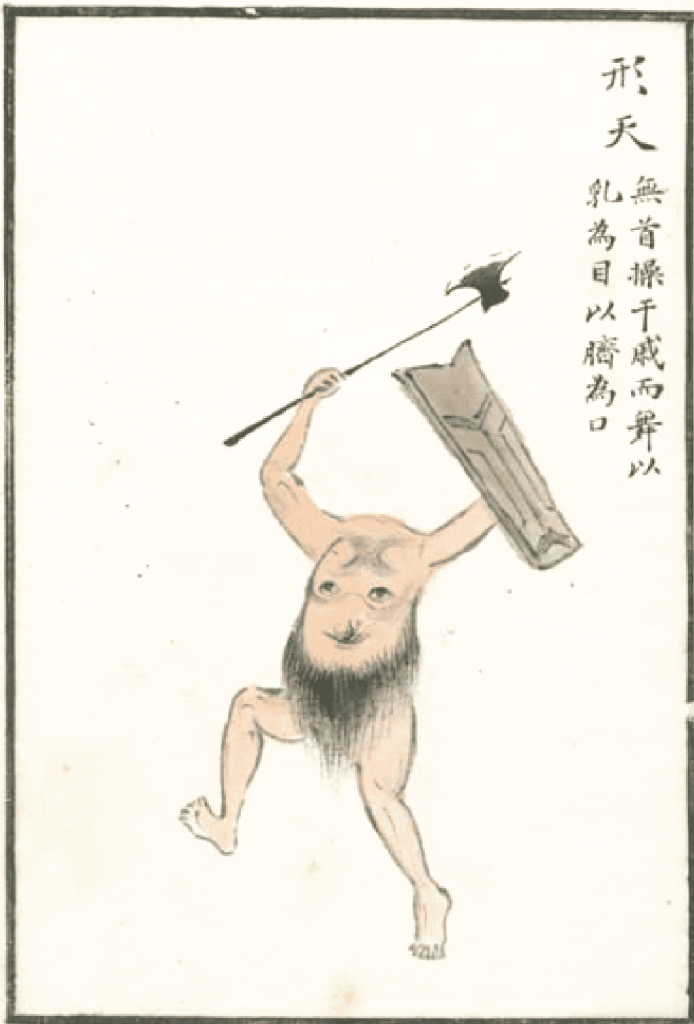
After his head was severed and buried at Mount Changyang, Xing Tian refused to surrender. He transformed his nipples into eyes and his navel into a mouth, then continued wielding his shield and battle-axe. The image of a headless warrior continuing his struggle became one of the most memorable episodes in Chinese mythological literature.
His story eventually acquired a meaning beyond physical combat. Xing Tian came to represent the determination to resist overwhelming opposition, even when success appears impossible. His legend is particularly remarkable because his defining moment is not his defeat but his refusal to let that defeat become the end of his existence.
Physical Traits
Xing Tian’s most recognisable physical characteristic is his complete lack of a head. Following his confrontation with the supreme divine ruler, his head was severed and buried at Mount Changyang. However, his body continued to function through an extraordinary transformation that allowed him to remain active.
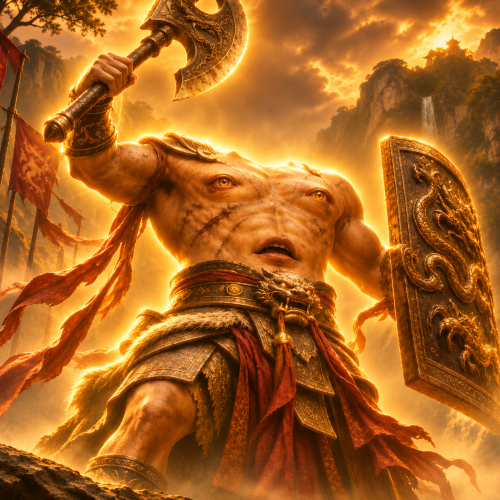
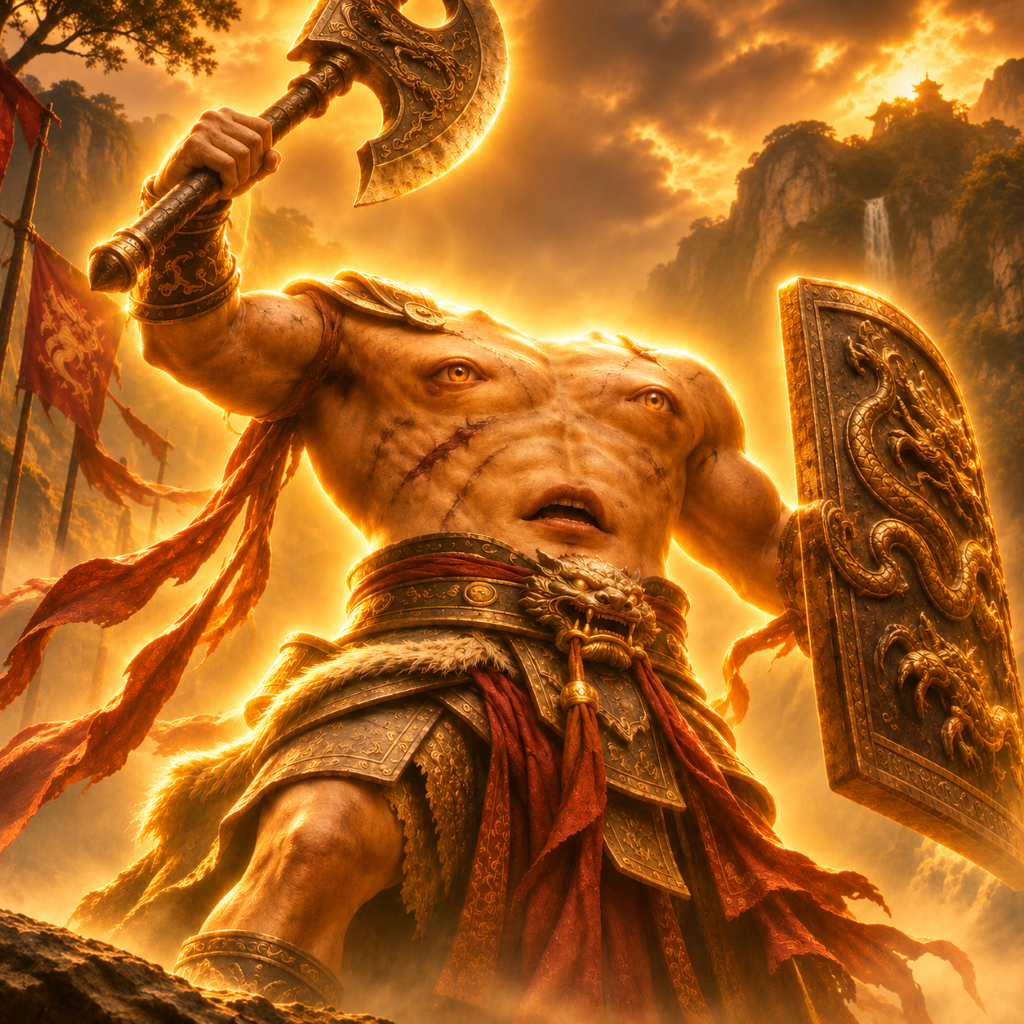
According to the Shan Hai Jing, Xing Tian transformed his nipples into eyes and his navel into a mouth. These unusual features allowed him to see and communicate despite losing his original head. The description is remarkably concise, but it provides enough detail to distinguish him from almost every other warrior in Chinese mythology.
His weapons are equally important to his appearance. Xing Tian carries a shield and a battle-axe, collectively referred to in the original Chinese text as ganqi (干戚). Rather than simply holding these weapons, he is described as dancing while wielding them. This movement is generally interpreted as a continuation of his struggle, expressing a spirit that remains active despite his physical defeat.
Traditional artistic representations commonly depict him as a powerful, muscular warrior with a headless torso, the eyes positioned on his chest and a mouth at his navel. He is usually shown carrying his characteristic shield and axe. It is important to distinguish these traditional representations from the original description. The earliest account does not establish his precise height, clothing, complexion or body proportions. His appearance in later paintings and popular culture reflects artistic interpretations of the brief ancient passage.
Family
Very little is known about Xing Tian’s family or personal relationships. The surviving account in the Shan Hai Jing concentrates almost entirely on his confrontation with the supreme divine ruler and his refusal to stop fighting after decapitation. There are no established accounts identifying his parents, siblings, spouse or children. Consequently, assigning him a conventional mythological genealogy would go beyond the available evidence.
Some later traditions connect Xing Tian with the Yan Emperor, also known as Yandi or the Flame Emperor. In these interpretations, Xing Tian served as a follower or minister of Yandi. Following Yandi’s defeat by the Yellow Emperor, Huangdi, Xing Tian reportedly challenged the victorious ruler himself. This association provides additional context for his rebellion, presenting him as a warrior who continued fighting after the defeat of the ruler he served. However, this relationship belongs to later narrative traditions rather than the brief original account in the Shan Hai Jing.
Xing Tian is also associated with the Kaiti clan in certain scholarly interpretations. Some research connects the clan with alternative forms such as Kaiti, Xinti and Diaoti. However, these names should not automatically be treated as the names of his immediate relatives. For now, his family background remains largely unknown, making his legendary actions far more prominent than any details of his personal life.
Other names
Xing Tian is known primarily by his Chinese name, written as 刑天 and romanised as Xíngtiān. The spelling Xingtian is also widely used in English-language publications and translations. Another historical romanisation is Hsing T’ien, which reflects an older system of representing Chinese names using Latin characters. His name is sometimes translated as ‘Punished by Heaven‘ or ‘He Who Was Punished by Heaven. Other interpretations associate it with opposition to Heaven. These translations vary, and none should be treated as an uncontested literal meaning.
In modern descriptions, Xing Tian is occasionally called the Headless Warrior, Headless Giant or Headless War God. These expressions describe his distinctive appearance and mythological role rather than functioning as established alternative names in the earliest Chinese source. Regardless of the spelling or descriptive title, these references generally identify the same legendary warrior whose struggle against divine authority became an enduring symbol of resistance.
Powers and Abilities
Xing Tian’s extraordinary abilities revolve around survival, physical endurance and his refusal to surrender. Unlike many supernatural figures in Chinese mythology, his original story does not provide an extensive catalogue of magical powers. Instead, it focuses on one extraordinary transformation that allows him to continue fighting after decapitation.
Xing Tian’s defining ability is his survival after losing his head. Rather than dying from the injury, his body continues functioning through the transformation of his sensory organs. This makes him an exceptional example of supernatural endurance in Chinese mythology. His nipples become his eyes, while his navel becomes his mouth. This transformation allows him to retain the basic functions necessary to continue his existence and struggle. It is the most distinctive supernatural feature associated with him.
Xing Tian is associated with the shield and battle-axe, weapons that define his identity as a formidable warrior. His continued use of them after decapitation demonstrates that losing his head did not end his capacity for combat. His ability to continue fighting after such a devastating defeat represents an exceptional level of physical resilience. His story does not establish conventional immortality, but his survival makes him an extraordinary figure.
Perhaps his most important characteristic is his determination. Xing Tian refuses to accept defeat even when his opponent has physically overcome him. His continued dance with shield and axe becomes a powerful expression of resistance. This final quality received particular recognition through the poetry of Tao Yuanming, who referenced Xing Tian in his tenth poem from Reading the Classic of Mountains and Seas. The poet associated his continued dance with a fierce determination that remained unchanged despite his fate.
Modern Day Influence
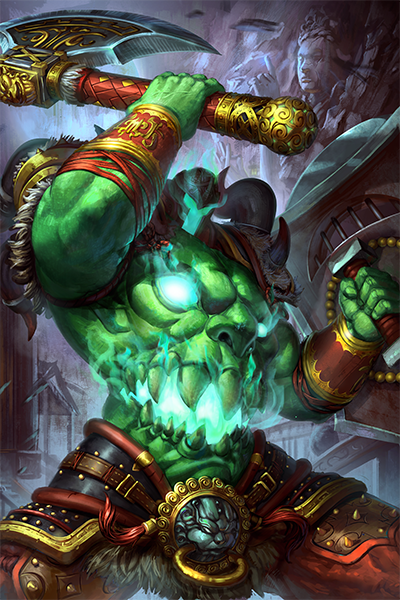
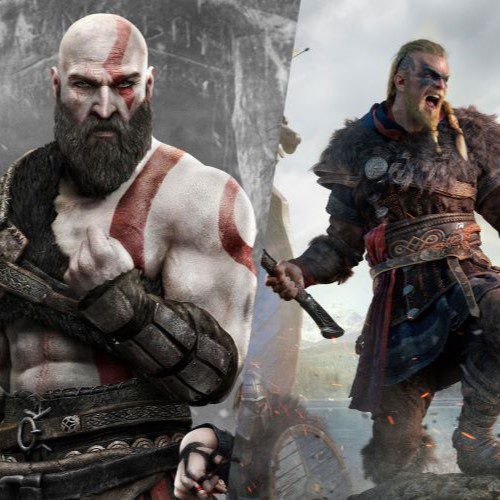
Xing Tian’s unusual appearance and compelling story have ensured his continued presence in modern interpretations of Chinese mythology. His legend has inspired literary discussions, artistic representations and appearances in contemporary entertainment. One of the most recognisable modern adaptations is his appearance in the multiplayer online battle arena game SMITE. Introduced in September 2015, Xing Tian appears as a playable character within the Chinese pantheon, carrying the title ‘The Relentless. His abilities draw inspiration from his mythological identity, including his chest-based roar, axe attacks and remarkable endurance.
His story has also attracted attention from scholars examining the continued reinterpretation of the Shan Hai Jing. Academic research has explored how ancient Chinese mythological figures and narratives have been adapted through contemporary literature, theatre and grap hic storytelling. His literary legacy, however, extends much further back. Tao Yuanming’s fifth-century poem helped establish Xing Tian as an enduring symbol of determination. The famous verse describes him dancing with his shield and axe while his fierce resolve remains unchanged.
This interpretation gives his legend a significance that reaches beyond its unusual physical imagery. Xing Tian represents the idea that defeat does not necessarily destroy the determination to resist. His continued struggle has made him an especially compelling figure for audiences interested in courage, perseverance and rebellion against seemingly absolute authority. Today, Xing Tian remains one of the most recognisable headless warriors in Chinese mythology. His legend demonstrates how even a relatively brief passage in an ancient text can develop into a powerful cultural symbol that survives across generations.
Related Images

Source
Birrell, A. (1999). Chinese mythology: An introduction. Johns Hopkins University Press.
Strassberg, R. E. (2002). A Chinese bestiary: Strange creatures from the Guideways through mountains and seas. University of California Press.
Yuan, K. (2000). Chinese mythology: An introduction (W. M. Bodman & N. C. Bodman, Trans.). Chinese Intercontinental Press.
Yang, L., & An, D. (2005). Handbook of Chinese mythology. Oxford University Press.
Tao, Y. (2000). The poetry of T’ao Ch’ien (J. R. Hightower, Trans.). Oxford University Press.
Xiyao, Z. (2019). Decapitation and transformation: Xing Tian in Chinese myth and folklore. Folklore: Electronic Journal of Folklore, 75, 151–168. https://www.folklore.ee/folklore/vol75/xiyao.pdf
Re-canonizing the Shanhaijing in the world. (2020). Literature, 1(1), 1–15. https://doi.org/10.1080/23306343.2020.1757323
Language Log. (2020, September 28). Headless men with face on chest. University of Pennsylvania.
https://languagelog.ldc.upenn.edu/nll/?p=48583
Frequently Asked Questions
Who is Xing Tian in Chinese mythology?
Xing Tian is a legendary Chinese warrior who continued fighting after being decapitated. He is remembered for his extraordinary endurance and refusal to surrender.
Why does Xing Tian have no head?
Xing Tian lost his head during a battle against a supreme divine ruler. His head was buried at Mount Changyang, but his body continued fighting.
How does Xing Tian see without a head?
According to the Classic of Mountains and Seas, Xing Tian transformed his nipples into eyes and his navel into a mouth after losing his head.
Who defeated Xing Tian in Chinese mythology?
The original text identifies his opponent as the Sovereign or supreme divine ruler. Later traditions commonly identify this figure as the Yellow Emperor, Huangdi.
What weapons does Xing Tian carry?
Xing Tian carries a shield and a battle-axe, known together as ganqi. He continues wielding these weapons even after losing his head.


