
Staff of Ra : The Solar Scepter of Egyptian Power
Mythlok Perspective
In Mythlok’s perspective, the Staff of Ra is authority illuminated. Associated with Ra, it represents rulership sustained by light and cosmic rhythm. Unlike weapons forged for combat, this staff radiates legitimacy rather than aggression. It symbolizes governance aligned with the daily renewal of the sun. Unlike Poseidon’s Trident, which unsettles foundations, the Staff of Ra stabilizes creation. It parallels the crook and flail of Egyptian kingship, where sovereignty rests on balance, and resembles Zeus’ thunderbolt only in its embodiment of supreme celestial authority.
Staff of Ra
Introduction
The Staff of Ra stands as more than a weapon in Egyptian mythology; it embodies the divine authority of Ra, the revered sun god. Representing ultimate power, this mystical staff has fascinated scholars, storytellers, and enthusiasts for ages, seen as a tool that channels the sun’s life-giving energy. With its power to command light, life, and fire, the Staff was believed to grant its wielder unmatched influence over the forces of nature. Its presence in mythology is profound, yet its legacy extends beyond ancient stories, finding new life in modern culture where it continues to inspire awe. As one of the most mysterious and potent artifacts linked to Ra, the Staff symbolizes the god’s supreme authority and creative force, a testament to his role as the king of gods and the source of all life.
Origins
The Staff of Ra, a revered artifact in ancient Egyptian lore, carries with it profound significance rooted in the civilization’s deep spiritual beliefs. As the powerful symbol wielded by Ra, the sun god, this staff was said to channel the sun’s boundless energy, embodying both his divine authority and the order he brought to the cosmos. The ancient Egyptians viewed the sun as the ultimate life-giver, essential for fertility and the natural rhythms of day and night, and Ra, as the sun god, held a central place in this worldview. Temples, rituals, and prayers were dedicated to him, all celebrating his role in maintaining cosmic balance and sustaining life.
Ra is often portrayed as a falcon-headed figure, with a radiant solar disc above his head, emphasizing his dominion over the heavens and his connection to the sky. This imagery not only reinforces his power but also represents his dual nature as both a creator and a destroyer—qualities revered and feared by his followers. His emergence from the chaotic waters of Nun in various creation myths illustrates Ra’s role in bringing order from disorder, a common theme where deities are seen as the stabilizers of a tumultuous universe.
The Staff of Ra also shares a symbolic link with the Was-scepter, an emblem of control and authority that was typically adorned with a stylized animal head. This scepter, associated with deities such as Set and Anubis, symbolizes the power to impose order over chaos. The connection between Ra’s staff and the Was-scepter suggests a merging of physical and spiritual power, portraying the staff as not just a weapon but as a divine right and a symbol of ultimate sovereignty. The staff’s importance lies in its embodiment of Ra’s supreme authority, uniting earthly rule and cosmic governance.
In essence, the Staff of Ra stands as a timeless emblem of authority, one that transcends simple mythology. Its origin story and spiritual significance reflect the cultural values and beliefs that shaped ancient Egypt. Held by gods and pharaohs alike, it was more than a mere weapon; it represented their divine mandate to rule, protect, and bring order. This potent symbol of Ra’s power over creation and chaos underscores the depth and influence of Egyptian mythology on its society and beyond.
Think you know your myths and legends? Dive into the world of ancient stories and test your knowledge with our engaging quizzes on Mythlok!
Powers
The Staff of Ra was renowned for powers that reflected the sun god’s supreme authority over creation and cosmic balance. It was said to channel raw solar energy, releasing beams of light and heat capable of piercing darkness or overwhelming enemies. As an extension of Ra himself, the staff embodied the dual force of creation and destruction. It could nurture life and sustain order, yet it also possessed the terrifying capacity to annihilate anything that defied divine will. Beyond its might, the staff symbolized Ra’s sovereignty over gods and mortals alike, serving as an emblem of Ma’at, the principle of universal harmony that preserved the delicate equilibrium between chaos and order.
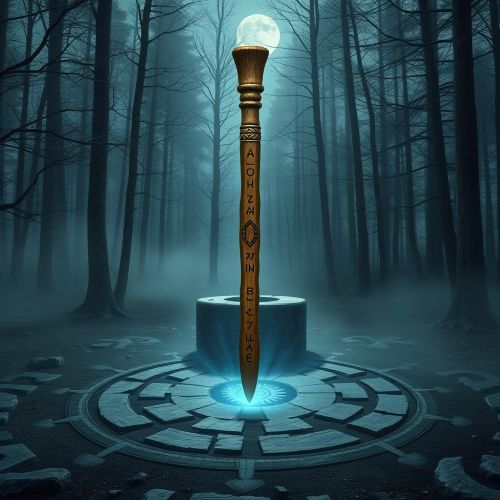
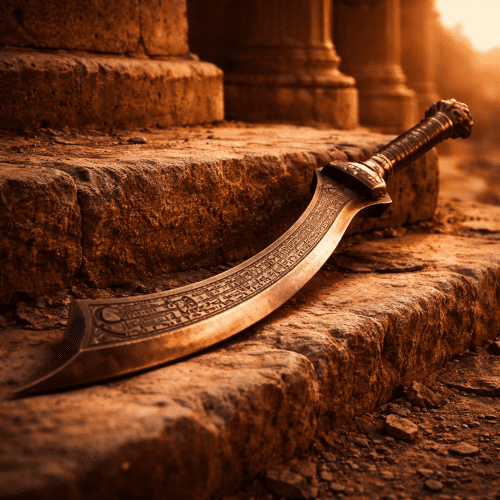
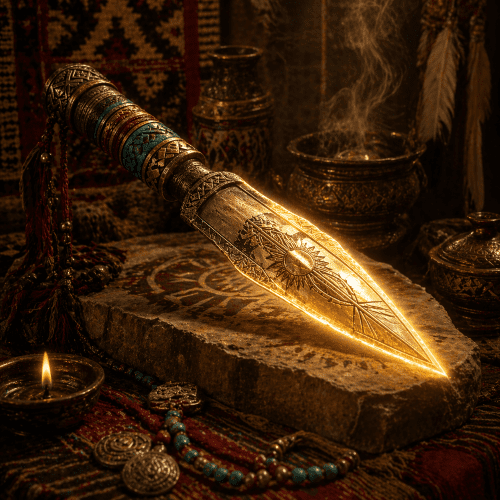
The Staff of Ra was also believed to possess transformative qualities, adapting to the needs of its wielder. In some traditions, it manifested as a sleek, golden blade-like form suited for close confrontation, reflecting Ra’s readiness to confront threats directly, especially in his eternal struggle against the chaos serpent Apophis. At other times, it appeared as a radiant scepter pulsing with solar brilliance, a manifestation reserved for divine presence and authority. With its fiery essence, the staff was capable of purging darkness and dissolving malevolent forces, reinforcing its role as both a guardian of cosmic stability and a weapon against encroaching chaos.
Owners/Users
Although the Staff of Ra is most closely associated with Ra himself, its influence extends across several central figures in Egyptian tradition. As the sun god’s primary emblem of authority, Ra wielded the Staff to defend the cosmos from chaos, particularly during his daily journey across the sky and through the underworld. Osiris, god of the afterlife and renewal, was at times linked symbolically to the Staff, representing the continuity of solar power beyond death and into rebirth. Even Set, embodiment of turbulence and disorder, briefly seized the Staff in mythic conflict, reflecting the perpetual tension between destructive chaos and sustaining order.
Horus, in avenging his father Osiris, is also connected with the Staff, symbolizing the restoration of balance and the triumph of rightful authority. By returning power to its proper source, Horus reaffirmed the cyclical nature of divine justice in Egyptian cosmology. Beyond the gods, pharaohs were often depicted holding a scepter associated with Ra’s authority, reinforcing their identity as earthly embodiments of solar power. Through royal iconography, the Staff became more than a divine implement—it evolved into a political and cosmic symbol of Ma’at, the sacred equilibrium that sustained both heaven and earth.
Instances used
The Staff of Ra occupies a central role in Egyptian tradition, appearing in myths that emphasize its cosmic significance. In Ra’s nightly journey through the underworld, he confronted the serpent of chaos, Apophis, using his divine authority to ensure the sun’s rebirth at dawn. This recurring battle symbolized the perpetual victory of light over darkness and order over disorder. In creation narratives, the Staff represented the establishment of structure from primordial chaos, reinforcing Ra’s function as creator and sustainer. Its presence in these myths underscores its symbolic role in shaping and preserving the universe.
The Staff also appears in the legend of Osiris and Horus, where it signifies rightful authority and divine succession. As Horus avenged his father and restored balance, the Staff became a marker of inherited legitimacy and cosmic justice. Over time, its symbolism extended beyond ancient religion into modern culture. Popular media, including films such as Indiana Jones and the Raiders of the Lost Ark, reimagined the Staff as a mystical key to hidden knowledge, blending historical reverence with cinematic adventure. Through both myth and modern storytelling, the Staff of Ra endures as a powerful emblem of wisdom, authority, and the triumph of order.



Source
Wikipedia. (n.d.). Ra. Retrieved from https://en.wikipedia.org/wiki/Ra
Ancient History Encyclopedia. (n.d.). Ra. Retrieved from https://www.ancient.eu/Ra/
Britannica. (n.d.). Ra. Retrieved from https://www.britannica.com/topic/Ra
Wilkinson, Richard H. (2003). The Complete Gods and Goddesses of Ancient Egypt. Thames & Hudson.
Pinch, Geraldine. (2004). Egyptian Mythology: A Guide to the Gods, Goddesses, and Traditions of Ancient Egypt. Oxford University Press.
“Spear of Ra – Gods of Egypt Wikia – Fandom,” Gods of Egypt Wikia, October 29, 2024.
What’s with the staff thingies that Anubis, Horus, Ra, Sekhmet, Thoth …,” Reddit, June 16, 2023.
Frequently Asked Questions
What is the staff of Ra?
In Egyptian mythology, Ra, the sun god and king of the gods, is frequently depicted holding a staff, often alongside the ankh (symbol of life). This staff is primarily a symbol of authority, power, and dominion. It signifies Ra’s role as the supreme ruler of the cosmos and his control over the natural order. While not typically associated with specific magical powers in the same way as some other mythological staffs, the staff of Ra embodies his divine status and the immense power he wields as the sun god and creator figure.
What is Ra's staff called?
While the sun god Ra is consistently depicted holding a staff as a symbol of his authority and power in Egyptian mythology, this staff doesn’t have a specific, widely recognized name. It’s simply referred to as his staff or scepter, emphasizing his dominion as the king of the gods and ruler of the cosmos. Sometimes, it is depicted as a Was-scepter, a common symbol of power and dominion associated with various deities and the pharaohs.
What are the powers of the staff of Ra?
In Egyptian mythology, the staff held by Ra, often depicted as a Was-scepter, primarily symbolizes his supreme authority, dominion over the cosmos, and his role as the king of the gods and sustainer of life. While not typically attributed specific magical powers in ancient texts, it embodies his inherent divine power and control over the natural order. The Was-scepter association further reinforces its representation of power and the maintenance of cosmic harmony (Ma’at), visually solidifying Ra’s preeminent status within the Egyptian pantheon.
How tall is the staff of Ra?
In Egyptian mythology, the staff of Ra, often associated with the Was-scepter, doesn’t have a fixed height mentioned in ancient texts. Its size would likely vary in depictions, primarily serving a symbolic purpose rather than a practical one. However, real Was-scepters have been found with varying lengths, some reaching up to two meters (around 6.5 feet), as one exceptional example discovered near Naqada. Therefore, if we were to imagine a physical representation of Ra’s staff based on existing Was-scepters, it could be quite tall, potentially around that height.
Is Indiana Jones based off a real story?
Indiana Jones is not based on a single real story but rather draws inspiration from the lives and adventures of several historical figures, including archaeologists like Hiram Bingham III, Roy Chapman Andrews, and Percy Fawcett, who were known for their daring expeditions and discoveries.