

Unhcegila : The Horned Water Serpent of Lakota and Dakota Lore
At a glance
| Description | |
|---|---|
| Origin | Lakota Mythology |
| Classification | Spirits |
| Family Members | Unktehi (Counterpart) |
| Region | United States of America |
| Associated With | Water, Floods, Destruction, Chaos, Serpents, Rivers, Lakes |
The Mythlok Perspective
In Mythlok’s Perspective, Unhcegila is far more than North America’s version of a dragon. She occupies a role similar to the world-serpents found in Norse, Mesopotamian, and Hindu mythology, yet her purpose is uniquely tied to the living landscape of the Lakota and Dakota peoples. She embodies the terrifying reality that nature cannot be conquered, only respected. Her battles with the Thunderbird are not merely heroic adventures but symbolic reminders that balance, rather than absolute victory, sustains the world. That enduring message makes Unhcegila one of the most meaningful serpent figures in Indigenous mythology.
Unhcegila
Introduction
Among the many powerful beings found in Lakota and Dakota mythology, few inspire as much fear as Unhcegila, the legendary horned water serpent. Unlike creatures that simply guard sacred places or test heroes, Unhcegila represents nature at its most destructive. Floods, mysterious disappearances, polluted waters, and sudden death are all connected to her presence in traditional stories.
Rather than being a simple monster, Unhcegila reflects an important belief within Lakota and Dakota cosmology—the constant struggle between opposing natural forces. Her stories often place her against Wakíŋyaŋ (the Thunderbird), whose storms and lightning restore balance whenever chaos threatens the world. Through this conflict, the myths explain not only dangerous landscapes but also the fragile relationship between humans and the natural world.
Many written accounts of Unhcegila were preserved during the late nineteenth and early twentieth centuries by ethnographers such as James R. Walker, who documented stories shared by Lakota spiritual leaders. While individual versions differ, they consistently portray Unhcegila as one of the most feared supernatural beings in Sioux oral tradition.
Physical Traits
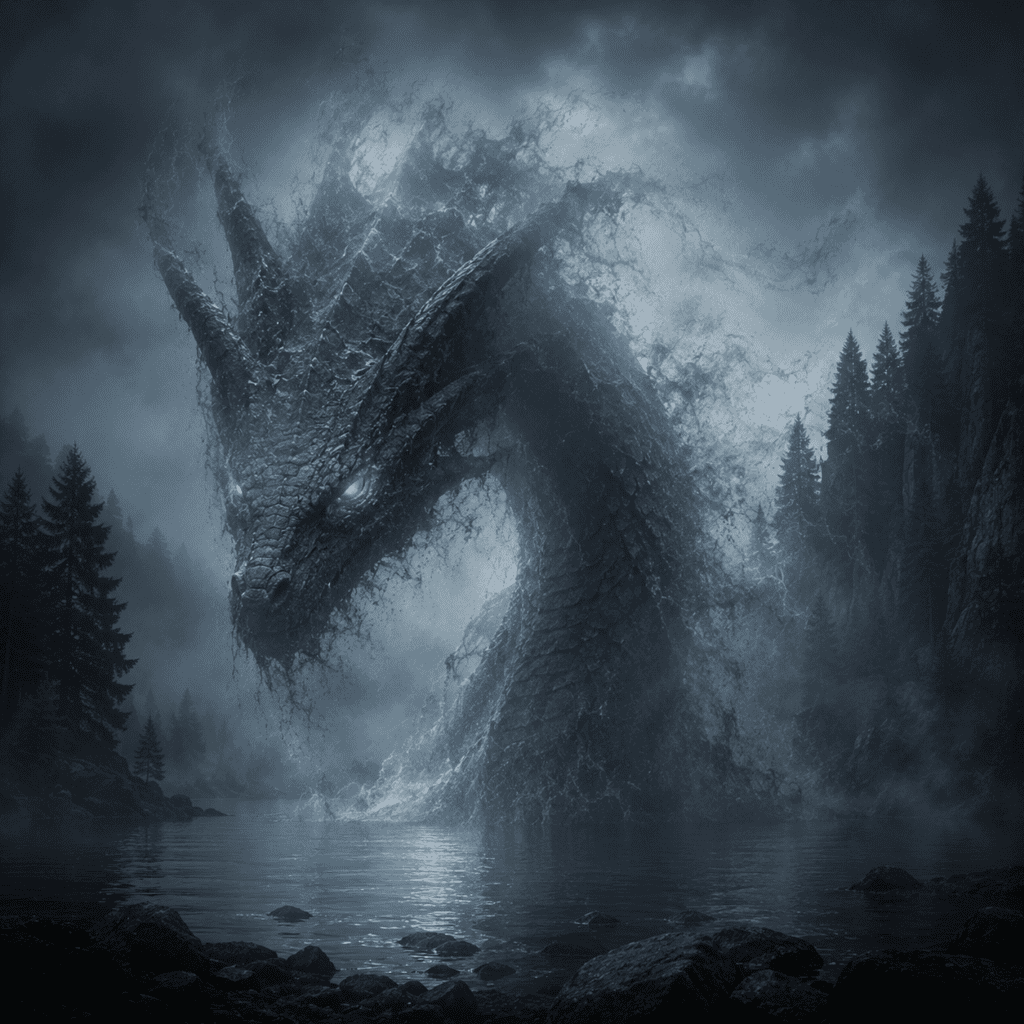
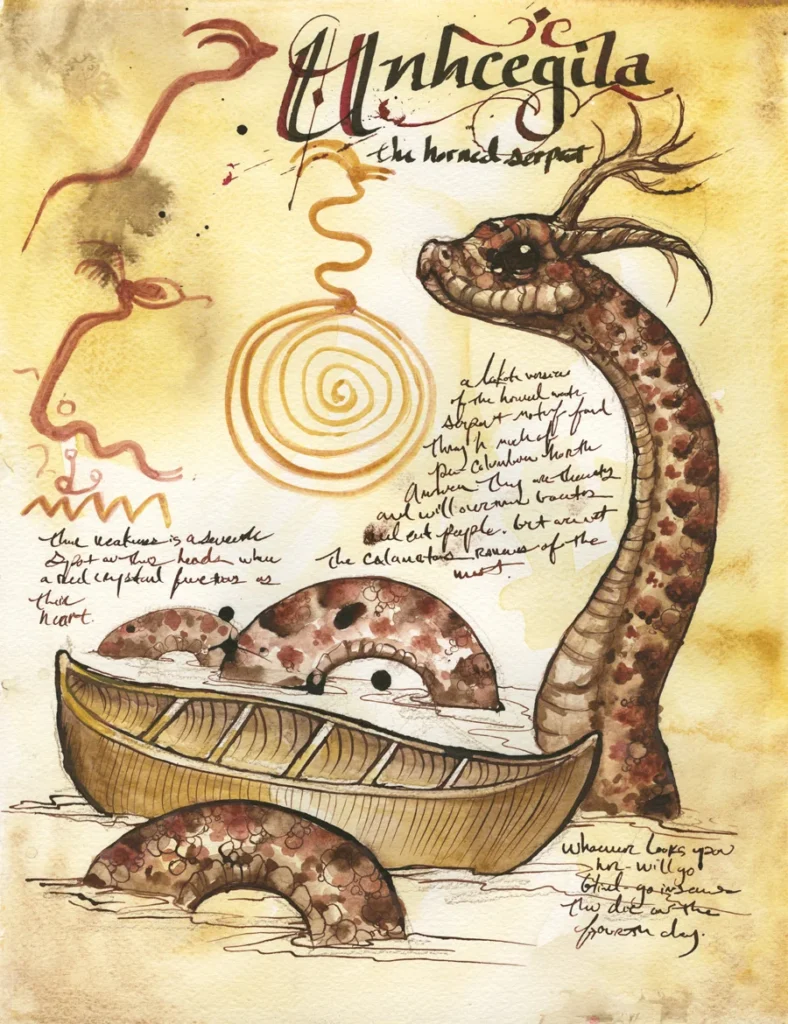
Descriptions of Unhcegila vary between communities and storytellers, reflecting the oral nature of Lakota and Dakota traditions. Some of the oldest accounts describe her as a mysterious, smoky presence with blazing eyes and sharp fangs emerging from mist rather than possessing a clearly defined body.
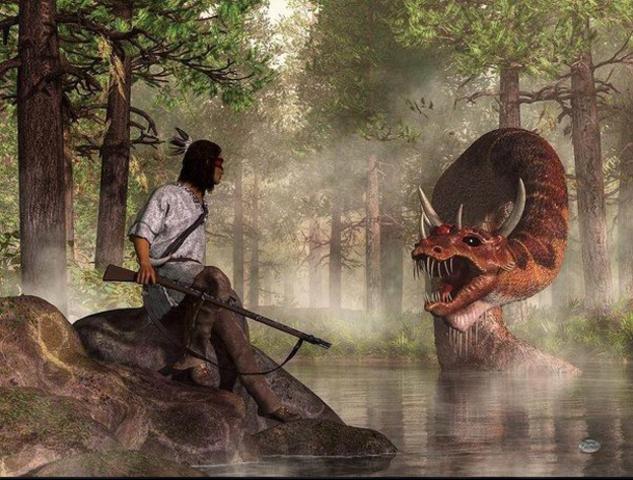
Later versions present a far more detailed image. Unhcegila appears as a gigantic horned serpent covered in thick, flint-like scales that ordinary weapons cannot penetrate. Her body stretches across rivers and lakes, while short but powerful legs allow her to move across land when necessary. Some traditions also describe large horns on her head and an additional horn near her nose or tail, emphasizing her terrifying appearance.
Her glowing eyes are among her most feared features. Looking directly into them is said to cause blindness, madness, or even death. Legends also describe iron-like claws, a thunderous roar, and an enormous saw-toothed tail capable of destroying everything in its path.
Despite her seemingly invincible body, Unhcegila possesses a single weakness. Hidden beneath the seventh patch of scales lies her crystal heart, the only vulnerable point on her otherwise impenetrable armor.
Family
Unlike many mythological beings, Unhcegila does not have a clearly defined family tree. Instead, she is closely connected to Unktehi (also spelled Unk Tehi or Unktehila), another powerful horned water being found throughout Lakota and Dakota traditions. Depending on the version of the story, the two may represent counterparts, members of the same supernatural race, or even different names for closely related beings.
Some oral traditions also mention that Unhcegila produced offspring that inherited her dangerous nature. These young serpents preyed upon humans and spread fear throughout the land until they were eventually destroyed by courageous heroes or powerful spiritual beings.
The most important relationship, however, is not familial but cosmic. Unhcegila stands in eternal opposition to the Thunderbird, whose lightning and storms serve as a natural counterbalance to the destructive forces of the water serpent. This rivalry symbolizes the balance between opposing elements rather than a simple battle between good and evil.
Other names
Because Lakota and Dakota stories were preserved through oral tradition long before they were written down, Unhcegila appears under several spellings. Common variations include Uncegila, Unk Cekula, Unktehila, and Unktehi. Modern scholars generally agree that many of these differences result from dialectal pronunciation and the challenges early ethnographers faced when recording Indigenous languages using the Latin alphabet.
Some sources use Unktehi to describe a broader class of horned water serpents, while others treat it as a specific supernatural being closely associated with Unhcegila. Although these interpretations vary, all describe immensely powerful creatures connected with dangerous bodies of water and destructive natural forces.
Powers and Abilities
Unhcegila’s greatest strength lies in her ability to command the destructive power of water. She is blamed for devastating floods that reshape landscapes, destroy settlements, and claim countless lives. Rivers and lakes touched by her presence become places of danger, where mysterious disappearances and unexplained deaths occur without warning.
Her supernatural gaze is equally feared. Anyone unfortunate enough to meet her eyes risks blindness, madness, or instant death, making direct confrontation almost impossible. Combined with her immense intelligence and nearly indestructible scales, this makes her one of the most formidable creatures in Lakota mythology.
Legends also describe her ability to move beneath the earth like a gigantic serpent, emerging unexpectedly to attack travelers or devastate entire regions. Her booming voice echoes like thunder across the landscape, announcing her arrival long before she appears.
Despite these overwhelming powers, Unhcegila is not invincible. Stories tell of heroic twins, aided by medicine people and sacred spiritual guidance, who eventually defeat her by striking the exposed crystal heart hidden beneath the seventh section of her scales. This victory reinforces a recurring theme in Lakota mythology: wisdom and spiritual knowledge triumph where brute force alone cannot.
Modern Day Influence
Unhcegila continues to be one of the best-known monsters in Lakota and Dakota mythology, appearing in books, documentaries, educational resources, and comparative mythology studies. Scholars often examine her legend alongside other Indigenous horned serpent traditions, such as the Cherokee Uktena, to explore common themes surrounding water, danger, and sacred landscapes.
The myth is also closely connected to locations in the Black Hills, the Badlands, and Bear Butte, where unusual rock formations have sometimes been interpreted through traditional stories about the serpent’s movements or defeat. These connections highlight how mythology helps explain and preserve the cultural significance of the landscape.
Outside academic circles, Unhcegila has inspired artists, fantasy writers, comic books, and tabletop games that draw upon Native American folklore. While these modern adaptations introduce the creature to wider audiences, they often simplify complex spiritual traditions into fantasy monsters. The original Lakota and Dakota stories remain deeply connected to cultural teachings about respecting nature, maintaining balance, and recognizing the immense power of the natural world.
Related Images
Source
Encyclopedia Britannica. (n.d.). Siouan peoples. https://www.britannica.com/topic/Siouan-peoples
Wikipedia contributors. (n.d.). Unhcegila. In Wikipedia. https://en.wikipedia.org/wiki/Unktehi
Gods and Monsters. (2024, June 10). Unktehila: The powerful water serpent of Native American myth. https://godsandmonsters.info/unktehila/
Mythical Encyclopedia. (2023, December 23). Unhcegila: A friendly introduction. https://mythicalencyclopedia.com/unhcegila/
Stronghold Nation. (2012, December 31). Unhcegila. https://www.stronghold-nation.com/history/myth/unhcegils
Deloria, E. (1998). Speaking of Indians. University of Nebraska Press.
Walker, J. R. (1980). Lakota Belief and Ritual. University of Nebraska Press.
Powers, W. K. (1977). Oglala Religion. University of Nebraska Press.
Frequently Asked Questions
Who is Unhcegila in Lakota mythology?
Unhcegila is a legendary horned water serpent in Lakota and Dakota mythology who represents floods, destruction, and the dangerous power of nature.
Is Unhcegila the same as Unktehi?
Not always. Some traditions treat Unhcegila and Unktehi as closely related beings or counterparts, while others use the names interchangeably for horned water serpents.
How was Unhcegila defeated?
According to Lakota tradition, heroic twins defeated Unhcegila by striking her only vulnerable spot—the crystal heart hidden beneath the seventh section of her scales.
What does Unhcegila symbolize?
Unhcegila symbolizes the destructive forces of water, the unpredictability of nature, and the importance of maintaining balance between opposing natural powers.
Where is Unhcegila's legend connected?
Her stories are closely associated with the Black Hills, Bear Butte, and the Badlands of the northern Great Plains, landscapes that hold deep spiritual significance in Lakota tradition.