


Adlivun : The Inuit Underworld of Ice and Spirits
| Description | |
|---|---|
| Mythology | Inuit Mythology |
| Description | Frozen underworld beneath land/sea |
| Ruler/Guardian | Sedna, Anguta |
| Inhabitants | Souls, Spirits, Marine animals |
| Nature | Neutral |
Mythlok Perspective
In Mythlok’s Perspective, Adlivun stands apart from many famous underworlds because it focuses on transformation rather than punishment. The frozen realm beneath the Arctic seas mirrors the Inuit relationship with a challenging environment where survival depends on balance, respect, and cooperation. Adlivun is not a place of fear but a spiritual threshold where souls are refined before moving onward. Its closest parallels can be found in the Norse concept of Hel and certain Siberian shamanic traditions, both of which view the afterlife as part of a larger cosmic cycle. Yet Adlivun remains uniquely Inuit, shaped by ice, sea, and the belief that humans, animals, and spirits are inseparably connected. In this way, it represents one of the world’s most environmentally rooted visions of the afterlife.
Adlivun
Introduction
Adlivun is one of the most important spiritual realms in Inuit tradition. The name is commonly translated as “those who live beneath us,” referring both to the underworld itself and the spirits who dwell there. In Inuit cosmology, the universe is often divided into three realms: the upper world, the earthly world, and the world beneath. Adlivun occupies this lower realm and serves as a destination for the souls of the deceased.
Unlike many underworlds found in world mythology, Adlivun is not primarily a place of eternal punishment. Instead, it functions as a transitional realm where souls undergo purification before continuing their spiritual journey. The concept reflects the Inuit understanding of life, death, and the interconnected relationship between humans, animals, nature, and the spirit world. Deeply influenced by the Arctic environment, Adlivun is imagined as a frozen domain beneath the earth and sea, embodying the landscape that has shaped Inuit culture for thousands of years.
Description
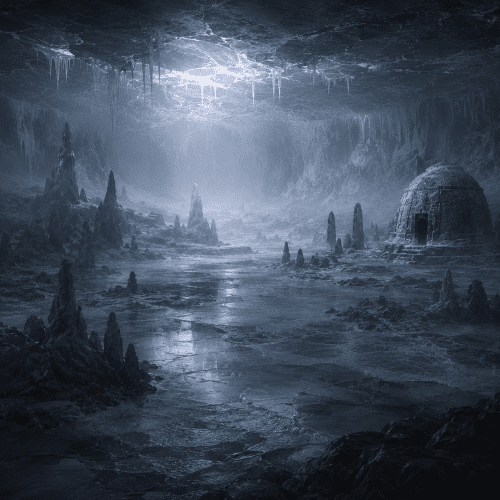
Adlivun is traditionally described as a vast frozen realm located beneath the land and the icy waters of the Arctic Ocean. In many stories, it lies at the bottom of the sea, hidden beneath layers of ice and darkness. The environment mirrors the harsh northern landscape familiar to the Inuit, with endless cold, icy expanses, and mysterious depths.
However, Adlivun is more than a geographical location in the spiritual imagination. It represents a place of transition where earthly concerns are gradually stripped away from the soul. Rather than serving as a final resting place, it acts as an intermediate realm where spirits prepare for the next stage of existence.
Many Inuit traditions teach that souls remain in Adlivun for approximately one year. During this period, spiritual impurities are removed, allowing the deceased to continue onward to higher realms such as Qudlivun, often known as the Land of the Moon. This concept emphasizes transformation rather than condemnation, making Adlivun unique among global underworld traditions.
Ruler/Guardian
The most famous figure associated with Adlivun is Sedna, the powerful sea goddess who rules the depths beneath the Arctic waters. Known by various names across Inuit communities, including Nuliajuk and Arnarquagssaq, Sedna occupies a central place in Inuit spiritual beliefs.
According to Inuit mythology, Sedna was once a mortal woman. Through a tragic series of events involving betrayal and abandonment, she fell into the sea and transformed into a divine being. In many versions of the story, her severed fingers became seals, walruses, whales, and other marine animals that sustain Inuit communities. As a result, Sedna became both the ruler of the sea and the guardian of marine life.
Another important figure connected to Adlivun is Anguta, often described as Sedna’s father. In some traditions, Anguta serves as a guide for the dead, escorting souls into the underworld and overseeing their transition. Together, Sedna and Anguta maintain the balance between the living world and the realm of the departed.
Inhabitants
The primary inhabitants of Adlivun are the souls of deceased humans. These spirits arrive after death and remain within the realm during their period of purification. Their presence reinforces the idea that death is not an ending but a stage in a continuing spiritual journey.
Beyond human spirits, Adlivun is populated by a variety of supernatural beings found throughout Inuit mythology. Animal spirits, known as tornat, are believed to inhabit the spiritual landscape alongside the dead. These spirits reflect the Inuit belief that animals possess souls and maintain an enduring connection to the human world.
Sedna herself resides within the realm, accompanied by powerful spirit beings and guardians. Some traditions also describe marine creatures, supernatural entities, and ancestral spirits dwelling within the frozen depths. Together, these inhabitants create a vibrant spiritual ecosystem that mirrors the interconnectedness of life in the Arctic.
Access
For most beings, entry into Adlivun occurs through death. After a person dies, their soul begins a journey guided by spiritual beings who ensure safe passage to the underworld. Inuit funeral customs often reflected these beliefs, with burial practices designed to assist the deceased on their spiritual voyage.
Psychopomps such as Anguta and Pinga are frequently associated with guiding souls to their destination. Once a spirit arrives in Adlivun, it begins the process of purification that prepares it for the next phase of existence.
Although access is generally reserved for the dead, powerful shamans known as angakkuit were believed capable of visiting Adlivun while still alive. Through trance states and spiritual journeys, they could travel between worlds, communicate with spirits, and seek guidance from supernatural beings for the benefit of their communities.
Instances of Visit
Shamanic journeys to Adlivun occupy an important place in Inuit oral tradition. When hunting conditions became difficult or marine animals disappeared, shamans would undertake spiritual descents into the underworld to meet Sedna.
According to tradition, Sedna’s hair could become tangled when humans violated sacred taboos or behaved improperly. Because her fingers were lost during her transformation, she was unable to comb her own hair. Shamans would therefore travel to her underwater dwelling and carefully comb her hair, easing her suffering and restoring harmony between humans and nature.
These journeys were not merely symbolic. For Inuit communities dependent on hunting for survival, maintaining a positive relationship with Sedna was essential. Through these spiritual encounters, shamans acted as mediators between the human and supernatural worlds.
Symbolism
Adlivun symbolizes purification, transformation, and renewal. Rather than representing fear or eternal punishment, it serves as a place where the soul prepares for its next stage of existence. This perspective reflects a broader Inuit worldview that emphasizes cycles rather than final endings.
The realm also symbolizes balance between humanity and nature. Inuit traditions teach that actions taken in the physical world affect the spiritual world, and vice versa. Respect for animals, adherence to cultural taboos, and responsible behavior were believed to maintain harmony throughout creation.
Another important theme is continuity. Death does not sever a person’s connection to family, community, or the natural world. Through spiritual transformation and the recycling of life force, individuals remain part of an ongoing cycle that links generations together.
Comparative Analysis
Adlivun shares similarities with several underworld traditions around the world, yet it retains characteristics that make it distinctly Inuit. Like the Greek underworld ruled by Hades, it exists beneath the world of the living. Like the Norse realm of Hel, it is associated with coldness and the dead.
The key difference lies in its purpose. Many underworlds function as permanent destinations where souls remain indefinitely. Adlivun, by contrast, is usually viewed as a temporary realm of cleansing and preparation. Souls are expected to continue their journey after completing their time there.
Its environmental symbolism is equally distinctive. While many cultures imagine fiery infernos or shadowy caverns, the Inuit envisioned an icy underworld beneath frozen seas. This reflects the realities of Arctic life and demonstrates how mythology is often shaped by the landscapes people inhabit.
Modern Influence
Adlivun continues to inspire scholars, artists, writers, and cultural preservation efforts today. Inuit communities actively preserve stories about Sedna, Adlivun, and traditional spiritual beliefs through education, oral storytelling, literature, and artistic expression.
The realm has also appeared in contemporary media, including novels, films, and video games that draw inspiration from Inuit mythology. These modern interpretations introduce global audiences to Inuit spiritual traditions while encouraging greater appreciation of Indigenous knowledge systems.
Beyond popular culture, Adlivun remains a powerful symbol of cultural identity. It reflects enduring Inuit values surrounding respect for nature, community responsibility, and the cyclical relationship between life and death. As interest in Indigenous worldviews continues to grow, Adlivun remains one of the most fascinating and distinctive underworld concepts in world mythology.
Sources
Wikipedia. “Adlivun.” https://en.wikipedia.org/wiki/Adlivun
The Enlightenment Journey. “The Adlivun: Inuit Underworld And Afterlife Realm.” https://theenlightenmentjourney.com/the-adlivun-inuit-underworld-and-afterlife-realm/
Academic Kids. “Adlivun.” https://academickids.com/encyclopedia/index.php/Adlivun
Boas, Franz. The Central Eskimo. Sixth Annual Report of the Bureau of American Ethnology, 1888. Smithsonian Institution.
Rasmussen, Knud. Intellectual Culture of the Iglulik Eskimos. Gyldendalske Boghandel, 1929.
Damas, David (ed.). Handbook of North American Indians, Volume 5: Arctic. Smithsonian Institution, 1984.
Patton, Kimberley C. (2007). The Great Woman Down There;’ Sedna and Ritual Pollution in Inuit Seascapes,” Chapter 5 in The Sea Can Wash Away All Evils: Modern Marine Pollution and the Ancient Cathartic Ocean, pp. 79-96. Columbia University Press.
Frequently Asked Questions
What is Adlivun in Inuit mythology?
Adlivun is the Inuit underworld where souls of the deceased undergo purification before moving to higher spiritual realms.
Who rules Adlivun?
Sedna, the powerful sea goddess, is the primary ruler of Adlivun and guardian of marine life.
Is Adlivun a place of punishment?
No. Adlivun is generally viewed as a realm of purification and transition rather than eternal punishment.
Can living people visit Adlivun?
According to Inuit tradition, shamans called angakkuit could spiritually journey to Adlivun through trance states.
How is Adlivun different from Hades or Hel?
Unlike many underworlds that serve as final destinations, Adlivun is typically a temporary realm where souls prepare for the next stage of existence.


