


Umqäqäi : The Chukchi Hero of the Arctic Spirit World
At a glance
| Description | |
|---|---|
| Origin | Chukchi Mythology |
| Classification | Mortals |
| Family Members | N/A |
| Region | Russia |
| Associated With | Survival |
The Mythlok Perspective
In Mythlok’s Perspective, Umqäqäi represents a powerful storytelling tradition where the hero is not divine but deeply human. Arctic mythologies often emphasize endurance rather than godlike power, reflecting the realities of life in extreme environments. The hero survives through intelligence and courage instead of supernatural abilities. This archetype appears in many cultures. The Inuit hero Kiviuq also journeys through a dangerous spirit-filled world, while in Norse tradition the explorer figures who venture beyond known lands face similar supernatural trials. These parallels show that across cultures, human resilience itself becomes the greatest mythic power.
Umqäqäi
Introduction
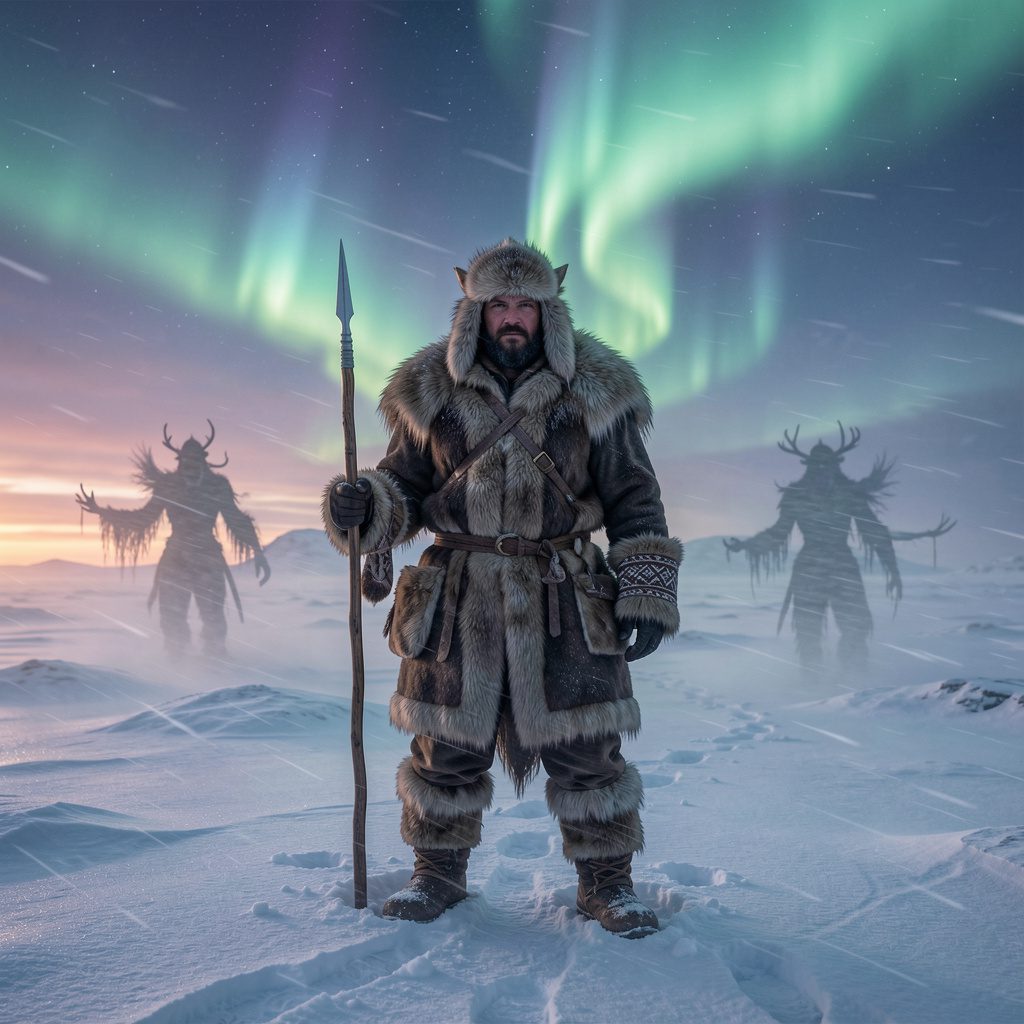
Umqäqäi is a human hero from Chukchi traditional storytelling, preserved in the early ethnographic work of Waldemar Bogoras. His story, recorded from an oral account in November 1900 and later published in Chukchee Mythology, follows a journey into a landscape inhabited by the mysterious ke’let, supernatural beings associated with the spirit world.
Umqäqäi travels with companions who, like him, are reindeer-drivers. Their journey takes them through a world where the boundary between ordinary human existence and the supernatural is remarkably thin. What begins as travel across the Arctic landscape becomes a dangerous encounter when they discover a settlement inhabited by ke’let.
The story provides a vivid glimpse into Chukchi ideas about supernatural beings and their relationship with human travelers. The ke’let are not distant gods ruling from a celestial realm. They exist within the same landscape as humans, possessing their own settlements, activities, and awareness of the people who pass through their territory.
When Umqäqäi and his companions encounter them, the situation quickly becomes threatening. A ke’let woman notices the travelers and reacts with fear. Umqäqäi responds by pointing toward her, after which she experiences a sudden painful sensation and difficulty breathing. The strange encounter gives the human traveler an unexpected advantage, but the group does not remain to challenge the spirits.
Instead, Umqäqäi and his companions attempt to escape with their reindeer. Their flight becomes another test when the animals‘ tether catches around a grassy hummock. Umqäqäi manages to free them, allowing the group to continue their journey and eventually return safely. The story of Umqäqäi is therefore a tale of human beings moving through a supernatural landscape, where awareness, quick action, and knowledge of the environment become essential for survival.
Physical Traits
Umqäqäi is portrayed as a human Chukchi man rather than as a monstrous or divine figure. The narrative focuses on his actions and experiences instead of providing an elaborate physical description. His identity as a reindeer-driver places him within an important aspect of traditional Chukchi life. Reindeer provided transportation, food, clothing materials, and economic support, while experienced reindeer-drivers needed considerable knowledge of animals and the Arctic environment.
The story gives particular attention to his interaction with the reindeer during the escape. Umqäqäi uses a long thong made from young walrus hide to tether the animals to a grassy hummock. When the group needs to flee, the tether becomes an obstacle, forcing him to work quickly to release the reindeer.
These details give Umqäqäi a distinctly practical physical identity. He belongs to a world of reindeer, tundra travel, animal equipment, and harsh northern landscapes. His strength is expressed through his ability to manage the demands of that environment rather than through exaggerated physical characteristics. His visual representation should therefore emphasize a realistic Chukchi traveler and reindeer-driver, dressed appropriately for the Arctic environment and equipped for travel, rather than giving him the appearance of a supernatural warrior.
Family
Umqäqäi’s story centres on his journey with companions rather than on his ancestry or household. His companions accompany him during the encounter with the ke’let and share the danger of the journey. The narrative does not establish a prominent family lineage for Umqäqäi. His importance comes from his actions during the adventure and his encounter with the supernatural world.
This makes him different from mythological figures whose identities depend on divine genealogy. His story is grounded in human experience: travelling, managing reindeer, recognizing danger, and finding a way back from an encounter with forces beyond the ordinary human world.
His companions are particularly important because the adventure is not presented as the journey of an isolated wanderer. The group travels together, encounters the ke’let together, and attempts to escape together. Their shared experience gives the story a strong sense of movement through an unfamiliar and dangerous landscape.
Other Names
The name appears in Bogoras’s work as U´mqäqäi, with transliteration differences appearing in reproductions of the ethnographic material. Forms such as U’mqaqai reflect attempts to represent the sounds of the Chukchi language through different writing systems. These variations are a normal feature of early ethnographic records of Indigenous languages, particularly when oral languages were transcribed by researchers working through different linguistic conventions.
Umqäqäi does not have an extensive collection of titles or epithets. His identity remains closely connected to the personal name preserved in Bogoras’s account. For modern reference, Umqäqäi is the most useful form of the name, while alternative spellings can be treated as transliteration variants.
Powers and Abilities
Umqäqäi’s most remarkable ability emerges during his encounter with the ke’let. When a ke’let woman becomes aware of the travelers, she experiences fear. Umqäqäi points toward her, and she suddenly feels a painful sensation accompanied by difficulty breathing. The story presents this event without providing a formal explanation, giving Umqäqäi an enigmatic connection to the supernatural encounter.
His abilities are not presented as a conventional collection of magical powers. Instead, the story reveals his unusual capacity through a single dramatic action. The episode establishes that Umqäqäi can affect a supernatural being in a way that is significant enough to frighten the ke’let.
His practical abilities are equally important. As a reindeer-driver, he is capable of managing the animals during difficult travel. When the group attempts to escape, their reindeer become caught by the tether secured around a grassy hummock. Umqäqäi works to free them and succeeds in getting the animals moving again.
His response to danger is therefore defined by quick thinking, physical competence, knowledge of reindeer, and an unexplained supernatural influence. The encounter also demonstrates the dangerous nature of the ke’let. Umqäqäi does not seek a prolonged confrontation with them. Once the supernatural beings become aware of the travelers, escape becomes the group’s priority. The hero’s success lies in getting himself, his companions, and the reindeer away from the supernatural settlement.
Modern Day Influences
Umqäqäi remains primarily known through the ethnographic record of Waldemar Bogoras, whose work preserved a large body of Chukchi traditional narratives at a time when many stories existed primarily through oral transmission. His adventure appears in Chukchee Mythology, published in 1910 as part of the publications associated with the Jesup North Pacific Expedition. The collection remains an important historical source for researchers examining Chukchi folklore, traditional religion, supernatural beings, and Indigenous Arctic storytelling.
Umqäqäi is less widely known than figures such as Raven, one of the major supernatural characters appearing across Chukchi traditions. His importance instead comes from the specificity of his story. It provides an unusually intimate look at an encounter between ordinary human travelers and the ke’let.
The narrative also preserves details of everyday Arctic life alongside supernatural events. Reindeer-driving, animal equipment, travel across the landscape, and the practical difficulties of moving through the environment are woven directly into the encounter with the spirit world. This combination of ordinary life and supernatural experience is one of the story’s most compelling characteristics. The ke’let are encountered within the same landscape through which humans travel, making the supernatural world feel immediate rather than distant.
Today, Umqäqäi is best understood as part of the wider body of Chukchi oral literature preserved through ethnographic documentation. His story contributes to the understanding of how Chukchi traditional narratives brought together human experience, animals, landscape, and supernatural beings within a single interconnected world.
Related Images

Source
Bogoras, W. (1909). Chukchee mythology. In The Chukchee (Vol. 7 of Memoirs of the American Museum of Natural History, Jesup North Pacific Expedition). G.P. Putnam’s Sons. Retrieved from https://sacred-texts.com/asia/cm/index.htm
Siimets, U. (2006). The sun, the moon and firmament in Chukchi mythology and folklore. Folklore, 32, 123-140.
https://www.folklore.ee/folklore/vol32/siimets.pdf
Wikipedia. (2007). Kutkh. https://en.wikipedia.org/wiki/Kutkh
Cosmovisions.shop. (2024, March 3). The fly agaric in Chukchi cosmology. https://cosmovisions.shop/blogs/psychedelic-plants/the-fly-agaric-in-chukchi-cosmology
Erudit.org. (2007). The diffusion of Chukchi “magic words” in Chukotkan and St. Lawrence Island Yupik folklore texts. Études/Inuit/Studies, 31(1-2). https://www.erudit.org/en/journals/etudinuit/2007-v31-n1-2-etudinuit2570/019722ar.pdf
Balzer, M. M. (1999). The Tenacity of Ethnicity: A Siberian Saga in Global Perspective. Princeton University Press.
Czaplicka, M. A. (1914). Aboriginal Siberia: A Study in Social Anthropology. Oxford University Press.
Vakhtin, N. (1992). Native Peoples of the Russian Far North. Minority Rights Group.
Frequently Asked Questions
Who is Umqäqäi in Chukchi tradition?
Umqäqäi is a human hero featured in a Chukchi folktale recorded by ethnographer Waldemar Bogoras. His story involves encounters with dangerous spirits and reflects themes of survival and resilience in Arctic culture.
Is Umqäqäi a god or spirit?
No. Umqäqäi is portrayed as a mortal human rather than a divine figure. His story highlights the struggles of ordinary people navigating a world filled with supernatural beings.
What creatures does Umqäqäi encounter in the story?
Why are stories like Umqäqäi important in Arctic folklore?
Where was the story of Umqäqäi recorded?
The narrative was documented in the early twentieth century by ethnographer Waldemar Bogoras during his research among the Chukchi people of northeastern Siberia.


