

Mount Popa : Myanmar’s Sacred Volcano of Spirits
At a glance
| Description | |
|---|---|
| Mythology | Burmese Mythology |
| Country | Myanmar |
| Closest airport | Nyaung U Airport (NYU) |
| Type | Natural (Volcanic) + Constructed (Monastery) |
| Accessibility | 07/10 |
Mythlok Perspective
In Mythlok’s View, Mount Popa represents a rare fusion of landscape and spirit, where geography itself becomes theology. Unlike purely symbolic sacred sites, this volcano embodies belief through physical ascent, requiring devotion to be expressed as effort. Comparable to Mount Olympus in Greek tradition and Mount Kailash in Indian belief, Mount Popa stands as a dwelling of higher forces tied to human emotion and morality. Yet unlike these distant or inaccessible peaks, Popa remains deeply interactive, allowing direct engagement with its spirits through ritual and pilgrimage. This balance between accessibility and sanctity makes Mount Popa not just a sacred mountain, but a living system of belief where myth continues to evolve with every visitor.
Mount Popa
Introduction
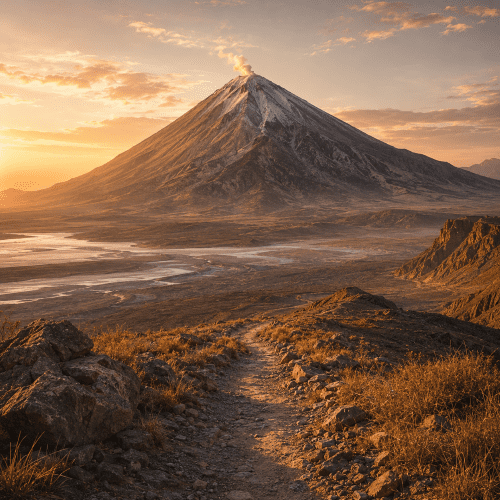
Mount Popa rises like a myth made visible from the dry plains of central Myanmar. Located about 50 kilometers southeast of Bagan, this extinct volcano reaches a height of 1,518 meters and is crowned by one of the most dramatic monasteries in Southeast Asia—Taung Kalat. Perched atop a steep volcanic plug, the monastery appears almost suspended between earth and sky, creating a powerful visual and spiritual presence.
But Mount Popa is far more than a geological wonder. It is widely regarded as the spiritual heart of Myanmar, a place where landscape and belief merge seamlessly. The mountain’s lush forests, unusual biodiversity, and constant pilgrim activity give it an atmosphere that feels alive with unseen forces. For travelers, it offers both a physical journey and an encounter with one of Southeast Asia’s most enduring spiritual traditions.
Connection with Mythology
Mount Popa is deeply tied to the belief in the 37 Nats, powerful spirits that form the foundation of Myanmar’s pre-Buddhist animist traditions. These beings are often believed to be the souls of individuals who died violently or unjustly, later transformed into guardians with immense supernatural influence.
At the center of this spiritual network is Min Mahagiri, one of the most revered nats. Once a blacksmith of extraordinary strength, his tragic death elevated him into a protective spirit associated with power and authority. Alongside him are figures like his sister and other legendary beings whose stories blend history, folklore, and morality.
Another prominent figure is Popa Medaw, also known as Me Wunna, a flower-eating ogress who lived on the mountain. Her love story with Byatta, a royal servant, ended in tragedy, leading to their transformation into nats. Their presence reinforces Mount Popa’s identity as a place where human emotion—love, betrayal, loss—transcends into divine existence.
The mountain’s reputation as the “Mount Olympus of Myanmar” comes from this concentration of spiritual beings. Pilgrims visit to seek blessings for prosperity, protection, and success, often making offerings at shrines along the climb. Even today, visitors follow traditional taboos such as avoiding certain colors or foods out of respect for the resident spirits.
Ways to Get There
Mount Popa is most easily reached from Bagan, making it a popular day trip for travelers exploring Myanmar’s ancient temple city. The journey typically takes between one and one and a half hours by car, passing through rural landscapes dotted with palm trees and small villages.
Private taxis and guided tours are the most convenient options, offering flexibility and the chance to stop along the way. Many tours include visits to local toddy palm farms or traditional workshops, adding cultural depth to the journey.
For those traveling from Mandalay, the trip is longer, usually around four hours by road. While buses and shared transport are available, they lack the comfort and convenience of private travel, especially given the final stretch to the mountain.
The final ascent is on foot. Visitors must climb 777 steps to reach Taung Kalat monastery. Shoes are not permitted, and the climb can be physically demanding, especially in heat. However, the steady progression upward mirrors the spiritual journey the site represents.
What to Look For
The climb to Taung Kalat is an experience in itself. Along the staircase, visitors encounter shrines dedicated to different nats, each adorned with colorful offerings, statues, and incense. These stops provide insight into the diversity of spiritual figures associated with Mount Popa.
At the summit, the monastery offers sweeping views of the surrounding plains. On clear days, the horizon stretches endlessly, revealing the contrast between the dry lowlands and the green volcanic slopes. Nearby Taung Ma-gyi, known as the “Mother Hill,” adds to the layered geography of the region.
Wildlife is another highlight. Monkeys are a constant presence along the steps, often interacting with visitors in unpredictable ways. The surrounding forests are also home to rare species like the endangered Popa langur, making the area significant from an ecological perspective as well.
The atmosphere at the top is both serene and charged. Bells, chants, and the scent of incense create a sensory environment that feels deeply rooted in ritual. It is a place where observation becomes participation, even for those unfamiliar with the traditions.
Importance in cultural history
Mount Popa represents a rare continuity of belief systems. Long before the rise of Theravada Buddhism in Myanmar, nat worship dominated spiritual life. Rather than replacing these traditions, Buddhism absorbed and coexisted with them, creating a unique cultural synthesis that continues today.
Historically, kings are believed to have sought the favor of the nats before major decisions, linking political authority with spiritual legitimacy. This connection elevated Mount Popa beyond a religious site into a symbol of national identity.
Festivals held here, particularly during the full moons of Nayon and Nadaw, attract thousands of devotees. These events are marked by music, dance, and trance rituals performed by nat mediums known as nat kadaw. Through them, the spirits are believed to communicate directly with the living, reinforcing the relevance of these ancient beliefs.
Today, Mount Popa also plays a role in conservation. As part of a national park, it protects a diverse ecosystem that has long been associated with sacred narratives. The idea that nature itself is inhabited by spirits continues to influence how the land is treated and preserved.
Best time to travel
The most comfortable time to visit Mount Popa is between November and February, when the weather is cooler and the skies are clear. These conditions make the climb more manageable and enhance visibility from the summit. Festival periods in April, May, and November offer a more immersive cultural experience, though they come with larger crowds and a more intense atmosphere. For those interested in witnessing living traditions, these times can be particularly rewarding.
The monsoon season, from June to October, is less ideal due to heavy rainfall and slippery steps. Meanwhile, the hot season leading into summer can make the climb physically challenging. Early morning visits are often the best choice regardless of season. The air is cooler, the light is softer, and the mountain feels at its most peaceful before the arrival of large groups.



Source
Mount Popa. (2006, January 8). In Wikipedia. https://en.wikipedia.org/wiki/Mount_Popa
Mount Popa Myanmar – Sacred Volcano & Nat Shrine Guide. (2026, January 18). Myanmar.com. https://myanmar.com/travel/destinations/bagan/popa/
Bagant Day Tours. (2017, August 24). Mount Popa – The Sacred Mountain on The Edge of Volcano.
https://bagandaytours.com/mount-popa-the-sacred-mountain-on-the-edge-of-volcano/
Kimkim. (2019, October 6). How to Get to Mount Popa – Best Routes & Travel Advice. https://www.kimkim.com/ab/getting-to-mount-popa
TNK Travel. (2017, April 24). The Fortune of Tours in Mt. Popa. https://www.tnktravel.com/blogs/myanmar-blogs/the-fortune-of-tours-in-mt-popa/
Travel Triangle. (2023, June 22). A Detailed Guide To Explore Popa National Park!. https://traveltriangle.com/blog/popa-national-park-in-myanmar/
The Revealer. (2024, May 7). Reviving Burmese Nat Shrines to Protect Myanmar’s Mount Popa National Park. https://therevealer.org/reviving-burmese-nat-shrines-to-protect-myanmars-mount-popa-national-park/
Frequently Asked Questions
Why is Mount Popa important in Myanmar?
Mount Popa is considered the spiritual home of the 37 Nats, making it the most important center for nat worship in Myanmar.
How many steps are there to climb Mount Popa?
There are 777 steps leading to the Taung Kalat monastery at the summit.
What is the closest airport to Mount Popa?
The nearest airport is Nyaung U Airport (NYU), located near Bagan.
. Is Mount Popa an active volcano?
No, Mount Popa is an extinct volcano.
What should visitors avoid when visiting Mount Popa?
Visitors traditionally avoid wearing certain colors and bringing meat, as these are considered disrespectful to the resident nats.