
Mount Nemrut : The Mountain of Giant Stone Gods in Türkiye
At a glance
| Description | |
|---|---|
| Mythology | Anatolian Mythology |
| Country | Turkey |
| Closest airport | Adıyaman Airport (ADY) |
| Type | Constructed |
| Accessibility | 07/10 |
Mythlok Perspective
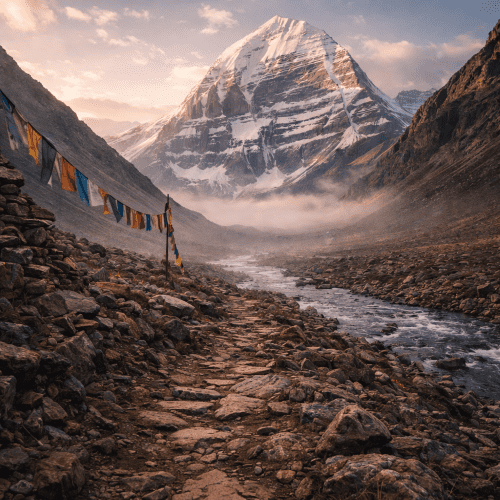
In Mythlok’s Perspective, Mount Nemrut represents one of history’s most dramatic attempts to turn kingship into mythology. Antiochus I did not simply build a tomb. He constructed a symbolic mountain throne where gods and king sat together as equals. The site reveals how rulers used mythic imagery to shape identity and political legitimacy. Sacred mountains appear across cultures as meeting points between heaven and earth. Mount Nemrut echoes Mount Olympus in Greek tradition and Mount Kailash in Indian cosmology. Each represents a cosmic summit where divine authority becomes visible in the landscape.
Mount Nemrut
Introduction
Mount Nemrut rises dramatically to about 2,134 meters above sea level in southeastern Türkiye, near the modern province of Adıyaman. Known locally as Nemrut Dağı, the mountain is one of the most extraordinary archaeological landscapes in the world. At its summit stands a monumental sanctuary built in the 1st century BCE by King Antiochus I of Commagene. Here, gigantic stone statues once sat in solemn rows around what is believed to be the king’s burial mound.
The site is famous for its massive sculpted heads scattered across the terraces, some nearly two meters tall, which once belonged to seated statues of gods and kings. These sculptures represent a fascinating fusion of Greek and Persian artistic traditions and reflect the cultural crossroads that defined ancient Anatolia. Mount Nemrut was designated a UNESCO World Heritage Site in 1987 because of its unique combination of architecture, religion, and political symbolism.
Today, Mount Nemrut attracts historians, archaeologists, photographers, and travelers seeking one of the most atmospheric ancient sites on Earth. Visitors often arrive before sunrise or sunset, when the light transforms the weathered stone faces into something almost mythic. Standing among these colossal figures, surrounded by sweeping mountain views, it becomes clear that this sanctuary was designed not only as a tomb but as a stage for eternal remembrance.
Connection with Mythology
Mount Nemrut is closely tied to the ambitions and beliefs of King Antiochus I Theos of Commagene, who ruled from roughly 69 to 34 BCE. Antiochus governed a small but strategically important kingdom located between the Roman and Parthian empires. To reinforce his legitimacy and divine authority, he created a state religion that blended elements of Greek and Persian belief systems.
At the summit sanctuary, known as a hierothesion, Antiochus erected colossal statues representing a syncretic pantheon of gods. These included Zeus-Oromasdes, a fusion of the Greek god Zeus and the Persian deity Ahura Mazda; Apollo-Mithras-Helios-Hermes, combining Greek and Iranian solar traditions; and Heracles-Artagnes-Ares, a merging of heroic and warrior figures from both cultures. Alongside these gods sits Antiochus himself, presented as their equal.
Flanking the statues are symbolic animals: a lion and an eagle. The eagle represents divine authority and the heavens, while the lion symbolizes power and royal protection. One of the most famous reliefs at the site is the Lion Horoscope, which shows a lion decorated with stars and planetary symbols. Some scholars interpret this as a celestial alignment marking the coronation of Antiochus or the dedication of the sanctuary.
Another distinctive feature is the dexiosis reliefs, which depict Antiochus shaking hands with the gods. These scenes illustrate his claim to divine lineage and eternal association with the divine realm. Through these monumental sculptures and inscriptions, Antiochus attempted to create a lasting cult in which the king would be worshipped long after his death.
Ways to Get There
Mount Nemrut is located in a relatively remote part of southeastern Türkiye, but reaching it has become much easier thanks to modern infrastructure and tourism. The closest airport is Adıyaman Airport (ADY), located roughly 80 kilometers from the mountain. From there, travelers usually drive to the town of Kahta, which serves as the main gateway to the Nemrut National Park. The journey from Adıyaman to the mountain typically takes around one and a half hours by car.
Another option is Malatya Airport (MLX), about 150 kilometers away. Malatya offers more frequent domestic flights from major cities such as Istanbul and Ankara, making it a convenient alternative for international visitors. From Kahta or the nearby village of Karadut, visitors drive along winding mountain roads to a designated parking area below the summit. The final approach involves a roughly 600-meter walk up a stone path. Although the climb is not technically difficult, the altitude and steep incline mean that visitors should pace themselves.
Many travelers choose guided tours that include sunrise or sunset visits, transportation, and accommodation in nearby towns. Staying overnight near the mountain is particularly popular, as it allows visitors to experience the statues in the dramatic changing light of dawn and dusk.
What to Look For
At the summit of Mount Nemrut, three terraces form the core of the sanctuary: the East Terrace, West Terrace, and North Terrace. The East Terrace is the most intact and impressive area. Here, the giant seated statues once faced the rising sun. The figures originally stood between eight and nine meters tall and depict Zeus-Oromasdes, Apollo-Mithras-Helios-Hermes, Heracles-Artagnes-Ares, the goddess Commagene (associated with fertility and prosperity), and King Antiochus himself. Over centuries, earthquakes and weathering caused the statues’ heads to fall forward, creating the iconic arrangement seen today.
Behind the statues on the East Terrace are long Greek inscriptions known as the Nomos, which explain Antiochus’s religious program and describe how rituals and festivals should be conducted at the sanctuary. The West Terrace mirrors the layout of the eastern side but faces the sunset. Although the statues here are more damaged, the sculpted heads remain strikingly preserved. This terrace also contains several relief panels depicting Antiochus interacting with various gods, as well as the famous Lion Horoscope slab.
The North Terrace forms a long stone platform connecting the other two terraces. Archaeologists believe it may have been used as a ceremonial passage or gathering space during religious processions. At the center of the complex lies a massive artificial mound made of loose limestone fragments. This tumulus rises about 50 meters high and is believed to conceal the burial chamber of Antiochus. Despite decades of investigation, the king’s tomb has never been definitively located.
Importance in cultural history
Mount Nemrut is one of the most remarkable expressions of cultural blending in the ancient world. The Kingdom of Commagene emerged in a region where Greek, Persian, and Anatolian traditions intersected, and Antiochus deliberately emphasized this hybrid identity.
Through monumental architecture and inscriptions, he claimed descent from both Alexander the Great and the Persian king Darius I. By combining deities from different traditions into single composite figures, he created a symbolic bridge between East and West.
The sanctuary remained largely forgotten until 1881, when German engineer Karl Sester documented the site during a survey expedition. Later archaeological work, particularly by American archaeologist Theresa Goell in the mid-20th century, revealed the extent of Antiochus’s ambitious project.
In 1987, Mount Nemrut was recognized as a UNESCO World Heritage Site due to its artistic originality and its insight into Hellenistic political ideology. Today it stands as one of Türkiye’s most iconic historical landmarks and a powerful reminder of how rulers used religion, architecture, and myth to legitimize power.
Best time to travel
The best time to visit Mount Nemrut is between May and September, when weather conditions are generally stable and roads to the summit are open. Spring and early summer offer comfortable temperatures and clearer skies, making sunrise visits particularly rewarding. During these months, the surrounding mountains are also greener, adding to the visual appeal of the landscape.
Autumn is another excellent time to visit because the air is often crisp and visibility across the valleys is exceptional. Fewer tourists during this season can make the experience feel more intimate. Winter travel is much more difficult. Heavy snowfall frequently blocks the mountain road, and access to the summit may be impossible for months. Even during summer, the summit can be surprisingly cold before sunrise, so warm clothing is recommended. For many visitors, the highlight of the journey is watching the sun rise or set behind the colossal statues, casting long shadows across the stone heads and turning the entire sanctuary into a dramatic ancient stage.

Source
History Hit. (2021, June 1). Nemrut – History Hit. https://www.historyhit.com/locations/nemrut/
eskapas.com. (2021, March 12). Mount Nemrut Travel Guide – Eastern Turkey Adventures – with Video. https://eskapas.com/mount-nemrut-travel-guide/
The Mediterranean Traveller. (2017, March 30). How to Visit Mount Nemrut: Turkey’s Mountaintop UNESCO World …. https://www.themediterraneantraveller.com/turkey-nemrut-dagi/
Daily Sabah. (2020, February 28). World heritage in Turkey: Nemrut, the Mountain of Gods salutes …. https://www.dailysabah.com/life/travel/world-heritage-in-turkey-nemrut-the-mountain-of-gods-salutes-anatolia
Wandering Wagars. (2024, March 10). Tips For Visiting Mount Nemrut: The Mountaintop Wonder Where …. https://wanderingwagars.com/mount-nemrut/
Google Arts & Culture. (2025, May 5). Nemrut Mountain: A Heritage from Past to Present. https://artsandculture.google.com/story/nemrut-mountain-a-heritage-from-past-to-present-the-directorate-general-of-cultural-assets-and-museums-of-t%C3%BCrkiye/5gWxZFkNWiPLzQ?hl=en
Turco Travel. (2026, January 1). Mount Nemrut National Park Ticket (Skip-Lines) – Turco Travel. https://turcotravel.com/tours/mount-nemrut-national-park
UNESCO World Heritage Centre. (2025, January 1). Nemrut Dağ – UNESCO World Heritage Centre. https://whc.unesco.org/en/list/448/
Tanrıverdi Travels. (2024, November 6). Mount Nemrut, Adıyaman – Everything you Need to Know. https://tanriverditravels.com/2024/11/06/mount-nemrut-adiyaman-everything-you-need-to-know/
Frequently Asked Questions
What is Mount Nemrut famous for?
Mount Nemrut is famous for its giant stone statues built by King Antiochus I of Commagene in the 1st century BCE. The statues represent a mix of Greek and Persian gods and surround a massive burial mound believed to contain the king’s tomb.
Where is Mount Nemrut located?
Mount Nemrut is located in southeastern Türkiye near the city of Adıyaman, within Nemrut Dağı National Park.
Who built Mount Nemrut?
The monument was constructed by King Antiochus I Theos of Commagene as a royal tomb and religious sanctuary.
Can you visit Mount Nemrut today?
Yes, Taktsang remains an active religious site where monks reside and perform rituals, and visitors are expected to observe respectful conduct.
Why are the statues on Mount Nemrut broken?
Yes. Mount Nemrut is open to visitors and is a popular destination for sunrise and sunset tours due to its spectacular views and archaeological importance.