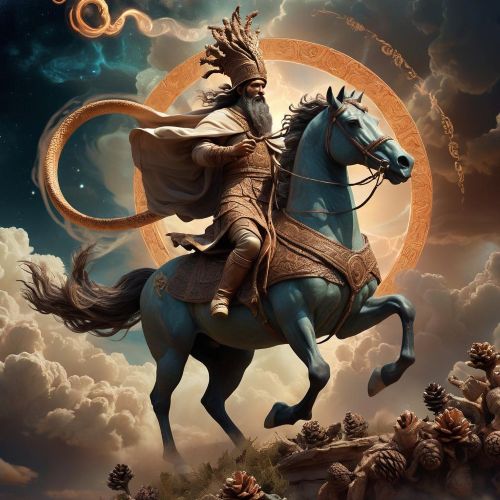
Phrygian Mythology
Phrygian mythology reflects the religious traditions of the Phrygian people, an ancient Anatolian culture that flourished in central and western Anatolia during the first millennium BCE. Their religious world developed from older Anatolian traditions while also interacting with Greek, Lydian, and other neighboring cultures. Much of what is known about Phrygian religion comes from inscriptions, archaeological remains, later Greek and Roman accounts, and evidence from sanctuaries. At its center was the worship of the Great Mother, known in Phrygian contexts as Matar, a powerful deity associated with mountains, fertility, wild nature, and the protection of communities. Her later identification with Cybele became one of the most important examples of an Anatolian deity entering the wider Mediterranean religious world.
The Great Mother was the dominant figure in Phrygian religious tradition. In inscriptions, she appears under names and titles associated with motherhood, sovereignty, and the landscape. She was closely connected with mountains and wild places, reflecting a religious tradition in which natural features could serve as sacred spaces. Images of the goddess frequently portray her as a powerful enthroned woman, sometimes accompanied by lions, emphasizing her authority over the natural world. Her sanctuaries were often established at prominent locations such as rocky outcrops, mountains, and other distinctive landscapes. The most famous Phrygian center associated with the Great Mother was the monumental sanctuary at Pessinus, although her worship extended across a much wider area of Anatolia.
Phrygian religious practice also placed considerable importance on music, ritual performance, offerings, and sacred landscapes. Archaeological evidence reveals sanctuaries containing rock-cut monuments, altars, inscriptions, and architectural features connected with the worship of the Great Mother and other divine powers. Phrygian religion was not preserved through a single surviving sacred book, meaning that its mythology must be reconstructed from fragmented evidence. This makes it important to distinguish early Phrygian traditions from stories that were developed or transformed by later Greek and Roman writers. The religious significance of the Great Mother is well established, while many detailed narratives associated with her were shaped by later traditions.
The figure of Attis is particularly important to this later development. Attis became closely associated with the Great Mother in Hellenistic and Roman religious traditions, where stories described his death and his connection with renewal and fertility. However, the familiar narrative of Cybele and Attis is better understood as part of the evolving Anatolian and Mediterranean tradition rather than as a straightforward record of an original Phrygian creation myth. Later authors developed elaborate accounts of Attis’s death, mourning, and ritual significance, and these traditions became particularly prominent in the Roman Empire.
Phrygian religion extended beyond the Great Mother. Divine and sacred figures associated with fertility, the natural world, local communities, and the protection of places appear in the surviving evidence, although their individual myths are often poorly preserved. The Phrygians also maintained strong connections between religion and the landscape, with mountains, rocks, springs, and other natural features serving as important sacred locations. This relationship between divinity and place was characteristic of ancient Anatolian religion more broadly.
Phrygian mythology became particularly influential beyond Phrygia through the transformation of the Great Mother into Cybele, a name through which she became known throughout the Greek and Roman worlds. Greek communities encountered and adapted the Anatolian goddess, while the Romans eventually adopted her as Magna Mater, the Great Mother. Her worship developed new rituals and meanings as it moved across the Mediterranean, demonstrating how ancient religious traditions could change while retaining recognizable connections to their origins.
Today, Phrygian mythology is best understood through the combination of archaeology, inscriptions, art, and later literary evidence. Rather than a mythology preserved in a single continuous body of texts, it represents a reconstructed religious tradition whose central themes include the power of the Great Mother, sacred landscapes, fertility, protection, and the relationship between humanity and the natural world. Through Matar and the later figure of Cybele, Phrygian religious traditions left a lasting mark on the mythology and religious history of Anatolia and the wider Mediterranean.