

Isla del Sol : The Sacred Island of the Sun in Lake Titicaca
At a glance
| Description | |
|---|---|
| Mythology | Inca Mythology |
| Country | Bolivia |
| Closest airport | El Alto International Airport (LPB) |
| Type | Natural |
| Accessibility | 07/10 |
Mythlok Perspective
In Mythlok’s View, Isla del Sol represents a rare convergence of landscape and origin myth, where geography itself becomes divine narrative. Unlike many sacred sites that symbolize gods, this island is believed to have produced them. Its role mirrors other cosmic birthplaces, such as Mount Olympus in Greek tradition or Mount Meru in Indian belief. Yet Isla del Sol remains uniquely grounded, where myth still lives within daily human activity, not just memory.
Isla del Sol
Introduction
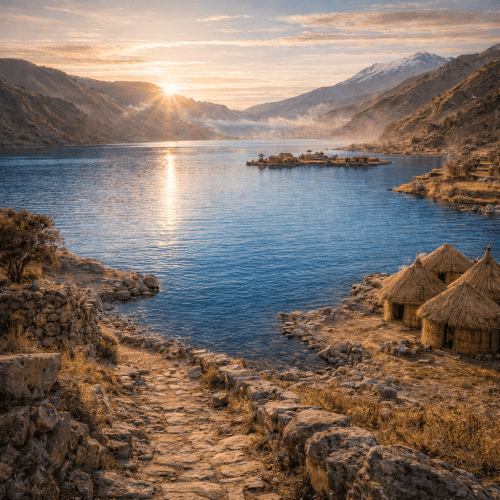
Isla del Sol is one of the most culturally significant islands in South America, located in the Bolivian waters of Lake Titicaca at an altitude of over 3,800 meters. Stretching roughly 14 kilometers in length, the island is defined by steep ridges, agricultural terraces, and a network of ancient stone pathways that connect its scattered settlements. Despite its remote location, Isla del Sol has been continuously inhabited for thousands of years, with archaeological evidence dating back to at least the third millennium BCE.
The island is home to small Aymara communities, primarily in villages such as Yumani in the south and Challapampa in the north. Life here remains deeply traditional, centered around farming, fishing, and small-scale tourism. With no cars and minimal modern infrastructure, Isla del Sol offers an experience that feels suspended in time. Its name, meaning “Island of the Sun,” reflects not just its natural beauty but its profound spiritual legacy in Andean belief systems.
Connection with Mythology
Isla del Sol holds a central place in Inca cosmology and is widely regarded as the mythical birthplace of the sun god Inti. According to Andean tradition, the world once existed in darkness until the creator deity Viracocha summoned the sun, moon, and stars from the waters of Lake Titicaca. From this moment, light entered the world, and Isla del Sol became sacred ground.
The island is also deeply tied to the origin story of the Inca civilization. Legend states that Manco Cápac and Mama Ocllo, children of Inti, emerged from the Sacred Rock known as Titi Qala. They were tasked with bringing order and knowledge to humanity, eventually journeying to establish Cusco as the heart of the Inca Empire.
It is important to clarify a common misconception. Isla del Sol is not connected to Aztec traditions, which belong to Mesoamerica and involve deities such as Huitzilopochtli. While both cultures revered the sun, their mythological systems developed independently. Isla del Sol’s significance is firmly rooted in Andean, not Central American, belief systems.
Ways to Get There
Reaching Isla del Sol requires a combination of land and water travel, adding to its sense of isolation and pilgrimage-like journey. Most travelers begin in La Paz, Bolivia, from where buses run to the lakeside town of Copacabana. This journey typically takes between three and four and a half hours, depending on conditions. Travelers coming from Peru often start in Puno and cross the border into Bolivia.
From Copacabana, boats are the only means of accessing the island. Public ferries usually depart twice daily, in the morning and early afternoon, and take around 1.5 to 2 hours to reach either Yumani or Challapampa. The southern route is more popular, while the northern section offers a quieter, more archaeological-focused experience.
Visitors should carry cash, as there are no ATMs on the island, and be prepared for high altitude conditions. The journey itself, crossing the vast expanse of Lake Titicaca, is often considered part of the experience, gradually revealing the island’s rugged silhouette rising from the water.
What to Look For
Isla del Sol is rich in archaeological and natural landmarks, offering a blend of history and landscape that feels deeply immersive. The Sacred Rock, or Titi Qala, is one of the most important sites, believed to be the exact point where the sun first emerged. Nearby lies the Chinkana complex, a labyrinth-like structure thought to have been used for ritual purposes and possibly priestly training.
In the southern part of the island, the ruins of Pilko Kaina stand as a testament to Inca architectural precision. This temple complex, constructed with finely cut stone, overlooks the lake and was likely used for ceremonial activities linked to solar worship.
The island’s ridge trail, which runs from north to south, offers one of the most rewarding hikes in the Andes. Along the way, travelers encounter ancient terraces still used for farming, herds of llamas grazing on hillsides, and panoramic views of the Cordillera Real mountains. The absence of vehicles allows for uninterrupted exploration, making the journey as meaningful as the destinations themselves.
Importance in cultural history
Isla del Sol is not just a mythological landmark but a continuous thread connecting multiple civilizations. Archaeological findings indicate human presence as early as 2200 BCE, with later developments linked to the Tiwanaku culture and eventually the Inca Empire.
During the height of the Inca period, the island became a major pilgrimage center. Rulers such as Tupac Inca Yupanqui invested in constructing temples, ceremonial complexes, and accommodations for pilgrims. The Sacred Rock area functioned as a spiritual hub, comparable in importance to other major Inca religious centers.
Today, the island remains culturally active. The Aymara communities continue to practice traditions that echo ancient Andean beliefs, blending them with elements introduced during the colonial period. Agriculture on terraced fields, communal living, and ritual practices all contribute to the island’s enduring cultural identity.
Best time to travel
The best time to visit Isla del Sol is during the dry season, which runs from May to September. During these months, the weather is generally clear, with daytime temperatures ranging between 13°C and 17°C. These conditions are ideal for hiking and exploring archaeological sites, though nights can be cold due to the high altitude.
The wet season, from November to March, transforms the landscape into a greener environment but brings frequent rain and potential travel disruptions. Boat schedules may be affected, and trails can become slippery.
Shoulder months such as April and October offer a balanced experience, with fewer crowds and relatively stable weather. Regardless of the season, strong ultraviolet radiation at this altitude makes sun protection essential throughout the year.


Source
Bolivian Life. (2025). Isla del Sol, Bolivia (2025 guide): Boats, hikes, tours & tips. https://www.bolivianlife.com/visiting-isla-del-sol-lake-titicaca/
Chacana Center. (2026). Why are Lake Titicaca & Isla del Sol important in Inca mythology? https://www.chacanacenter.com/post/lake-titicaca-isla-del-sol
Herr Translator. (2025). Isla del Sol: Bolivia’s sacred Inca sanctuary. https://herrtranslator.blog/2025/05/22/isla-del-sol-bolivias-sacred-inca-sanctuary/
Lowell Silverman. (2016). The sanctuary on Isla del Sol, Part I: The sacred rock, Titikala. https://lowellsilverman.wordpress.com/2016/04/19/the-sanctuary-on-isla-del-sol-part-i-the-sacred-rock-titikala/
Wikipedia. (2025). Isla del Sol. https://en.wikipedia.org/wiki/Isla_del_Sol
Frequently Asked Questions
What is Isla del Sol famous for?
Isla del Sol is famous as the mythical birthplace of the Inca sun god Inti and the origin of the Inca civilization.
When is the best time to visit Isla del Sol?
The dry season from May to September offers the best weather for exploration.
Where is Isla del Sol located?
It is located in Lake Titicaca, on the Bolivian side of the lake in the Andes Mountains.
How do you reach Isla del Sol?
Travelers reach it by boat from Copacabana after arriving from La Paz or Puno.
Is Isla del Sol connected to Aztec beliefs?
No, it is part of Inca tradition and has no direct link to Aztec cosmology.