

Chichen Itza : The Sacred Maya City of Kukulkan
At a glance
| Description | |
|---|---|
| Mythology | Mayan Mythology |
| Country | Mexico |
| Closest airport | Mérida International Airport (MID), Cancún International Airport (CUN) |
| Type | Constructed |
| Accessibility | 09/10 |
Mythlok Perspective
In Mythlok’s Perspective, Chichen Itza reveals how ancient civilizations used architecture to express cosmic order. The famous pyramid of Kukulkan was designed so that light and shadow form a descending serpent during the equinoxes, symbolizing the god’s arrival on earth. This blending of astronomy and ritual echoes other sacred complexes across the world. Just as the Maya shaped temples to mirror the heavens, monuments such as Angkor Wat in Cambodia and the pyramids of Egypt also embodied the belief that sacred architecture could reflect the structure of the cosmos.
Chichen Itza
Introduction
Chichen Itza, an awe-inspiring archaeological site in the Yucatán Peninsula, Mexico, reflects the grandeur of the ancient Maya civilization. This UNESCO World Heritage Site is renowned for its distinctive architecture and cultural significance, drawing visitors globally. The site’s highlights include the famed Pyramid of El Castillo and the Temple of Warriors, which embody the sophisticated achievements of Maya engineering and artistry.
Often regarded as a gateway to ancient Maya culture, Chichen Itza offers a profound exploration of Mayan mythology and history. Its intricate carvings and monumental structures not only showcase the civilization’s architectural prowess but also serve as a window into their spiritual and cultural beliefs. As one of Mexico’s most visited destinations, Chichen Itza continues to captivate travelers with its blend of historical depth and mythological intrigue.
Connection with Mythology
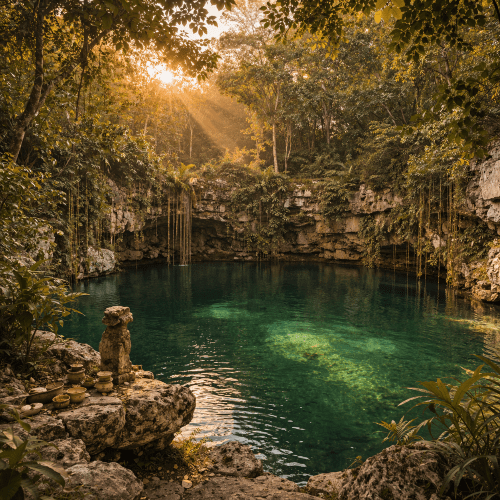
The name “Chichen Itza” translates to “at the mouth of the well of the Itza,” reflecting its proximity to the local cenote, a natural sinkhole revered by the Maya. These cenotes, crucial in the Yucatan Peninsula’s arid climate, were both vital water sources and sacred sites for religious rituals. They were central to offerings made to Chaac, the rain god, underscoring the Maya’s spiritual and environmental interconnectedness.
Mayan architecture at Chichen Itza demonstrates their advanced astronomical knowledge and calendar systems. Structures like El Castillo are precisely aligned with celestial events, revealing the Maya’s deep connection to the cosmos. The Temple of Kukulcan, or El Castillo, is particularly notable. It features 91 steps on each of its four sides, totaling 365 when including the top platform, mirroring the solar year. During the spring and autumn equinoxes, the play of sunlight creates a shadow effect on the pyramid’s steps, resembling a serpent descending, which symbolizes Kukulcan’s journey to the earth.
The Maya integrated their mythology into their daily lives and architectural designs, blending their understanding of time, celestial events, and divine beings. This integration is evident in their rituals and ceremonies, which were deeply rooted in their belief system. The Temple of Kukulkan is a prime example of this, showcasing how mythology and astronomy intertwined in their culture. Other structures, like the Temple of Warriors and the Hall of the Hundred Columns, are adorned with carvings of gods and mythical figures, providing insight into the Maya’s worldview. These sites reflect the sacred nature of Chichen Itza, where mythological themes are interwoven with architectural marvels and astronomical significance.
Ways to Get There
Traveling to Chichen Itza is relatively easy, with several transportation options available from major cities in Mexico’s Yucatán Peninsula. Visitors staying in Cancun or Playa del Carmen can reach the site in about two to three hours by road. Renting a car is a popular option because it allows travelers to explore nearby attractions at their own pace, including cenotes, small towns, and scenic countryside along the route. The highways leading to Chichen Itza are well maintained, making the journey comfortable for independent travelers.
Public transportation is another convenient way to reach the ancient Maya city. Direct bus services operated by ADO run regularly from Cancun, Playa del Carmen, and other nearby cities, offering a reliable and affordable option. Many visitors also choose guided tours, which typically include transportation, entrance tickets, and expert commentary about the archaeological site. These tours often combine the visit with stops at local cenotes or the historic colonial town of Valladolid, adding more cultural depth to the experience.
Chichen Itza is also easily accessible from Mérida, which lies about 120 kilometers to the west. From there, travelers can take buses, arrange guided excursions, or drive directly to the site. Whether arriving from Mérida, Cancun, or other cities in the region, the journey itself becomes part of the experience, gradually revealing the landscapes and cultural heritage that once formed the heart of the ancient Maya world.
What to Look For
Importance in cultural history
Chichen Itza, a UNESCO World Heritage Site, offers a profound glimpse into the sophisticated Maya civilization. Renowned for its architectural and astronomical advancements, the site features iconic structures like El Castillo, which reflects the Maya’s deep understanding of astronomy through its alignment with the solar calendar. As a major urban center between 600 AD and 1200 AD, Chichen Itza exemplifies the Maya’s intricate urban planning and their ability to integrate diverse cultural influences, blending elements from both Maya and Toltec traditions.
The city’s economic significance was bolstered by its strategic location along key trade routes, facilitating a thriving marketplace that exchanged luxury goods, agricultural products, and artisanal crafts. This economic prosperity, combined with its role as a political and cultural hub, underscores Chichen Itza’s importance in Mesoamerican trade networks and regional politics. The archaeological findings at the site reveal a vibrant, interconnected society that engaged in complex trade and cultural exchanges.
Today, Chichen Itza remains a powerful symbol of Maya heritage, embodying the rich traditions and achievements of an ancient civilization. Its preservation is crucial for maintaining a connection with the past and reinforcing the identity of contemporary Mayans. The site serves as both a historical record and a source of cultural pride, allowing modern descendants to celebrate and draw inspiration from their ancestral legacy.
Best time to travel
Timing your visit to Chichen Itza can significantly enhance your experience. The optimal months for a visit are between November and April, when the dry season provides pleasant weather and lower chances of rain, creating ideal conditions for exploration.
To avoid the busiest times and enjoy a more peaceful visit, consider arriving early in the morning or late in the afternoon. These hours not only offer cooler temperatures but also better lighting for photography, enhancing the overall experience. Additionally, if you are interested in experiencing the site’s astronomical features, visiting during the Spring or Autumn Equinox will allow you to witness the remarkable shadow play on El Castillo, where the feathered serpent appears to descend the pyramid.
Cultural festivals at Chichen Itza can also provide a unique perspective on Mayan heritage, offering an enriched visit. While the peak tourist seasons can attract larger crowds, planning your visit outside these periods can help you fully appreciate the site’s historical and cultural significance without the rush of peak times.


Sources
Encyclopaedia Britannica. (n.d.). Chichen Itza. https://www.britannica.com/place/Chichen-Itza
UNESCO World Heritage Centre. (n.d.). Pre-Hispanic City of Chichen-Itza. https://whc.unesco.org/en/list/483/
National Geographic. (n.d.). Chichen Itza. https://www.nationalgeographic.com/history/article/chichen-itza
World History Encyclopedia. (n.d.). Chichen Itza. https://www.worldhistory.org/Chichen_Itza/
Sharer, R. J., & Traxler, L. P. (2006). The ancient Maya (6th ed.). Stanford University Press.
Schele, L., & Freidel, D. (1990). A forest of kings: The untold story of the ancient Maya. William Morrow.
Coe, M. D., & Houston, S. (2015). The Maya (9th ed.). Thames & Hudson.
Milbrath, S., & Peraza Lope, C. P. (2003). Revisiting the Venus Table of the Dresden Codex and its astronomical significance for Chichen Itza. Latin American Antiquity, 14(3), 269–290. https://doi.org/10.2307/3557564
Frequently Asked Questions
Where is Chichen Itza located?
Chichen Itza is located in the Yucatán Peninsula of Mexico, about 120 kilometers east of Mérida.
What is Chichen Itza famous for?
Chichen Itza is famous for the Temple of Kukulkan, also known as El Castillo, a pyramid that displays a serpent shadow during the equinoxes.
Who built Chichen Itza?
Chichen Itza was built by the Maya civilization and became one of the most important cities in the region between the 9th and 12th centuries.
What is the Sacred Cenote at Chichen Itza?
The Sacred Cenote is a natural sinkhole that was used for rituals and offerings to the rain god Chaac.
Why is Chichen Itza important today?
Chichen Itza is a UNESCO World Heritage Site and one of the New Seven Wonders of the World, attracting millions of visitors every year.