


Tag-ani : The Harvest Goddess of Tagalog Tradition
At a glance
| Description | |
|---|---|
| Origin | Philippine Mythology |
| Classification | Gods |
| Family Members | Bathala (Father), Tala, Liwayway, Bighari, Kidlat, Hangin, Araw (Siblings) |
| Region | Philippines |
| Associated With | Harvest, Agricultural abundance, Seasonal cycles, Prosperity |
The Mythlok Perspective
In Mythlok’s Perspective, Tag-ani represents a quieter but essential divine force, one that reflects humanity’s dependence on nature rather than dominance over it. Unlike thunder gods or solar deities, her power lies in sustenance and continuity. Similar figures appear across cultures, such as Demeter in Greek tradition or Inari in Japanese belief, yet Tag-ani remains more abstract, almost seasonal in identity. This makes her less personified but deeply symbolic, embodying the cycle of effort, patience, and reward that defines agrarian life.
Tag-ani
Introduction
Tag-ani stands as a lesser-known yet meaningful figure in Tagalog folklore, representing the vital concept of harvest and agricultural abundance. Rooted in traditions from Oriental Mindoro in the Philippines, Tag-ani is described as a daughter of Bathala, the supreme deity in the Tagalog pantheon. Her presence appears in a recorded myth from the early 1970s, where Bathala gathers his children before descending to the world of humans.
Within this narrative, Tag-ani is counted among a group of divine siblings who embody natural and cosmic forces. While some of her brothers and sisters are tied to visible phenomena like the sun, wind, and lightning, Tag-ani represents something equally essential but quieter in nature, the harvest. This connection reflects the deep dependence of early Filipino communities on agriculture and seasonal cycles.
Despite limited documentation, Tag-ani remains an important symbolic figure. She reflects how ancient belief systems explained survival, prosperity, and the rhythms of life through divine personalities. Today, she is increasingly rediscovered as interest in precolonial Filipino traditions continues to grow.
Physical Traits
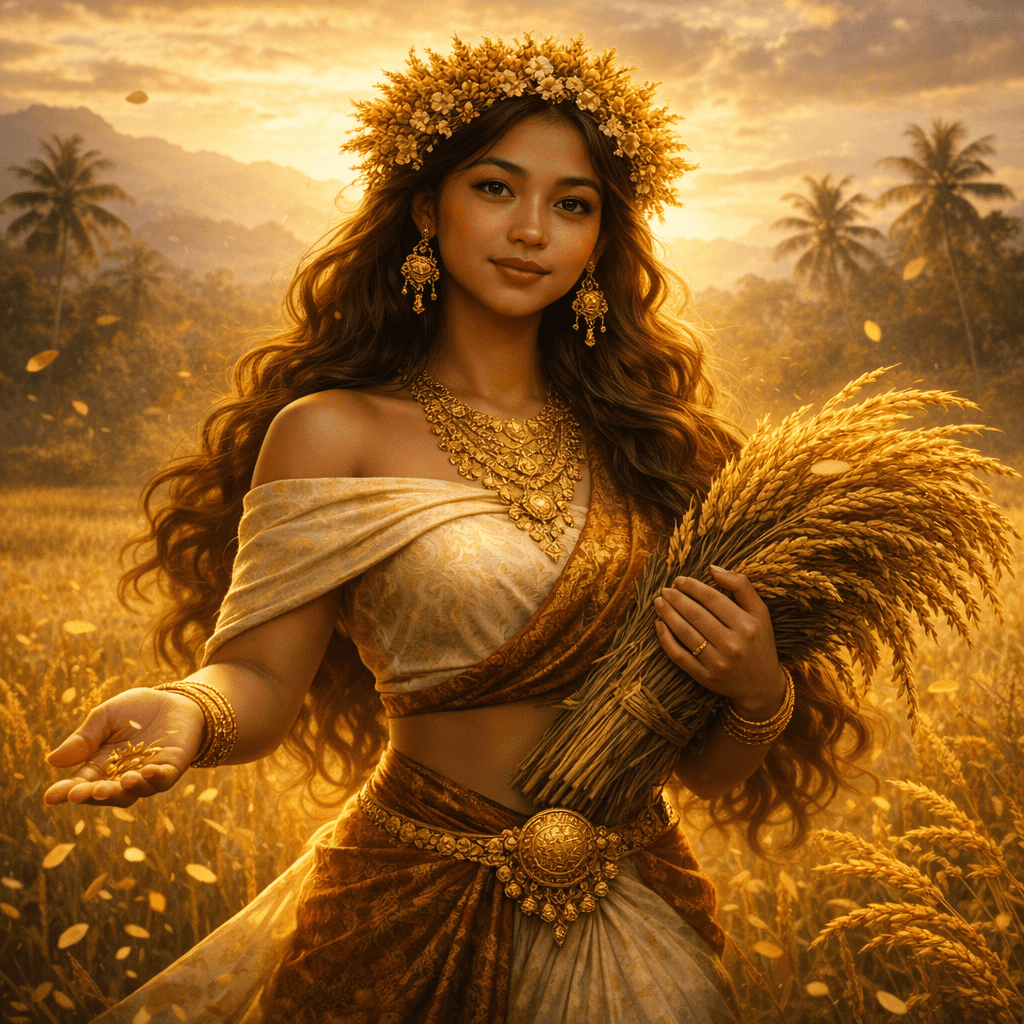
There are no detailed physical descriptions of Tag-ani in surviving mythological records. She is generally described alongside her sisters as a “lovely maiden,” a common portrayal used for female deities in Tagalog folklore. This lack of specificity is not unusual, especially for deities associated with abstract or seasonal concepts.
Unlike figures such as Tala or Liwayway, who are directly tied to visible celestial phenomena, Tag-ani represents a process rather than a single visual form. Because of this, her appearance is left open to interpretation. She is often imagined as youthful, serene, and closely connected to nature, reflecting abundance and nourishment rather than power or intensity. This ambiguity actually strengthens her symbolic identity. Instead of being confined to a fixed image, Tag-ani becomes a representation of the harvest itself, something experienced rather than seen.
Family
Tag-ani is identified as one of the children of Bathala, the supreme creator and ruler of the heavens in Tagalog belief systems. In the Oriental Mindoro account, Bathala is portrayed as having several children, each embodying a specific element or force of nature.
Her sisters include Tala, associated with the morning star, Liwayway, who represents dawn, and Bighari, connected to flowers and the rainbow. Her brothers include Kidlat, the god of lightning, Hangin, the god of wind, and Araw, the sun. Together, they form a symbolic family that explains the workings of both the sky and the earth.
A divine messenger named Panginoon is also mentioned in the story, acting as a bridge between Bathala and his children. This structured family dynamic reflects how Tagalog mythology organizes natural phenomena into a unified cosmic order.
It is important to note that not all sources agree on Bathala’s children. Earlier works, such as those by F. Landa Jocano, list different offspring. This variation suggests that Tag-ani may belong to a regional or localized version of the myth rather than a universally recognized lineage.
Other names
Tag-ani does not have widely recorded alternative names in Philippine mythology. She is consistently referred to by this single name across available sources. The name itself carries clear meaning. In Tagalog, “tag-ani” directly refers to the harvest season. This linguistic origin reinforces her role not just as a deity, but as a personification of a crucial phase in agricultural life. Rather than being a distinct character with multiple titles, Tag-ani functions as a concept brought to life through myth. This simplicity is characteristic of many early deities, where names were closely tied to their function rather than elaborate identities.
Powers and Abilities
Tag-ani’s primary domain is the harvest, placing her at the center of agricultural prosperity. While specific powers are not explicitly detailed in surviving texts, her role strongly implies influence over crop yield, seasonal cycles, and the success of farming efforts.
In the context of Tagalog belief systems, deities associated with nature often governed essential aspects of daily survival. Tag-ani’s presence among Bathala’s children suggests that harvest was viewed as a divine process, not merely a human activity. Her influence would have been understood as ensuring abundance, nourishment, and continuity of life. Compared to other deities like Kidlat or Araw, whose powers are dramatic and visible, Tag-ani’s abilities are subtle but equally important. She represents the reward of patience, labor, and harmony with nature.
Modern Day Influence
Tag-ani does not enjoy the same level of recognition as major figures like Bathala or Mayari, but her significance is gradually being revisited. As interest in precolonial Filipino culture grows, scholars, artists, and digital platforms have begun highlighting lesser-known deities, including Tag-ani.
Projects focused on Philippine folklore, such as online archives and cultural initiatives, have played a role in preserving and sharing her story. Academic works by researchers like Damiana L. Eugenio and Ferdinand Blumentritt continue to support the documentation of these traditions.
In modern contexts, Tag-ani’s essence survives more through cultural practices than direct worship. Harvest festivals, thanksgiving rituals, and agricultural traditions across the Philippines still echo the ancient reverence for abundance and the land. Even without widespread recognition, Tag-ani remains symbolically present in these practices.
Her rediscovery also raises an important point about accuracy. As digital interest grows, distinguishing between authentic sources and modern reinterpretations becomes essential to preserving her true place in folklore.
Related Images





Source
Abrigo, E. N. (1971). Oriental Mindoro folktales: An analysis (Master’s thesis, Philippine Women’s University). https://www.aswangproject.com/bathalas-seven-children/
Clark, J. (2022). Bathala’s seven children. The Aswang Project. https://www.aswangproject.com/bathalas-seven-children/
Eugenio, D. L. (2001). Philippine folk literature: The myths. University of the Philippines Press.
Jocano, F. L. (1969). Outline of Philippine mythology.
Rincs Art. (n.d.). Tag-ani depictions.
Schult, V. (1991). The genesis of lowland Filipino society in Mindoro. Philippine Studies, 39(1), 92-103.
Wikipedia contributors. (2023). List of Philippine mythological figures. Wikipedia. https://en.wikipedia.org/wiki/List_of_Philippine_mythological_figures
Frequently Asked Questions
Who is Tag-ani in Philippine mythology?
Tag-ani is a Tagalog harvest goddess associated with agricultural abundance and is described as a daughter of Bathala in a regional myth from Oriental Mindoro.
What does the name Tag-ani mean?
The name Tag-ani comes from the Tagalog word for “harvest season,” directly reflecting her role and symbolism.
Is Tag-ani widely worshipped today?
Tag-ani is not widely worshipped in modern times, but her essence survives through agricultural traditions and cultural practices.
What are Tag-ani’s powers?
Tag-ani is associated with ensuring bountiful harvests and agricultural prosperity, though specific powers are not explicitly described in myths.
How is Tag-ani related to Bathala?
In one documented myth, Tag-ani is one of Bathala’s children, alongside deities representing natural elements like the sun, wind, and lightning.