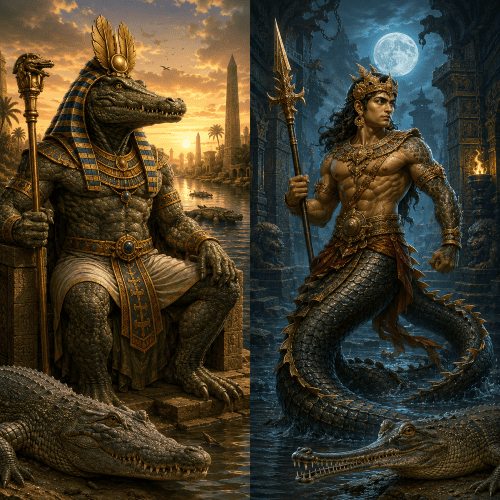


Philippine Moon Gods and the Differences Between Bulan, Mayari and Libulan
The night sky over the Philippine archipelago has always shimmered with layered meaning. Across islands and ethnolinguistic groups, the moon was not just a celestial body but a living presence, often personified as a deity guiding tides, fertility, romance, and fate. Among the most compelling figures in this tradition are Bulan, Mayari, and Libulan. Though they emerge from different regional traditions, they are often grouped together in discussions about Philippine Moon Gods. Yet their personalities, gender expressions, myths, and cultural symbolism differ in fascinating ways.
Bulan The Gentle Youth of the Sky
Bulan originates from Bicolano tradition. He is typically portrayed as a beautiful, delicate young male deity associated with the moon’s soft glow and poetic beauty. Unlike many lunar deities around the world who are female, Bulan represents a distinctly masculine lunar archetype.
In Bicol mythology, Bulan is closely linked with Bakunawa, the great sea serpent or dragon believed to devour the moon during eclipses. The serpent’s obsession with Bulan’s beauty becomes central to the myth. In some versions, the moon’s phases are explained by Bakunawa’s repeated attempts to swallow him, only for the people to drive the dragon away with noise and ritual.
Bulan is often associated with gentleness, youthfulness, and emotional sensitivity. His symbolism leans toward romance, longing, and ephemeral beauty. Rather than a warrior figure, he embodies vulnerability and artistic grace. This makes him unique among Philippine Moon Gods, as he represents a softer, almost androgynous masculine energy tied to night, dreams, and desire.
Mayari The One-Eyed Lunar Warrior
Mayari comes from Kapampangan mythology and presents a striking contrast to Bulan. She is a goddess of the moon and often associated with beauty, revolution, and strength. Unlike Bulan’s gentle disposition, Mayari is a warrior figure.
In myth, Mayari is the daughter of Bathala, the supreme deity. After Bathala’s death, a conflict erupts between Mayari and her brother Apolaki, the sun god, over who should rule the heavens. Their battle is fierce, and in some versions, Mayari loses one eye during the fight. A compromise is eventually reached: Apolaki rules the day, and Mayari governs the night.
Her missing eye becomes symbolic. The moon’s softer light compared to the sun is sometimes explained as the result of her injury. Unlike Bulan, whose myths revolve around pursuit and vulnerability, Mayari’s narrative is about power-sharing, resilience, and cosmic balance. Among Philippine Moon Gods, Mayari most clearly reflects themes of feminine sovereignty. She is both radiant and wounded, powerful yet tempered. Her myth resonates strongly in modern Filipino reinterpretations that emphasize pre-colonial female agency and leadership.
Libulan The Visayan Lunar Presence
Libulan appears in Visayan mythology and shares similarities with Bulan in that he is often depicted as male. However, Libulan’s characterization is less centered on beauty and more connected to cosmological structure. In some Visayan accounts, Libulan is associated with cycles of time and the natural order. He may be linked to deities of wind or stars depending on the region and oral tradition. Unlike the dramatic conflict narratives of Mayari or the romantic tension surrounding Bulan, Libulan represents a quieter lunar authority.
Visayan cosmology often presents a layered universe populated by various sky deities, and Libulan occupies a place within this celestial hierarchy. His presence emphasizes rhythm and balance. The waxing and waning of the moon become markers of agricultural cycles, navigation, and ritual timing.
Among Philippine Moon Gods, Libulan may be the most abstract figure. He is less dramatized in surviving stories but deeply embedded in cosmological systems. This makes him crucial for understanding how lunar worship functioned in everyday life rather than only in epic narratives.
Key Differences and Cultural Context
When comparing Bulan, Mayari, and Libulan, three major differences emerge: gender representation, mythic function, and symbolic emphasis. Bulan and Libulan are typically male, challenging the common global association of the moon with femininity. Mayari, on the other hand, fits more closely into the archetype of the moon goddess, yet she defies passivity by being a warrior and political figure.
In terms of mythic function, Bulan’s story revolves around pursuit and cosmic danger, especially through his connection to Bakunawa. Mayari’s narrative is political and cosmic, centered on conflict and compromise. Libulan’s mythology is structural, grounding the lunar presence in calendrical and cosmological systems.
Symbolically, Bulan represents beauty and vulnerability, Mayari symbolizes resilience and authority, and Libulan reflects continuity and natural order. Together, they reveal that Philippine Moon Gods are not a single archetype but a spectrum of identities shaped by regional traditions.
The Broader Significance of Philippine Moon Gods
The diversity among Bulan, Mayari, and Libulan reflects the broader diversity of the Philippine archipelago itself. Before colonial unification under Spanish rule, the islands were home to numerous independent communities with distinct cosmologies.
These lunar deities show how celestial observation was woven into storytelling, governance, agriculture, and social values. The moon regulated planting seasons, fishing practices, and ritual calendars. It also served as a metaphor for beauty, struggle, and transformation.
Today, renewed interest in Philippine Moon Gods is part of a wider cultural revival. Artists, writers, and educators are rediscovering these figures to reconnect with pre-colonial heritage. Mayari often appears in modern feminist reinterpretations. Bulan is celebrated in art that explores gender fluidity and sensitivity. Libulan is invoked in academic discussions about indigenous cosmology and timekeeping.
Rather than seeing them as competing versions of the same deity, it is more accurate to view Bulan, Mayari, and Libulan as parallel expressions of lunar reverence. Each embodies a different relationship between humanity and the night sky. In comparing them, we gain insight not only into mythology but into the cultural imagination of the Philippines itself. The moon above the archipelago is not singular. It shines through many stories, many names, and many identities.



No posts were found.