Repun-kamuy : The Ainu God of the Sea and Orcas
At a glance
| Description | |
|---|---|
| Origin | Ainu Mythology |
| Classification | Gods |
| Family Members | N/A |
| Region | Japan |
| Associated With | Sea, Marine life, Whales, Fishing, |
The Mythlok Perspective
Kamohoaliʻi represents a departure from the traditional humanised deity. Within the Mythlok framework, he is understood less as a god who governs the sea and more as the ocean itself choosing to be known. Unlike Mediterranean deities such as Poseidon or Neptune, shaped in the human image to be bargained with, Kamohoaliʻi remains fundamentally elemental. While he shares the predatory divinity of the Fijian shark god Dakuwaqa, he is defined by his sacred role as a navigator, marking the limits of human dominion.
Repun-kamuy
Introduction
Repun-kamuy is one of the most important deities in Ainu belief, revered as the god of the sea and the guardian of marine life. The Ainu, an indigenous people of northern Japan including Hokkaido, Sakhalin, and the Kuril Islands, developed a deeply animistic worldview in which every natural force holds a spirit known as a kamuy. Within this system, Repun-kamuy stands as the ruler of the open ocean, a domain both feared and depended upon for survival.
For coastal Ainu communities, the sea was not merely a resource but a living entity that demanded respect. Repun-kamuy embodied this relationship. He was seen as a provider who guided fish into nets and delivered whales to shore, yet also as a powerful force whose favor had to be earned through ritual offerings such as inao, carved wooden prayer sticks. His myths reflect a balance between generosity and unpredictability, mirroring the ocean itself.
Physical Traits
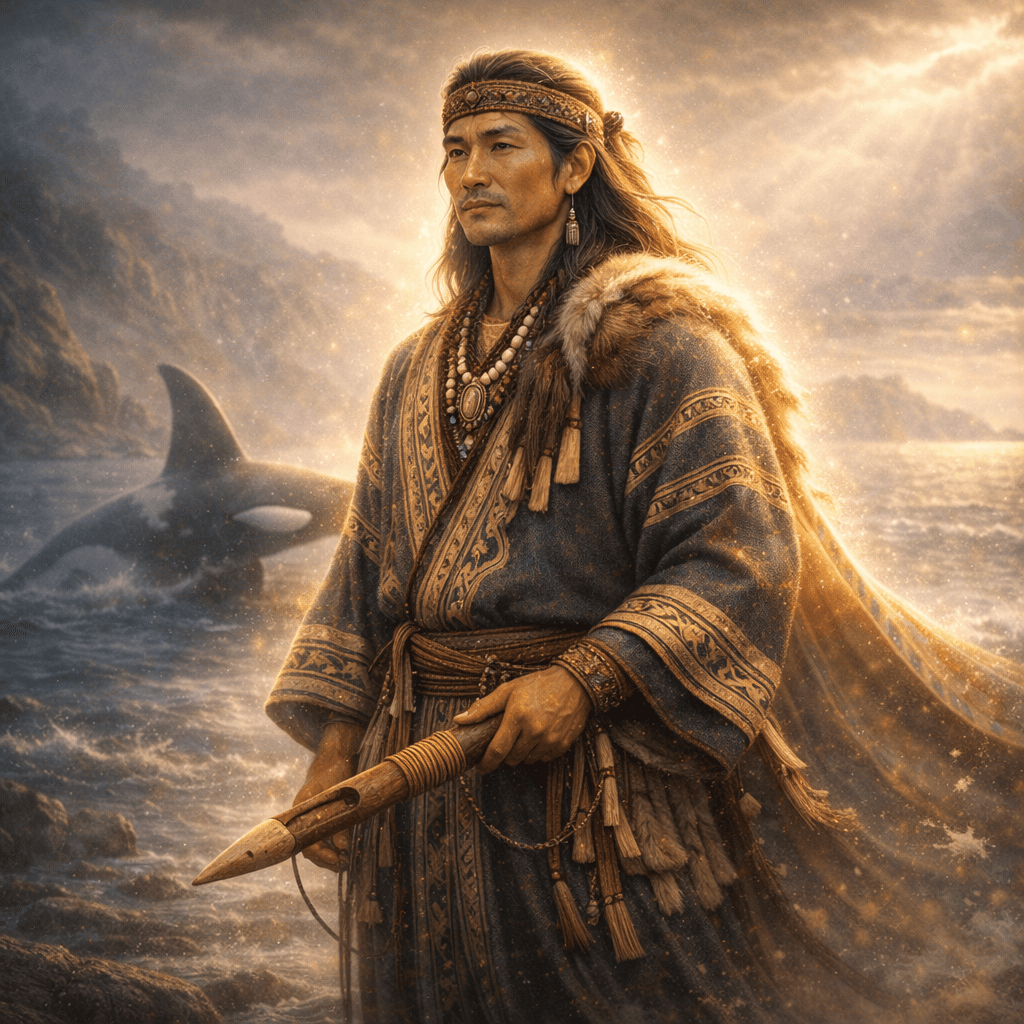
Repun-kamuy is most commonly associated with the orca, a creature that holds deep symbolic meaning in Ainu culture. Orcas were not viewed as ordinary animals but as divine manifestations, and in many traditions, the name “Repun-kamuy” itself is used to refer to these whales. When the deity chooses to appear to humans, he is believed to take the form of the largest and most powerful whales, reinforcing his authority over the sea.
In some oral traditions, however, Repun-kamuy also appears in human form. He is described as a young man carrying a harpoon, often playful and energetic. This dual imagery—both whale and human—captures his nature as a being who exists between worlds, bridging the divine and the mortal. It also reflects the Ainu tendency to humanize natural forces without diminishing their power.
Family
Repun-kamuy’s myths occasionally explore his early life and relationships, adding depth to his character. In certain stories, he is raised by his elder sister, who acts as both caretaker and disciplinarian. She guides him during his youth, especially when his mischievous behavior threatens to cause trouble. This relationship highlights a recurring Ainu theme: even powerful beings require guidance and balance.
The presence of familial ties among kamuy emphasizes that divine beings are not isolated figures but part of a larger spiritual community. Repun-kamuy is also connected indirectly to other important deities, such as Kamuy Fuchi, the hearth goddess, who represents domestic stability. Together, these figures illustrate the Ainu worldview in which sea, home, and survival are interconnected aspects of life.
Other names
Repun-kamuy is known by several variations of his name, reflecting differences in oral transmission and translation. The form “Rep-un Kamuy” is a common alternative, while longer ritual titles such as “Repun-riri-kata inao uk kamui” emphasize his role as a receiver of offerings. This title translates roughly to “the god upon the waves who receives inao,” highlighting the importance of ritual exchange between humans and the divine.
The use of his name to describe orcas further reinforces his identity. Rather than being separate from nature, Repun-kamuy is embedded within it. This linguistic overlap shows how the Ainu did not distinguish sharply between deity and natural form, seeing both as expressions of the same spiritual essence.
Powers and Abilities
As the god of the sea, Repun-kamuy governs all marine life and oceanic forces. His most celebrated ability is his role as a provider. He is believed to guide fish toward fishermen and drive whales ashore, ensuring that coastal communities have enough food to survive harsh conditions. These acts are not random but are seen as deliberate gifts, given in response to respect and proper ritual behavior.
He is also regarded as the chief of all sea kamuy, with lesser spirits operating under his authority. This elevated status makes him central to maritime life in Ainu belief. Despite his immense power, he is often portrayed as benevolent rather than wrathful. In some stories, even when humans behave improperly, he responds with tolerance rather than punishment, suggesting a deity who values intention and relationship over strict obedience.
Repun-kamuy communicates with humans through intermediaries. Among these are a tortoise-like servant known as Rep-un-kontukai and the albatross, both of which act as messengers carrying prayers across the boundary between land and sea. This system of communication reinforces the idea that interaction with the divine requires respect, ritual, and symbolic exchange.
Modern Day Influence
Repun-kamuy continues to hold cultural relevance today, particularly within efforts to preserve and revive Ainu heritage. Although many Ainu people have adopted other religions over time, traditional beliefs are experiencing renewed interest. Stories of the kamuy, including Repun-kamuy, are being recorded, taught, and shared through cultural institutions and community initiatives.
In regions like Hokkaido, the presence of orcas in coastal waters still carries symbolic meaning, linking modern observation with ancient belief. Repun-kamuy has also found a place in contemporary media and education, where he represents the Ainu connection to nature and sustainable living.
More broadly, his legacy aligns with modern environmental thought. The idea that humans must maintain a respectful relationship with nature resonates strongly in discussions about conservation and ecological balance. Repun-kamuy, as both a giver and a force to be respected, embodies this timeless principle.
Related Images

Source
Batchelor, J. (1901). The Ainu and their folk-lore. Religious Tract Society.
Etter, C. (1949). Ainu folklore: Traditions and culture of the vanishing aborigines of Japan. Wilcox and Follett.
Atlas Mythica. (n.d.). Repun Kamuy: Ainu sea god. https://atlasmythica.com/repun-kamuy-ainu-god-sea/
Wikipedia. (n.d.). Rep-un-kamuy. https://en.wikipedia.org/wiki/Rep-un-kamuy
Munro, N. G. (1995). Ainu creed and cult. Columbia University Press.
Ashkenazy, M. (2003). Handbook of Japanese mythology. ABC-Clio.
Philippi, D. L. (1979). Songs of Gods, Songs of Humans: The Poetry of the Ainu. Princeton University Press.
Ohnuki-Tierney, E. (1974). The Ainu of the Northwest Coast of Southern Sakhalin. Holt, Rinehart and Winston.
Siddle, R. (1996). Race, Resistance and the Ainu of Japan. Routledge.
Frequently Asked Questions
Who is Repun-kamuy in Ainu belief?
Repun-kamuy is the Ainu god of the sea, responsible for marine life, fishing success, and oceanic balance.
Why is Repun-kamuy associated with orcas?
Orcas are considered his physical manifestation, symbolizing his power and presence in the ocean.
What powers does Repun-kamuy have?
He controls the sea, guides fish into nets, sends whales as gifts, and governs all marine spirits.
Is Repun-kamuy a benevolent deity?
Yes, he is generally seen as generous and protective, rewarding humans who respect nature and rituals.
How is Repun-kamuy relevant today?
He remains important in Ainu cultural revival and is often seen as a symbol of environmental harmony.