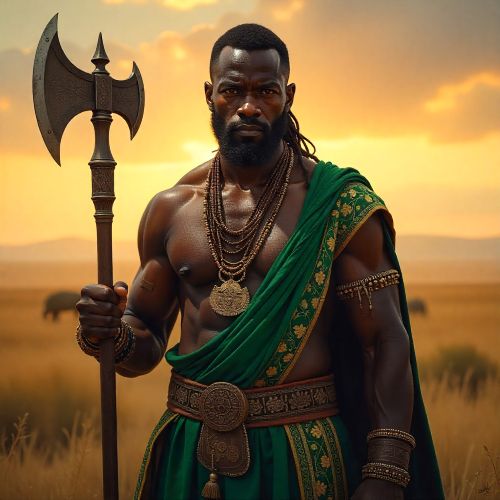


Nkongolo Mwamba : The Brutal Red King of Luba Tradition
At a glance
| Description | |
|---|---|
| Origin | Luba Mythology |
| Classification | Mortals |
| Family Members | Kahatwa (Father), Bulanda (Sister), Mabela/Mabula (Sister), Ilunga Mbidi Kiluwe (Brother-in-law), Kalala Ilunga (Nephew) |
| Region | Democratic Republic of the Congo |
| Associated With | Kingship, the Rainbow, Political Authority, Warfare, Tyranny, Foundation of the Luba Kingdom |
The Mythlok Perspective
In Mythlok’s Perspective, Nkongolo Mwamba represents a mythological archetype found across many cultures: the founder whose strengths create a kingdom but whose flaws prevent him from becoming its ideal ruler. He is not remembered for divine miracles or heroic adventures, but for the lessons embedded within his rise and fall. Much like the contrast between Cronus and Zeus in Greek tradition or Ravana and Rama in Indian epics, Nkongolo stands as the older order that must give way to a new vision of leadership. His enduring importance lies not in his victories, but in the cultural conversation he inspires about power, legitimacy, and the qualities that define a worthy ruler.
Nkongolo Mwamba
Introduction
Nkongolo Mwamba is one of the most important figures in Luba tradition and the legendary founder of the earliest Luba kingdom in Central Africa. Remembered as the first great ruler of the Luba people, he occupies a unique place in both history and mythology. While scholars debate whether Nkongolo represents a single historical ruler or a dynasty of early kings, oral traditions consistently portray him as the leader who united scattered communities and established the foundations of centralized authority.
His story survives through generations of oral narratives, memory boards known as Lukasa, and royal traditions that shaped the political culture of the Luba people. Yet Nkongolo is not remembered as an ideal king. Instead, he serves as a cautionary figure whose flaws ultimately led to his downfall.
The Luba epic places him in direct contrast to the noble hunter-prince Mbidi Kiluwe and later to Kalala Ilunga, the hero who overthrew him. Through this contrast, Nkongolo became a symbol of uncontrolled power, while his rivals embodied wisdom, order, and legitimate kingship. This tension between tyranny and righteous rule remains one of the central themes of Luba cultural memory.
Physical Traits
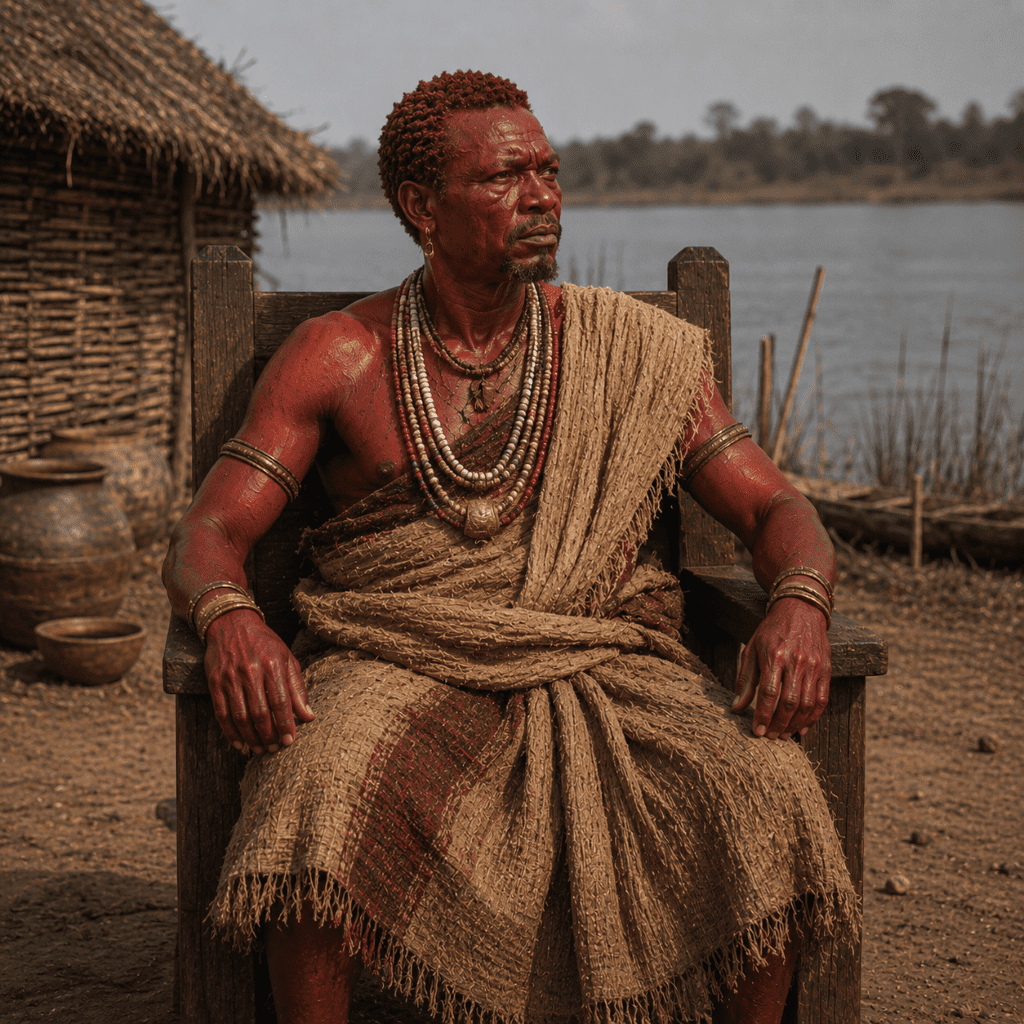
Descriptions of Nkongolo Mwamba are highly symbolic rather than historical. He is most famously known as the “Red King,” a title linked to his unusual red complexion. In Luba tradition, the color red is associated with bloodshed, violence, instability, and destructive power. Because of this symbolism, Nkongolo became a representation of fear and oppression rather than benevolent leadership.
His name itself is commonly translated as “Rainbow,” connecting him to a powerful cosmic symbol found throughout Central African belief systems. The rainbow was often associated with a serpent-like force that existed between the natural and supernatural worlds. As a result, Nkongolo is frequently linked to the image of a rainbow-serpent, a being that embodies immense power but also unpredictability.
Luba narratives further emphasize his harsh character through descriptions of his appearance. Some traditions claim he was exceptionally unattractive and lacked the refinement expected of a sacred ruler. Stories even suggest that he descended from a hyena, an animal often associated with greed, aggression, and disorder. These details are less about physical reality and more about communicating his role as the antithesis of the ideal king.
Family
Family relationships play a crucial role in the story of Nkongolo Mwamba because they ultimately determine the fate of his kingdom. According to Luba oral traditions, Nkongolo belonged to an ancient lineage connected to the earliest ancestors of the Luba people. Different versions of the story provide different genealogies, reflecting the fluid nature of oral history. What remains consistent is his connection to the ruling family that governed the kingdom before the rise of the sacred kings.
His two sisters, Bulanda and Mabela, became central figures in the succession narrative. When the eastern prince Mbidi Kiluwe arrived in Nkongolo’s kingdom, both women became associated with him through marriage alliances. These unions created a link between the old ruling order represented by Nkongolo and the new political vision introduced by Mbidi.
The most important member of this family network was Kalala Ilunga, the son of Bulanda and Mbidi Kiluwe. As he grew into a skilled hunter, warrior, and leader, Kalala increasingly overshadowed his uncle. Their rivalry eventually escalated into open conflict, culminating in Nkongolo’s defeat and the establishment of a new royal dynasty. This uncle-nephew struggle became one of the defining legends of Luba culture.
Other names
Nkongolo Mwamba appears under several names and titles throughout historical and ethnographic sources. The most common alternative form is simply Kongolo, which is frequently used interchangeably with Nkongolo in academic literature and oral traditions.
He is also known as The Red King, a title reflecting both his symbolic appearance and his association with violence and fear. Another significant title is Muntu wa Malwa, often translated as a man of evil, terror, or misfortune. This name reflects how later generations remembered his character. Because the word “Nkongolo” is associated with the rainbow, he is sometimes referred to simply as The Rainbow, emphasizing his connection to cosmic and supernatural symbolism within Luba thought.
Powers and Abilities
Unlike gods or spirits, Nkongolo Mwamba was not believed to possess magical powers in the conventional sense. His abilities were primarily expressed through kingship, military strength, and symbolic authority.
His greatest achievement was the consolidation of numerous clans and communities into a centralized political system. This transformation laid the groundwork for what would eventually become one of Central Africa’s most influential kingdoms. Even his critics within the oral traditions acknowledge his importance as a state-builder.
Nkongolo’s authority was reinforced by his association with the rainbow-serpent and the cosmic forces linked to it. In Luba symbolism, this connection elevated him beyond an ordinary ruler and presented him as a figure who bridged the human and spiritual worlds.
He was also remembered as a capable conqueror who expanded his influence across neighboring territories. Oral histories describe him as a determined warrior who sought to increase his kingdom’s power through military campaigns and strategic alliances.
However, Luba tradition consistently emphasizes that power without wisdom leads to failure. Nkongolo’s inability to govern with restraint ultimately undermined his authority. As Kalala Ilunga gained support among the people and nobility, the old king’s position weakened until he was finally overthrown.
Modern Day Influence
Nkongolo Mwamba remains a powerful figure in Central African cultural memory. His story continues to be studied by historians, anthropologists, and scholars of African mythology because it preserves valuable insights into the origins of the Luba Kingdom and the evolution of sacred kingship.
His legacy survives through Lukasa memory boards, where specific colored beads help storytellers recall the history of rulers, migrations, and important cultural events. On these memory devices, Nkongolo is traditionally represented by a red bead, reinforcing his identity as the Red King and the rainbow-serpent associated with violence.
The political ideas connected to his reign also influenced neighboring kingdoms. The Luba model of governance, refined after Nkongolo’s fall, spread across large areas of present-day Democratic Republic of the Congo, Zambia, and Angola.
Today, Nkongolo is remembered not only as a founder but also as a warning. His story illustrates how authority can create order, but also how unchecked power can lead to instability. For many people studying African history and mythology, he remains one of the most fascinating examples of a ruler whose legacy combines both achievement and failure.
Related Images

Source
Britannica. (2025). Nkongolo Mwamba | Luba mythological figure. https://www.britannica.com/topic/Nkongolo-Mwamba
Civilization Archive. (2025). Luba Empire. The Civilization Archive. https://thecivilizationarchive.com/civilization/luba-empire
Expedition Subsahara. (2023). The Luba People of Congo. https://expeditionsubsahara.com/blogs/news/the-luba-people-of-congo
Encyclopaedia Africana. (2025). NKONGOLO. https://encyclopaediaafricana.com/nkongolo/
Met Museum. (2003). Kingdoms of the Savanna: The Luba and Lunda Empires. The Metropolitan Museum of Art. https://www.metmuseum.org/essays/kingdoms-of-the-savanna-the-luba-and-lunda-empires
Wikipedia. (2023). Kongolo Mwamba. https://en.wikipedia.org/wiki/Kongolo_Mwamba
Wikipedia. (2010). Lukasa. https://en.wikipedia.org/wiki/Lukasa
World History Encyclopedia. (2020). Religion – Kingdom of Luba. https://www.worldhistory.org/Kingdom_of_Luba/
Frequently Asked Questions
Who was Nkongolo Mwamba?
Nkongolo Mwamba was the legendary first ruler of the Luba Kingdom and a central figure in Luba tradition, remembered as both a founder and a tyrannical king.
Why is Nkongolo Mwamba important?
He is important because he represents the earliest foundations of Luba kingship and serves as a symbolic lesson about the dangers of unchecked power.
What does the name Nkongolo mean?
The name Nkongolo is commonly translated as “Rainbow” in Luba tradition and is linked to powerful cosmic symbolism.
Was Nkongolo Mwamba a god?
No. Nkongolo Mwamba is generally regarded as a legendary mortal king rather than a deity, although myths connect him to supernatural symbolism.
How did Nkongolo Mwamba die?
According to Luba oral tradition, he was defeated and killed by his nephew Kalala Ilunga, who established a new royal dynasty.