
Nidar : The Somali Punisher Who Made Wrong Things Right
At a glance
| Description | |
|---|---|
| Origin | Somali Mythology |
| Classification | Gods |
| Family Members | N/A |
| Region | Somalia |
| Associated With | Justice, Punishment, Moral retribution |
The Mythlok Perspective
In Mythlok’s Perspective, Nidar represents a form of justice that differs from the warrior-heroes found in many mythological traditions. While figures such as Huur embody death through a supernatural messenger, Nidar embodies consequence through moral accountability. His survival in the saying “Nidar baa ku heli” shows how a mythological figure can endure not through epic stories, but through language itself. Nidar is remembered because the warning he represents remains timeless.
Nidar
Introduction
Nidar is a figure associated with justice and punishment in Somali traditional belief. He is described as the “righter of wrongs” and as a champion of people who were exploited or mistreated by others. Rather than being remembered through a large cycle of surviving myths, Nidar is most clearly preserved through his moral function and through a Somali saying associated with his name: “Nidar baa ku heli,” commonly rendered as “Nidar will find you” or “Nidar will catch up with you.”
This makes Nidar unusual within Somali mythology. Much of the available information about him is extremely brief, while modern summaries of Somali traditional religion place him among figures such as Waaq, Ayaanle, Huur and Wagar. The standard descriptions identify Nidar specifically with correcting wrongdoing and defending those exploited by their fellow human beings.
The evidence does not support constructing a detailed biography for Nidar. There is no well-preserved epic describing his birth, adventures, battles or death, and there is no reliable traditional portrait that establishes what he looked like. His surviving identity is instead centred on a simple moral principle: wrongdoing has consequences, particularly when the vulnerable are harmed.
The saying associated with Nidar is particularly significant because Somali cultural knowledge has historically been transmitted through oral literature, poetry, wisdom and proverbs. A scholarly repository describing a collection of Somali proverbs likewise characterises such material as an important record of traditional Somali culture and oral wisdom.
Physical Traits
No reliable traditional physical description of Nidar has been identified in the available sources. Accounts that mention him do not establish his height, facial features, clothing, age, weapons, complexion, animal form or dwelling place. His identity is therefore better understood through his function than through a documented physical appearance.
This distinction matters when representing Nidar visually. Other Somali mythological figures have much clearer descriptions. Huur, for example, is described in modern summaries as a messenger of death associated with the form of a large bird, while other Somali legendary beings have distinctive physical characteristics. Nidar, by comparison, is simply identified as the punisher or righter of wrongs.
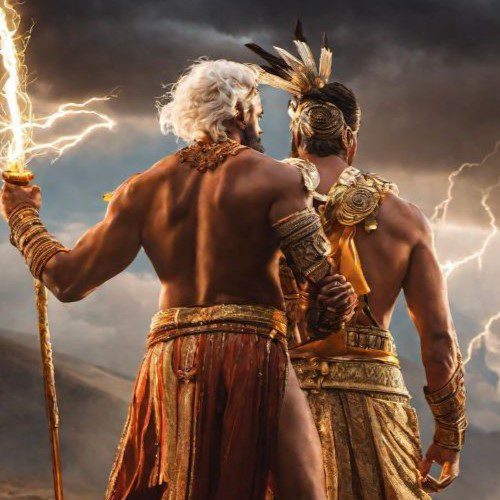
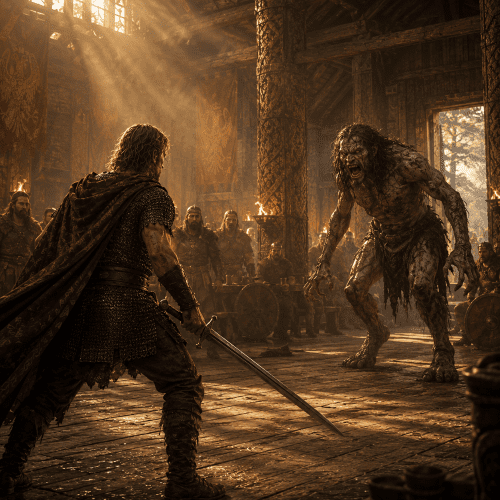
Consequently, descriptions of Nidar as a horned demon, giant warrior, masked spirit or heavily armoured supernatural being should not be presented as established Somali tradition. Those details would be artistic interpretations rather than documented characteristics.
The limited evidence may also explain why Nidar’s role has survived more clearly than his appearance. His cultural memory is concentrated in a moral warning rather than a narrative describing his physical form. The surviving tradition tells people what Nidar represents more clearly than what he looks like.
Family
Nidar’s family is undocumented in the available sources. No reliable account identifies his parents, siblings, spouse, children or descendants. There is also no surviving genealogy placing him within a documented divine family.
Modern summaries of Somali mythology place Nidar alongside figures associated with the older Somali religious tradition, including Waaq, Ayaanle, Huur and Wagar. However, appearing within the same catalogue does not establish a familial relationship between these figures.
Some modern sources go further and describe Nidar as operating within a hierarchy connected to Waaq, but this level of detail should be treated cautiously unless the underlying source is consulted directly. What can be established more securely is that Nidar belongs to the body of material discussing Somali traditional religious belief and is associated specifically with justice and punishment.
There is also reason to avoid merging Nidar automatically with similarly spelled names such as Nidir. The available evidence does not establish that every occurrence of Nidar, Nidir or related spellings refers to the same supernatural figure. A careful account should therefore retain Nidar as a distinct entry rather than importing characteristics from loosely related internet descriptions.
Other names
The principal name is Nidar. Modern English-language summaries commonly gloss the name through the functional title “Punisher,” while descriptions of the figure also call him the “righter of wrongs.” The most important expression associated with Nidar is “Nidar baa ku heli.” Sources translate the saying along the lines of “Nidar will find you” or “Nidar will find and punish you.” It functions as a warning directed at someone who has committed an injustice, particularly against another person.
This expression may actually be more culturally significant than any supposed collection of alternative names. It demonstrates how a mythological figure can survive through language even when detailed narratives become difficult to trace. Nidar does not need a long heroic saga to remain recognisable: his name itself became a reminder that wrongdoing could eventually catch up with the wrongdoer. “Punisher” and “righter of wrongs” are therefore best treated as descriptive titles rather than necessarily as formal traditional names. The evidence does not justify adding a long list of alternative names or epithets.
Powers and Abilities
Nidar’s central attribute is the punishment of wrongdoing. He is described as the figure who makes wrong things right and as a champion of people exploited by their fellow human beings. His role combines retribution with protection: those who abuse others are subject to punishment, while those who suffer exploitation are associated with the justice Nidar represents.
The saying “Nidar baa ku heli” reinforces this function. The idea is not simply that Nidar possesses physical strength, but that wrongdoing cannot permanently escape consequence. In that sense, Nidar represents moral accountability made personal: the wrongdoer will eventually be “found.” The available evidence does not provide specific magical abilities. There is no securely documented weapon associated with Nidar, nor is there a traditional account establishing shape-shifting, flight, control of storms, prophecy, healing, immortality or command over a particular supernatural realm.
It is therefore more accurate to describe Nidar’s power in terms of justice, punishment and moral retribution than to invent a supernatural power set. His mythology is not built around spectacular feats in the surviving material. His significance lies in what he represents. This also distinguishes Nidar from a purely evil spirit. The surviving descriptions explicitly connect him with correcting wrongs and defending exploited people. His punishment is presented as a response to injustice rather than as indiscriminate violence.
Modern Day Influence
Nidar’s strongest surviving influence is linguistic. The expression “Nidar baa ku heli” continues to be cited as a Somali warning that someone who has committed wrongdoing will eventually be found or punished. A source discussing Somali religious tradition specifically notes that the threat is directed at oppressors, demonstrating how Nidar’s name functions as a continuing expression of accountability.
This survival is significant because it shows how mythology can persist without remaining a fully articulated religious system. A figure may disappear from everyday worship while continuing to live in proverbs, expressions and cultural memory. Nidar is particularly well suited to this form of survival because his defining idea is easy to communicate: a person who wrongs others should not assume that the wrongdoing will go unanswered. Modern mythology references continue to describe Nidar as a Somali deity or mythological figure associated with punishment and justice. However, these sources often reproduce the same short description rather than providing independent evidence for additional stories or characteristics.
For that reason, Nidar is best understood today through the evidence that remains strongest: his association with justice, his defence of those who have been exploited, and the enduring warning represented by “Nidar baa ku heli.” His surviving mythology may be brief, but the idea behind it is remarkably clear. Nidar represents the expectation that injustice will eventually have a consequence.
Related Images


Source
Burton, R. F. (1856). First footsteps in East Africa, or, An exploration of Harar. Longman, Brown, Green, and Longman. https://archive.org/details/firstfootstepsi00burtgoog
Kapchits, G. (1986). On subjects and motifs of Somali folk-tales: Experience of cataloguing. Paper presented at the Third International Congress of Cushitic and Omotic Languages. https://hdl.handle.net/2307/2168
Kapchits, G. (1993). On types of Somali folk-tales. In M. Mohamed Abdi (Ed.), Anthropologie somalienne: Actes du IIe Colloque des Études Somaliennes (pp. 247–250). Les Belles Lettres. https://hdl.handle.net/2307/3100
Mohamed-Abdi, M. (1992). Histoire des croyances en Somalie: Religions traditionnelles et religions du livre. Les Belles Lettres. https://www.africabib.org/rec.php?RID=117742767
Wikipedia contributors. (n.d.). Somali mythology. In Wikipedia. Retrieved October 1, 2026, from
https://en.wikipedia.org/wiki/Somali_mythology
Xaange, A. C. (1988). Sheekoxariirooyin soomaaliyeed [Folktales from Somalia]. Akademiyada Soomaaliyeed Cilmiga iyo Fanka in cooperation with the Scandinavian Institute of African Studies.
Zorc, R. D., & Osman, A. A. (1993). Somali-English dictionary. Dunwoody Press. https://www.dunwoodypress.com/collections/african-languages/products/somali-english-dictionary
Frequently Asked Questions
Who is Nidar in Somali mythology?
Nidar is a Somali mythological figure associated with justice and punishment. He is described as the righter of wrongs and a defender of people exploited by others.
What does Nidar represent in Somali mythology?
Nidar represents justice, punishment and moral accountability. His role centres on correcting wrongdoing and defending people who have been mistreated or exploited.
What does “Nidar baa ku heli” mean?
“Nidar baa ku heli” is commonly translated as “Nidar will find you” or “Nidar will catch up with you,” warning wrongdoers that punishment will follow.
What are Nidar’s powers?
Nidar is associated with punishing wrongdoers and correcting injustice. Sources do not document specific weapons, magical techniques, transformations or other supernatural abilities.
Does Nidar have a family in Somali mythology?
No documented source establishes Nidar’s parents, spouse, children or siblings. His family and genealogy remain unknown in the available accounts.
