

Waaq : Creator Sky Deity of Oromo & Somali Belief | Mythlok
Listen
Mythlok Perspective
From the Mythlok perspective, Waaq represents monotheistic transcendence as an intrinsic cosmic order rather than a segmented pantheon. His presence unites sky, earth, and morality through harmony with nature and community life. When compared cross-culturally, Waaq mirrors the sky creator archetypes of Tāne in Māori tradition and Yahweh in early Israelite thought, yet differs in relational emphasis. Where Tāne shapes forests and Yahweh establishes covenant, Waaq integrates universal balance, moral order (safuu), and ecological unity. This contrast highlights an East African worldview where spirituality, natural equilibrium, and social cohesion are inseparable strands of reality.
Waaq
Introduction
In Somali mythology, Waaq is revered as the supreme deity, the god of the sky, and the creator of the universe. Worshiped by various Cushitic-speaking communities, Waaq has profoundly influenced the spiritual and cultural life of the Horn of Africa. His mythology reflects the close relationship between the Somali people and their natural environment. Waaq was especially venerated in pre-Islamic times, regarded as the high god of Somali pastoral and agricultural societies. He was seen as the guardian of fertility, rain, and the overall well-being of his people. His role in Somali life continues to resonate across generations, blending ancient traditions with modern beliefs.
Physical Traits
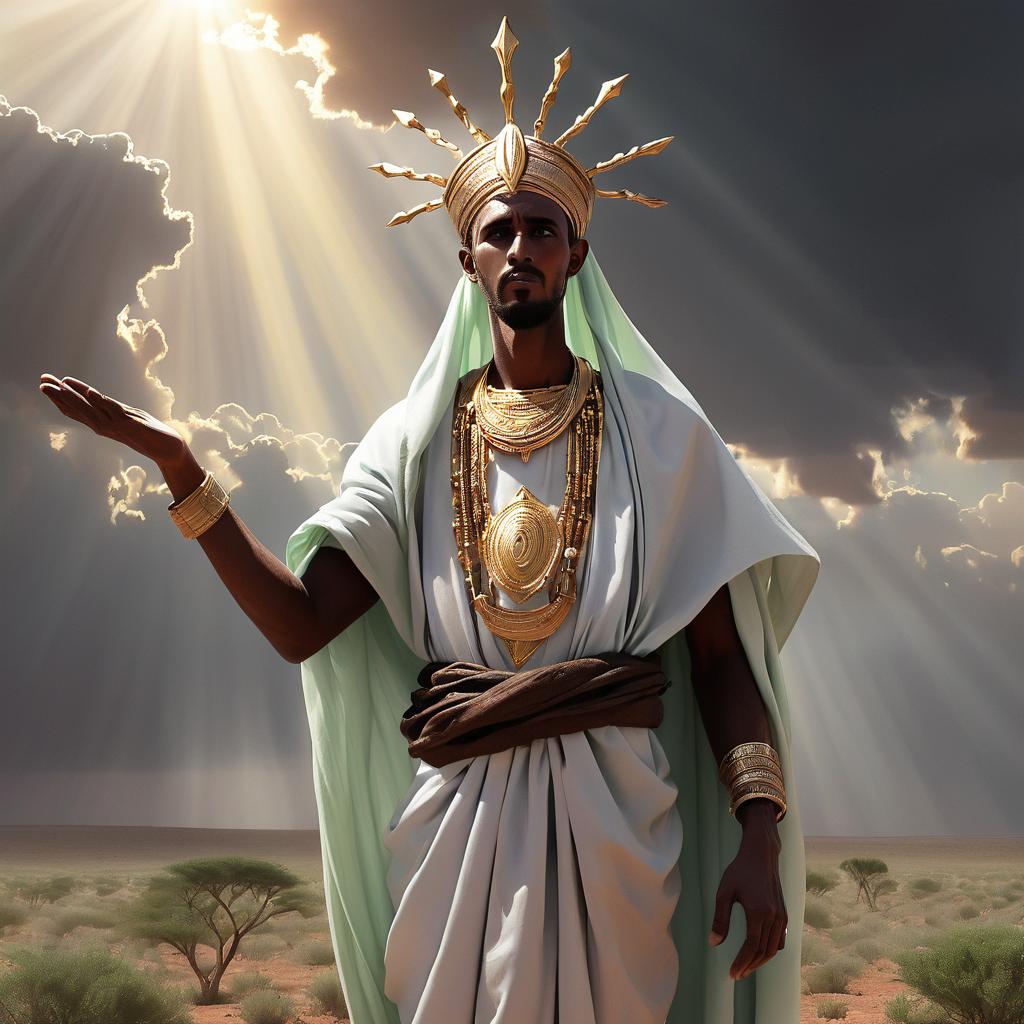
In Somali mythology, Waaq is not typically described in physical terms, unlike many deities from other cultures. Instead, he is personified through abstract concepts, often embodying the sky and heavens to signify his omnipotence. Some traditions depict him as an ethereal presence, representing natural forces rather than specific physical traits. Waaq is closely associated with elements like brightness and weather control, particularly rain, which is vital for the Somali people’s pastoral and agricultural livelihoods. His connection to the sky underscores his role as a powerful, life-sustaining force. Rather than having a defined form, Waaq is envisioned as an omnipresent and all-encompassing deity, embodying the vastness and power of the heavens.
Family
Waaq’s familial ties vary among Somali clans and their storytelling traditions. In many tales, he is the supreme deity, often paired with a celestial counterpart named Khaalid, symbolizing the earth. Together, they represent complementary forces that sustain creation and fertility in the world. Some stories also attribute offspring to Waaq, embodying qualities like wisdom, strength, and agriculture, adding layers to his mythology. Although Waaq’s family structure is not as explicitly defined as in other mythologies, he is recognized as the creator of all life, reinforcing his role as the ultimate source and architect of the universe.
Other names
Waaq is known by various names and titles that reflect Somalia’s rich linguistic and cultural diversity, with each name highlighting different aspects of his character. The primary name, Waaq, signifies him as the high god, the creator and sustainer of life. Qaalim emphasizes his authority and governance, showcasing his role in overseeing human affairs and providing moral guidance, while Dahabo, often used in poetry, links him to themes of wealth and prosperity, associating him with abundance and fertility. Additionally, regional variations such as “Waaqa” or “Waaqo” further illustrate the widespread reverence for Waaq across different Cushitic cultures within the Horn of Africa.
Powers and Abilities
Waaq is endowed with a multitude of powers that underscore his significance in Somali mythology. As the supreme deity, he is credited with the creation of the universe, encompassing the earth, sky, and all living beings. Waaq wields dominion over essential natural elements, particularly rain and fertility, which are vital for the survival and prosperity of Somali pastoral and agricultural communities. His ability to bring rain is crucial, emphasizing his integral role in sustaining life and ensuring the well-being of his followers.
Beyond his creative and environmental powers, Waaq also serves as a moral compass and protector for his devotees. Many stories recount his interventions during crises, showcasing his role in providing guidance and support to those in need. Additionally, Waaq is recognized for his healing abilities, nurturing the health and vitality of individuals and communities. This aspect of his divinity ties closely to his role as a fertility deity, where his blessings extend to families, reinforcing the harmony and balance he ensures in both the natural world and the lives of the Somali people.
Modern Day Influence
Although the worship of Waaq has diminished since the arrival of Islam in Somalia, his influence remains evident in modern society. Elements of his mythology are interwoven into Somali cultural practices, oral traditions, and folklore, reflecting a deep spiritual connection to the natural world. Today, Waaq’s legacy is celebrated through various festivals and rituals that honor agricultural cycles and family life, adapting to the contemporary socio-religious landscape where Islam is predominant.
In addition, discussions about Waaq’s significance have emerged among Somali intellectuals and communities, particularly in the diaspora, as they seek to reclaim indigenous beliefs and assert cultural identity. By revisiting the narratives surrounding Waaq, these groups foster cultural pride and a sense of historical continuity. His figure continues to inspire Somali poetry and literature, where writers explore themes of creation, nature, and the human experience. This artistic expression not only preserves his story but also connects past and present for future generations. Waaq’s traditional narratives often highlight themes of unity, social justice, and resilience, making him a symbol of hope and strength amid the challenges faced by the Somali people today.
Related Images


Sources
Argenti, N. (2001). Power and memory in the kingdom of Dahomey. Africa: Journal of the International African Institute, 71(3), 357–375. https://www.jstor.org/stable/3556885
Encyclopaedia Britannica. (n.d.). Waaq. https://en.wikipedia.org/wiki/Waaq
Encyclopaedia Britannica. (n.d.). Waaqeffanna. https://es.wikipedia.org/wiki/Waaqeffanna
Grokipedia. (n.d.). Waaq. https://grokipedia.com/page/Waaq
Lewis, I. M. (2001). Sufism in Somalia. (Relevant sections on Waaq continuities). Red Sea Press.
Mire, S. (2015). Cushitic sky-god belief and the site of Saint Aw-Barkhadle. African Archaeological Review. https://doi.org/10.1007/s10437-015-9181-z
Robinson, E. (1991). Traditional Oromo religion: Beliefs and rituals. Addis Ababa University Press.
Workineh, K. (2011). Indigenous and modern environmental ethics: A study of Oromo tradition. Council for Research in Values and Philosophy.
Watch
Frequently Asked Questions
Who is Waaq in Cushitic mythology?
Waaq is the supreme sky deity revered in ancient Cushitic belief systems, particularly among Oromo and Somali traditions, where he is regarded as creator and moral guide.
Does belief in Waaq still exist today?
Yes, Waaq’s influence persists in cultural practices, Oromo identity, and place names, even as Islam and Christianity became dominant; traditional beliefs and festivals continue among communities practicing Waaqeffanna.
What does the name Waaq mean?
In Cushitic languages such as Oromo and Somali, Waaq (also Waaqa or Waaqo) literally means “God” and specifically denotes a monotheistic creator deity.
How was Waaq worshiped historically?
Waaq was central in pre-Islamic and pre-Christian monotheistic practices of Cushitic peoples, where worship involved rituals honoring natural forces and moral laws rather than idols or intermediaries.
What is Waaqeffanna?
Waaqeffanna is the indigenous Oromo religion that centers on the belief in one God, Waaqa, emphasizing harmony with nature, social ethics, and ancestral respect.
