
Nemain : Ireland’s Goddess of War, Panic and Chaos
Listen
At a glance
| Description | |
|---|---|
| Origin | Irish Mythology |
| Classification | Gods |
| Family Members | Ernmas (Mother), Badb and Macha (Sisters), Neit (Wife) |
| Region | Ireland |
| Associated With | Battle frenzy, Panic, Chaos, Fear |
The Mythlok Perspective
From the Mythlok perspective, Nemain is not merely a war goddess but an elemental force of psychological collapse. Where many traditions glorify strength and heroism, Nemain exposes the fragility beneath those ideals. She aligns closely with figures such as Phobos in Greek tradition or the Norse concept of battle-frenzy, yet remains distinct in her emphasis on sound, confusion, and collective unraveling. Unlike gods who command armies, Nemain dissolves them, reminding us that fear is universal and uncontrollable once unleashed.
Nemain
Introduction
Nemain is one of the most unsettling figures in Irish tradition, embodying the invisible terror that erupts in the heart of battle. Rather than striking with weapons or leading armies directly, Nemain represents the psychological collapse that overtakes warriors when fear becomes uncontrollable. She belongs to the Morrígna, the cluster of war-associated female powers that includes Badb and Macha, and is sometimes treated as an independent goddess and at other times as an aspect of Badb herself. Medieval Irish sources describe her not as a conqueror but as a force that unravels order, turning discipline into chaos and courage into panic. Through Nemain, Irish tradition acknowledges that wars are not decided by strength alone, but by the fragile state of the human mind when faced with violence.
Physical Traits
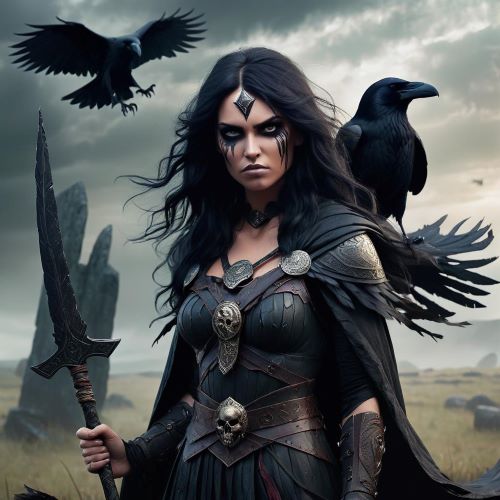
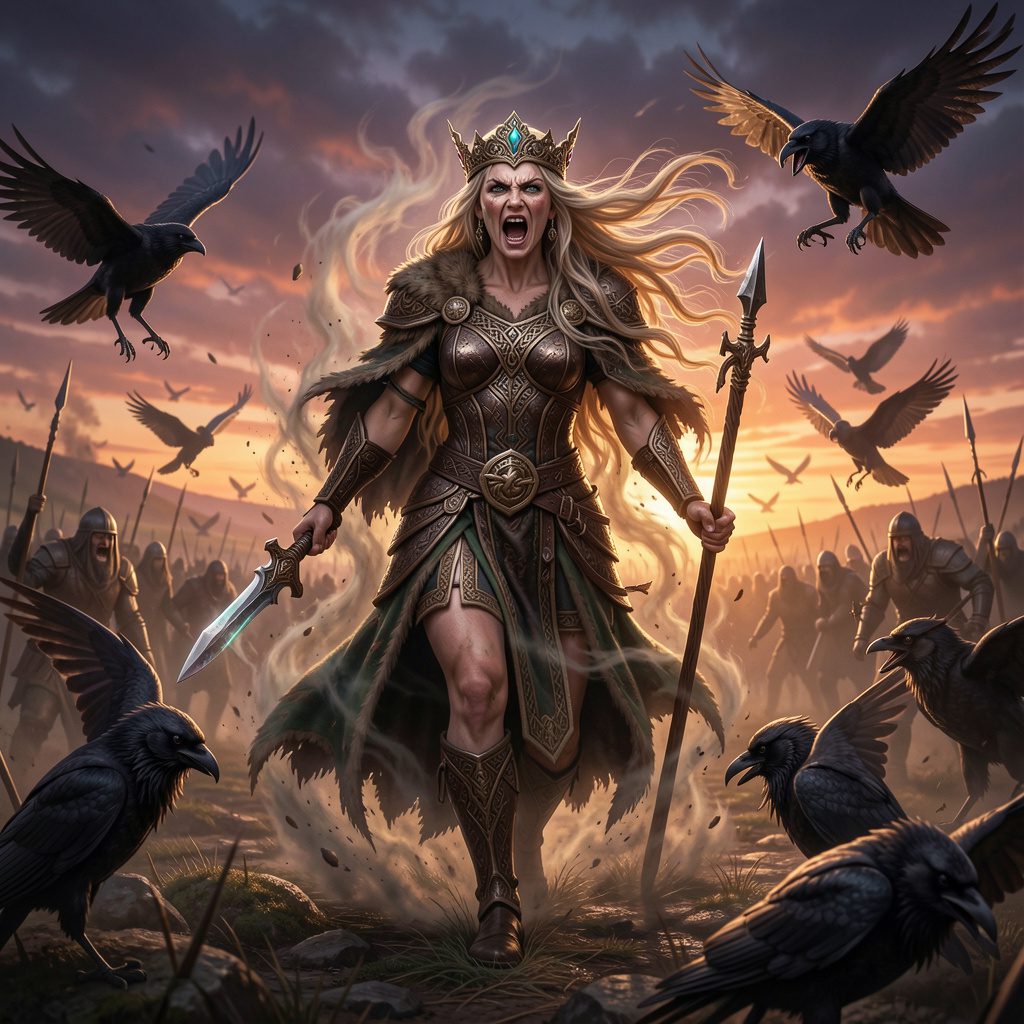
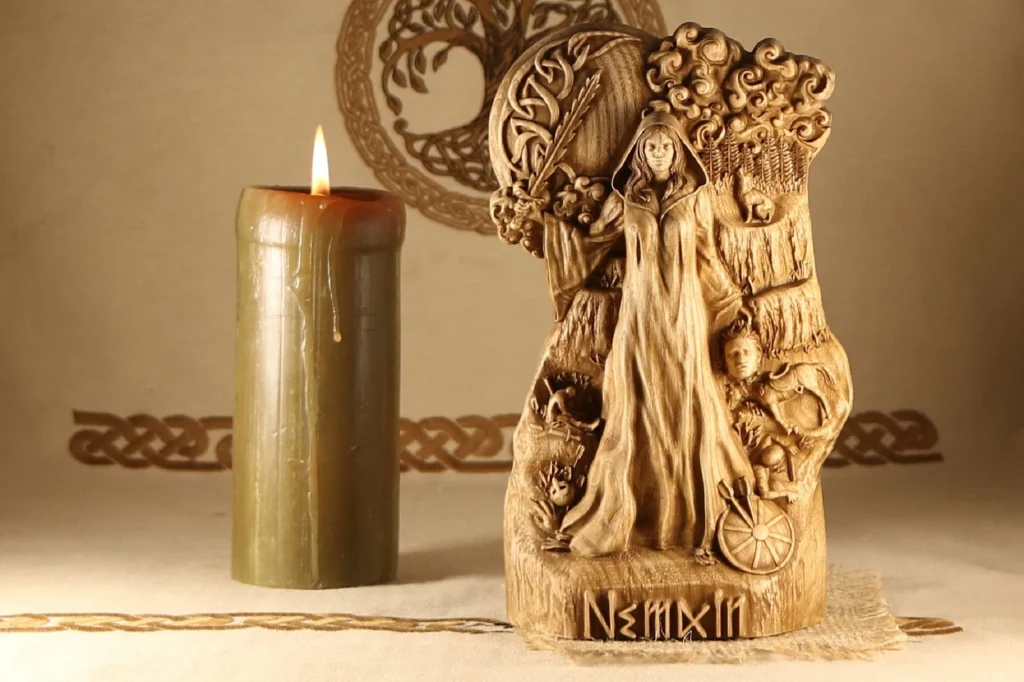
Nemain stands apart from many mythic figures because she is rarely described in physical terms. Early Irish texts focus almost entirely on her effects rather than her form, suggesting that she is not meant to be seen but experienced. Her presence is marked by uproar, shrieking, and supernatural disturbance that sweeps through battlefields without warning. This emphasis on sound rather than sight reinforces her role as a manifestation of fear itself. Later folklore and artistic interpretations occasionally imagine her as a spectral woman or a war-bird hovering above the slain, but these images are symbolic rather than canonical. The absence of a fixed appearance makes Nemain uniquely terrifying, as she exists wherever panic takes hold, unbound by shape or body.
Family
Nemain is traditionally connected to the divine lineage of the Tuatha Dé Danann, the supernatural beings who populate Ireland’s mythic past. She is frequently identified as a daughter of Ernmas, alongside other war-associated figures such as Badb and Macha, reinforcing her place within a powerful martial family. Nemain is also named as one of the wives of Neit, a god of war, a pairing that symbolically unites battle strategy with battle frenzy. No surviving myth assigns children to Nemain, which aligns with her function as a disruptive force rather than a nurturing or dynastic one. Her familial ties position her as part of a collective influence over warfare rather than a solitary deity acting in isolation.
Other names
Across manuscripts and oral traditions, Nemain’s name appears in multiple forms, including Neman, Neamhan, and Neamhain. These variations reflect the evolution of Old and Middle Irish language rather than different identities. Linguistically, her name is linked to concepts of frenzy, venom, and violent agitation, all of which mirror her mythological role. Some scholars note possible Indo-European roots associated with sacred force or overwhelming power, suggesting that Nemain represents a holy terror rather than random chaos. The consistency of meaning across name variants underscores how central panic and confusion are to her identity, regardless of spelling or regional tradition.
Powers and Abilities
Nemain’s power lies entirely in psychological domination. She does not wound bodies directly; instead, she shatters resolve. Irish epics describe her unleashing cries so dreadful that warriors lose all reason, turning their weapons on allies or fleeing in blind terror. In accounts connected to the Táin Bó Cúailnge, her influence leads to mass death without a single physical blow struck by her own hand. This form of warfare, rooted in mental collapse, distinguishes Nemain from other battle figures who embody physical destruction. Her presence represents the moment when fear overrides training and instinct, transforming organized forces into disordered crowds. Through Nemain, Irish tradition acknowledges fear as a weapon as lethal as any blade.
Modern Day Influence
Nemain continues to resonate in modern interpretations of Celtic tradition, particularly in discussions of psychological warfare and emotional breakdown under stress. She appears in contemporary fiction, games, and visual art as a symbol of chaos unleashed through fear rather than violence. In modern pagan and spiritual circles, Nemain is sometimes invoked as a force of confrontation, representing the necessity of facing inner turmoil rather than suppressing it. Scholars and storytellers alike draw parallels between Nemain’s role and modern understandings of morale, trauma, and panic in conflict zones. Her enduring relevance lies in her reminder that the most devastating battles are often fought within the mind.
Related Images
Source
Hennessey, W. M. (1870). The ancient Irish goddess of war. Revue Celtique, 1, 27–57. https://www.sacred-texts.com/neu/celt/rac/rac04.htm
Irelandwide.com. (2025, March 18). Nemain: Celtic goddess of chaos and frenzy. https://irelandwide.com/nemain-goddess-of-chaos/
Kiddle. (n.d.). Nemain facts for kids. Retrieved February 9, 2026, from https://kids.kiddle.co/Nemain
Monaghan, R. (2014). The encyclopedia of Celtic mythology and folklore. Facts on File.
Ó hÓgáin, D. (2006). The lore of Ireland: An encyclopedia of myth, legend & art. University of Oklahoma Press.
Pagans & Witches Amino. (2020, October 8). Nemain: The Morrigan cont. https://aminoapps.com/c/pagans-witches/page/blog/nemain-the-morrigan-cont/ERZk_wMVIPujzx17YPq8MKzK7zqKeKVnE4
Squire, C. (2000). Celtic myth and legend, poetry & romance. Dover Publications.
Wikipedia contributors. (2026). Nemain. Wikipedia. Retrieved February 9, 2026, from https://en.wikipedia.org/wiki/Nemain
Frequently Asked Questions
Who is Nemain in Irish tradition?
Nemain is a war-associated goddess who personifies panic, frenzy, and psychological collapse on the battlefield. Rather than engaging in combat herself, she represents the moment when fear overwhelms discipline, causing warriors to lose control and order to dissolve into chaos.
Is Nemain part of the Morrígna?
Yes, Nemain is traditionally grouped with Badb and Macha as part of the Morrígna, a collective of female war powers in Irish tradition. Depending on the source, she is treated either as a distinct goddess or as an aspect of Badb, emphasizing the fluid nature of Irish divine identities.
What powers does Nemain have?
Nemain’s primary power is the ability to induce overwhelming fear, confusion, and battle-frenzy among warriors. Through supernatural cries, disturbances, and unseen influence, she causes armies to turn on one another or collapse in terror without direct physical attack.
Does Nemain have a physical form?
Early Irish sources do not describe Nemain with a fixed physical appearance, focusing instead on her effects and presence. She is portrayed as an unseen or spectral force, experienced through sound, panic, and disorder rather than sight.
Is Nemain still worshipped today?
Nemain is not widely worshipped in a formal or organized sense, but she appears in modern pagan practices, scholarly discussions, and cultural reinterpretations. She is often invoked symbolically as a representation of emotional confrontation, inner chaos, or the destructive power of fear.