


Ndzambyaphuungu : The Sky-Dwelling Creator of Yaka Tradition
At a glance
| Description | |
|---|---|
| Origin | Yaka Mythology |
| Classification | Gods |
| Family Members | N/A |
| Region | Democratic Republic of the Congo |
| Associated With | Creation, Life, Death, Sky |
The Mythlok Perspective
In Mythlok’s Perspective, Ndzambyaphuungu highlights how a supreme creator can shape a culture’s understanding of existence without being the central focus of everyday worship. Like Nyame in Akan mythology, Ndzambyaphuungu represents a higher creative power, while spiritual relationships and religious practices connect people to the unseen world. However, Yaka traditions place particular emphasis on ancestors as intermediaries in everyday spiritual life. This contrast reveals how different cultures distinguish between the power that creates the universe and the spiritual forces that remain close to human experience.
Ndzambyaphuungu
Introduction
Ndzambyaphuungu is the creator deity of the Yaka people, an ethnic community whose traditional homeland extends across parts of the southwestern Democratic Republic of the Congo and neighbouring Angola. Known as the creator who inhabits the sky, Ndzambyaphuungu occupies a position of supreme authority in Yaka religious thought. The deity is associated with the origins of existence, the mysteries of life and death, and questions that human beings cannot fully answer.
Unlike gods who feature prominently in dramatic myths, battles or adventures, Ndzambyaphuungu is primarily known through descriptions of the Yaka understanding of the spiritual universe. The available ethnographic accounts provide limited information about individual myths involving this creator. His significance instead emerges from his position above the spiritual world and his relationship to the forces that influence human existence.
An important feature of traditional Yaka religion is the distinction between acknowledging a supreme creator and directing religious activities towards that creator. Descriptions of Yaka beliefs identify Ndzambyaphuungu as the origin of existence, while explaining that ceremonies and religious attention frequently focus on ancestors, known as bambuta, and other spiritual forces. These relationships are central to understanding how the creator fits into the wider religious landscape. This makes Ndzambyaphuungu a distinctive figure in African mythology. His importance lies not in a collection of surviving heroic stories but in the fundamental questions his presence addresses: where life comes from, what governs existence, and what remains beyond human understanding.
Physical Traits
Ndzambyaphuungu has no well-established physical description in the available sources on Yaka religious beliefs. Accounts identify the deity as a creator who inhabits the sky, but they do not provide a reliable description of his face, body, clothing, age or other human characteristics.
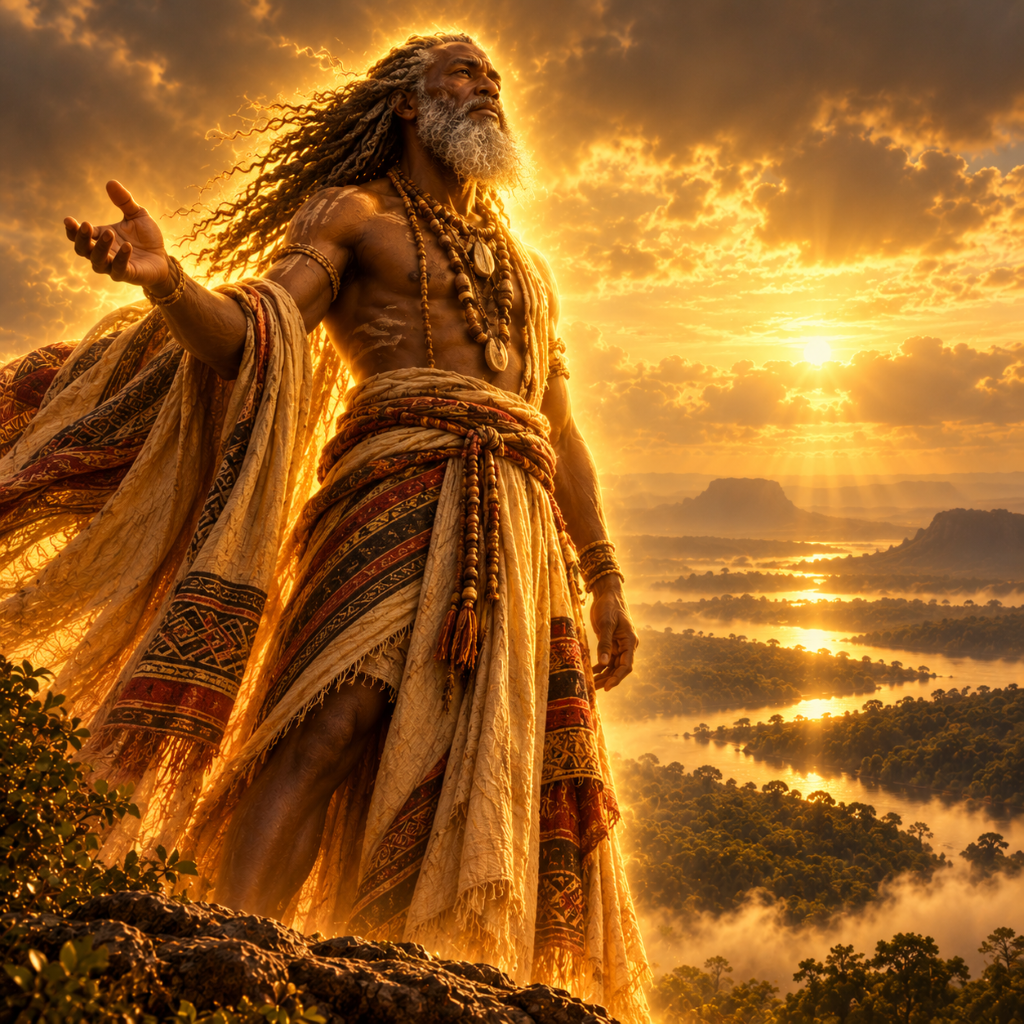
The absence of a documented appearance is significant because it distinguishes what is known about the deity from visual representations developed for modern storytelling. Depicting Ndzambyaphuungu as an elderly man, a warrior, or a human figure surrounded by lightning would introduce artistic interpretations that cannot be confidently attributed to traditional Yaka accounts. Instead, the sky provides the clearest point of reference for understanding his place in the spiritual universe. It establishes a distinction between the supreme creator and the spiritual beings encountered more directly through everyday religious practices.
This does not establish that every Yaka community understands the deity in precisely the same way. Religious traditions can vary between communities and change over time. Nevertheless, the available descriptions support presenting Ndzambyaphuungu primarily through his celestial association and creative role rather than assigning him an invented physical form. For visual storytelling, a restrained representation of a vast sky, subtle atmospheric light and a sense of immense presence can communicate the deity’s significance without suggesting that a particular human appearance is historically documented.
Family
The available sources do not establish a divine genealogy for Ndzambyaphuungu. No reliably documented account consulted here identifies a spouse, children, parents or siblings belonging to the creator within Yaka tradition. This limitation matters because names associated with supreme creators in neighbouring Central African religions can appear similar without necessarily identifying the same divine figure or sharing an identical mythology. Assigning Ndzambyaphuungu a spouse or offspring on the basis of another culture’s traditions would risk combining distinct religious accounts.
His position as creator does not, by itself, establish that he belongs to a family of gods. The surviving descriptions are more concerned with his relationship to existence and the spiritual order than with personal relationships or divine ancestry. Ancestors occupy a much more visible place in descriptions of Yaka religious life. The bambuta are understood within a tradition in which the relationship between living people and the departed remains important to ritual, social obligations and spiritual understanding. They should not, however, be presented as Ndzambyaphuungu’s children or relatives without evidence establishing such a connection.
Consequently, Ndzambyaphuungu’s family relationships remain undocumented in the sources consulted. Leaving these relationships unspecified offers a more accurate account than filling gaps in the evidence with familiar patterns from other mythologies.
Other names
Ndzambyaphuungu appears in sources with variations in spelling and capitalization. The name is commonly recorded as ndzambyaphuungu, while other descriptions of Yaka religious beliefs use forms such as Ndzaambi and Ndzambi Phungu when discussing the supreme being. These variations reflect the importance of linguistic context when researching African religious traditions. Names may be recorded differently by researchers working in different languages, and spelling conventions can change as oral traditions are transcribed into written accounts.
The element Phungu is explained in a regional account of Yaka beliefs through ideas of greatness and supremacy. In this interpretation, the expression refers to the great one associated with the sky and standing above other powers. The broader concept of Ndzambi is associated with the creator and the origin of humanity and other things. The name Nzambi Mpungu also occurs in descriptions of Kongo religious traditions. Although the shared terminology reflects a wider Central African religious and linguistic context, the Kongo name should not automatically be treated as an interchangeable name for Ndzambyaphuungu in every Yaka context.
Powers and Abilities
Ndzambyaphuungu’s principal attribute is creation. Descriptions of Yaka religious tradition identify him as the creator who inhabits the sky and associate him with life, death and the questions that human beings cannot resolve. These attributes establish his position as a supreme spiritual authority rather than simply another member of a larger pantheon.
His association with life and death places the deity at the centre of humanity’s understanding of existence. Life begins within a world ultimately attributed to the creator, while death represents another fundamental dimension of human experience. The available descriptions do not provide a detailed account of how Ndzambyaphuungu creates individual beings or what happens after death, so those details should not be supplied as established Yaka narratives.
Some regional descriptions of Yaka belief also associate the supreme being with justice, lawgiving, eternal existence and comprehensive knowledge or power. These attributes reflect interpretations of the creator’s supremacy, although their precise expression may differ between accounts. They are best understood as theological characteristics rather than a list of supernatural techniques.
Equally important is the creator’s relationship to everyday religious practice. Ndzambyaphuungu is acknowledged as the supreme creator, but accounts frequently describe religious ceremonies as concentrating on ancestors and other spiritual forces. These beings occupy a more immediate place in people’s efforts to understand misfortune, maintain relationships with the departed and address practical concerns. This distinction reveals that supreme authority does not necessarily mean constant direct intervention. Ndzambyaphuungu’s significance rests primarily in his position as the source of existence and the ultimate reference point for questions beyond ordinary human knowledge.
Modern Day Influence
Ndzambyaphuungu remains relevant to the study of Yaka religious heritage and the wider diversity of African understandings of creation. His place in descriptions of Yaka beliefs provides an example of how a supreme creator can occupy a central position in cosmology even when everyday religious practices give greater attention to ancestors and other spiritual beings.
The distinction also challenges simplified portrayals of African traditional religions. Such religions cannot be reduced to a single pattern of worship, nor can their diverse understandings of creators, ancestors, spirits and ritual specialists be treated as interchangeable. The Yaka example demonstrates the importance of examining how these elements relate to one another within a particular cultural setting.
Today, Yaka communities include people who identify with Christianity as well as those who maintain or participate in traditional cultural and spiritual practices. Contemporary religious identities can overlap in complex ways, and the available evidence does not justify assuming that every Yaka person understands or venerates Ndzambyaphuungu in the same manner.
The deity is also relevant to comparative mythology because the name and concept invite examination alongside creator figures from neighbouring Central African traditions. Such comparisons can reveal shared regional themes, including the existence of a supreme being and the importance of ancestral relationships. They must nevertheless preserve the differences between individual communities.
Further documentation from Yaka-speaking communities, oral historians and ethnographic research would help clarify how understandings of Ndzambyaphuungu are expressed today. Until more specific evidence is available, the most reliable approach is to recognize the creator’s established place in Yaka cosmology without attributing unverified ceremonies, stories or popular representations to him. Ndzambyaphuungu ultimately represents a profound idea within Yaka religious thought: the existence of a supreme creator associated with the origins of life and the mysteries that remain beyond human understanding.
Related Images

Source
Anthropologie et Sociétés. (2018). Divination and worldmaking in Kwaango. Érudit.
https://www.erudit.org/en/journals/as/2018-v42-n2-3-as04040/1052645ar.pdf
Duke University. (2022). West-Central African indigenous. The Sacred Arts of the Black Atlantic.
https://sacredart.caaar.duke.edu/religions/west-central-african-indigenous/
Luhangu, D. (1966). La notion de Dieu chez les Yaka. In Dieu, idoles et sorcellerie dans la région du Kwango–Bas-Kwilu (Ser. I, Vol. 2, pp. 13–19). CEEB.
Mbila, A. T. (n.d.). Les croyances religieuses et magiques chez les Bayaka du territoire de Kasongo-Lunda. Congo Virtuel. https://www.congovirtuel.com/page_rapport_travaux/page_article_mbila.php
Plancquaert, M. (1932). Les Yaka et les Bayaka du Kwango: Contribution ethno-historique. Institut Royal Colonial Belge.
The Sacred Arts of the Black Atlantic. (2023). Yaka power figure (Nkisi) #1. Duke University.
https://sacredart.caaar.duke.edu/artifacts/yaka-power-figure-nkisi-1/
Vansina, J. (1962). Les anciens royaumes de la savane. Institut de Recherche Scientifique en Afrique Centrale.
Yaka people. (n.d.). 101LastTribes. https://www.101lasttribes.com/tribes/yaka.html
Frequently Asked Questions
Who is Ndzambyaphuungu in Yaka mythology?
Ndzambyaphuungu is the supreme creator deity in Yaka tradition, described as a sky-dwelling being associated with life, death and the mysteries of existence.
What is Ndzambyaphuungu the god of?
Ndzambyaphuungu is associated with creation, life, death and supreme spiritual authority in Yaka religious beliefs.
Where does Ndzambyaphuungu live?
Yaka accounts describe Ndzambyaphuungu as a creator who inhabits the sky, although they do not establish a more specific divine dwelling.
Does Ndzambyaphuungu have a wife or children?
No reliably documented source consulted identifies a wife, children or other divine relatives of Ndzambyaphuungu in Yaka tradition.
How do the Yaka honour Ndzambyaphuungu?
Descriptions of Yaka religion emphasize ancestors and other spiritual forces in everyday rituals, rather than regular ceremonies directed specifically towards Ndzambyaphuungu.


