

Morana : Slavic Goddess of Frost and Rebirth
At a glance
| Description | |
|---|---|
| Origin | Slavic Mythology |
| Classification | Gods |
| Family Members | Lada, Svarog, Lelia, Yarilo (varies by tradition) |
| Region | Poland, Czech Republic, Slovakia, Russi |
| Associated With | Winter, Death, Rebirth, Frost, Nightmares, Decay |
The Mythlok Perspective
In Mythlok’s Perspective, Morana stands out as one of the most emotionally layered deities in Slavic mythology because she represents winter not simply as destruction, but as transformation. Ancient cultures feared her because winter threatened survival, yet they also understood her necessity within nature’s cycle. That duality makes her mythology remarkably human. Morana closely resembles figures like Hel from Norse mythology and the Cailleach from Celtic folklore, both of whom embody seasonal death and harsh natural forces. Unlike purely malevolent deities, Morana exists as a cosmic balance between endings and renewal, making her less a villain and more a guardian of nature’s darker rhythms.
Morana
Introduction
Morana is one of the most powerful and feared figures in Slavic mythology. Across the Slavic world, she appears as the goddess of winter, death, decay, and seasonal transformation. Although many ancient communities feared her arrival because of the suffering associated with winter, Morana was never viewed as a purely evil deity. Instead, she represented a necessary force within nature’s cycle, embodying the inevitable connection between death and rebirth.
Her mythology developed among agricultural societies that depended heavily on seasonal stability. Long winters brought famine, disease, isolation, and death, making Morana a deeply significant figure in everyday life. Ancient Slavs believed her presence covered the land in darkness and frost, while her departure marked the return of warmth, fertility, and life.
Morana’s importance extended beyond weather and mortality. She symbolized transformation itself. Her myths suggest that destruction is often required before renewal can occur. This duality made her one of the most philosophically complex deities in Slavic belief systems. Even today, her legacy survives through folk rituals, festivals, literature, and modern media inspired by Slavic traditions.
Physical Traits
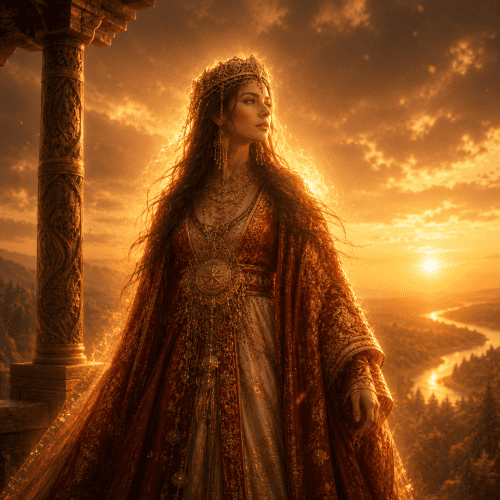
Morana’s appearance changes dramatically depending on the region and the story being told. In many traditions, she appears as a hauntingly beautiful young woman with pale skin, long black hair, and piercing eyes. Her unnatural whiteness reflects snow, frost, and what many Slavic communities once described as the “white death” of winter.
Other legends portray Morana as an aged crone similar to the witch figure Baba Yaga. In these stories, she becomes a terrifying old woman wandering forests and abandoned places during the cold months. This contrast between youthful beauty and monstrous age reinforces her connection to transformation and the shifting nature of life itself.
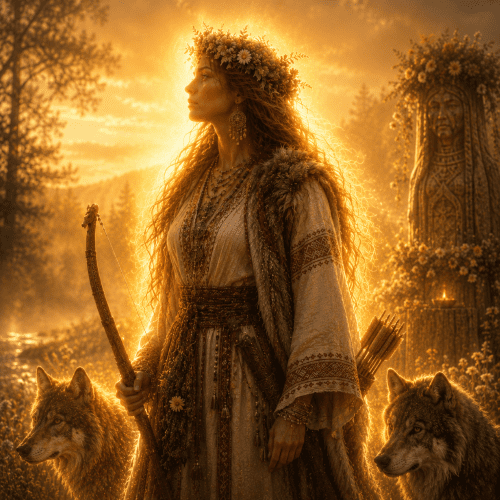
Morana is often depicted carrying a sickle or scythe, symbols associated with harvests, endings, and mortality. Some artistic depictions include ravens, wolves, snakes, or barren trees surrounding her. These creatures and landscapes emphasize her dominion over death, wilderness, and the darker side of nature. In Slavic rituals, Morana is frequently represented by a straw effigy dressed in white or dark clothing. These effigies became central to ceremonies celebrating the end of winter and the arrival of spring.
Family
The family connections of Morana vary widely across Slavic traditions because much of ancient Slavic mythology survived through fragmented oral folklore rather than unified written texts. In some reconstructed traditions, Morana is described as the daughter of Lada and Svarog, placing her among the higher deities of the Slavic pantheon.
Certain legends identify her as the sister of Lelia, another goddess associated with beauty, youth, and springtime. Morana’s relationship with spring deities is especially important because it reflects the seasonal struggle between winter and rebirth.
Some myths also connect Morana to Yarilo. In these traditions, Yarilo’s return each spring restores life to the earth, while his eventual betrayal or death leads to Morana reclaiming power over the land through autumn and winter.
Other folk stories associate Morana with Koschei the Deathless, a supernatural figure tied to death and immortality in Slavic folklore. These varying relationships show how Morana’s mythology evolved differently across Slavic cultures over centuries.
Other names
Morana is known by many names throughout the Slavic world, reflecting regional languages and traditions. The most common variations include Morena, Mara, Marzanna, Marena, Mora, and Moréna. In Poland, she is especially known as Marzanna, whose effigy is ceremonially destroyed during spring festivals. Czech and Slovak traditions often use the names Morena or Moréna, while Russian folklore sometimes refers to her as Marena or Mara.
The root of her name is linked to ancient Indo-European words associated with death, dreams, and destruction. Linguists often connect “Mora” to the origin of the English word “nightmare,” reflecting Morana’s association with bad dreams, sleep paralysis, and supernatural fear. This linguistic connection demonstrates how deeply her mythology influenced early European understandings of death, fear, and the unseen world.
Powers and Abilities
Morana possesses powers associated with winter, death, decay, and spiritual transformation. Her most important ability is control over the cold season itself. According to folklore, she could blanket the world in frost, freeze rivers, destroy crops, and bring deadly storms across the land.
She is also closely tied to mortality and the underworld. Some Slavic traditions describe Morana as a guardian of Nav, the realm of the dead. In this role, she oversees the boundary between the living and the spiritual world.
Morana is frequently associated with nightmares, illness, curses, and supernatural fear. Certain folk beliefs claimed she could influence dreams or appear during long winter nights when darkness and isolation overwhelmed villages.
Shape-shifting is another recurring element in her mythology. Morana can appear as a beautiful maiden, an elderly witch, or a ghostly spirit depending on her intentions. This fluid identity reinforces her role as a goddess of transition and impermanence. Despite her destructive abilities, Morana also represents renewal. Her departure each spring allows nature to recover and flourish again, making her power both terrifying and essential.
Modern Day Influence
Morana remains one of the most culturally significant figures in Slavic folklore today. Her influence survives most strongly through the traditional ritual known as the “Drowning of Marzanna,” still practiced in parts of Poland, Slovakia, and the Czech Republic.
During this ceremony, communities create straw effigies representing Morana before carrying them through villages and eventually burning or drowning them in rivers. The ritual symbolizes the banishment of winter and the welcoming of spring. Although the practice now functions mainly as a cultural celebration, its roots reach deep into pre-Christian Slavic spirituality.
Morana has also become increasingly popular in modern fantasy media. She appears in novels, games, folklore-inspired art, and television adaptations influenced by Slavic mythology. Modern interpretations often portray her as a mysterious winter queen or dark nature goddess with immense supernatural power.
In video games and fantasy literature, Morana frequently represents themes of balance, survival, death, and transformation. Her visual imagery, including pale skin, black robes, ravens, and snow-covered landscapes, has made her one of the most recognizable figures in modern Slavic-inspired fantasy. Academic interest in Morana has also grown in recent years as scholars explore the reconstruction of ancient Slavic religion and folklore traditions.
Related Images


Source
Černý, J. (2020). Morana – The ancient Slavic goddess of winter and death. Slavorum. https://www.slavorum.org/morena-and-legends-of-this-ancient-slavic-goddess-of-winter/
Mythus Fandom Community. (2007). Morana | Myth and folklore wiki. https://mythus.fandom.com/wiki/Morana
Novak, A. (2021, April 16). Morana – Slavic goddess of winter, death and misfortune in love. Lastavica. https://lastavica.hr/en/croatian-culture-and-history/morana-slavic-goddess-of-winter-death-and-misfortune-in-love
Słowiński, P. (2019, March 17). Marzanna the winter witch – A Polish ritual. Polish Housewife. https://polishhousewife.com/marzanna-the-winter-witch/
Słowiński, P. (2024). Rites of spring: Drowning Marzanna – Winter’s witch. In Your Pocket. https://www.inyourpocket.com/warsaw/rites-of-spring-drowning-marzanna-winters-witch_72571f
Wikipedia Contributors. (2023). Morana. Wikipedia. https://en.wikipedia.org/wiki/Morana
Ivanov, V., & Toporov, V. (1984). Studies in Slavic Mythology. Moscow: Nauka.
Długosz, J. (1455–1480). Annales seu cronicae incliti Regni Poloniae. Kraków.
Hapon, M. (2014). Mother of Poland: Marzanna. Warsaw: Polish Folklore Press.
Frequently Asked Questions
Who is Morana in Slavic mythology?
Morana is the Slavic goddess of winter, death, decay, and seasonal rebirth.
What does Morana symbolize?
Morana symbolizes mortality, winter, transformation, and the cycle of death and renewal.
Is Morana connected to Marzanna?
Yes. Marzanna is one of the regional names and forms of Morana in Polish folklore.
How was Moranna worshipped?
Ancient Slavic communities honored Moranna through seasonal rituals, especially ceremonies marking winter’s end.
What is the Marzanna ritual?
The Marzanna ritual involves burning or drowning an effigy of Moranna to symbolize the arrival of spring.