
Mebege : The Supreme Creator of Central African Tradition
At a glance
| Description | |
|---|---|
| Origin | Central African Mythology |
| Classification | Gods |
| Family Members | Dibobia (Wife), Zame ye Mebege, Nyingwan Mebege, Nlona Mebege (Children) |
| Region | Gabon, Cameroon, Equatorial Guinea |
| Associated With | Creation, Cosmic order, Life, |
The Mythlok Perspective
In Mythlok’s Perspective, Mebege represents one of the most profound expressions of self-born creation, where the universe is not crafted but unfolded from the creator’s own being. This aligns him with figures like Atum from Egyptian belief and Brahma from Indian tradition, yet his narrative stands apart in its emphasis on internal substance as the source of reality. Where others create through will, Mebege creates through sacrifice and transformation, making existence itself a living extension of divinity.
Mebege
Introduction
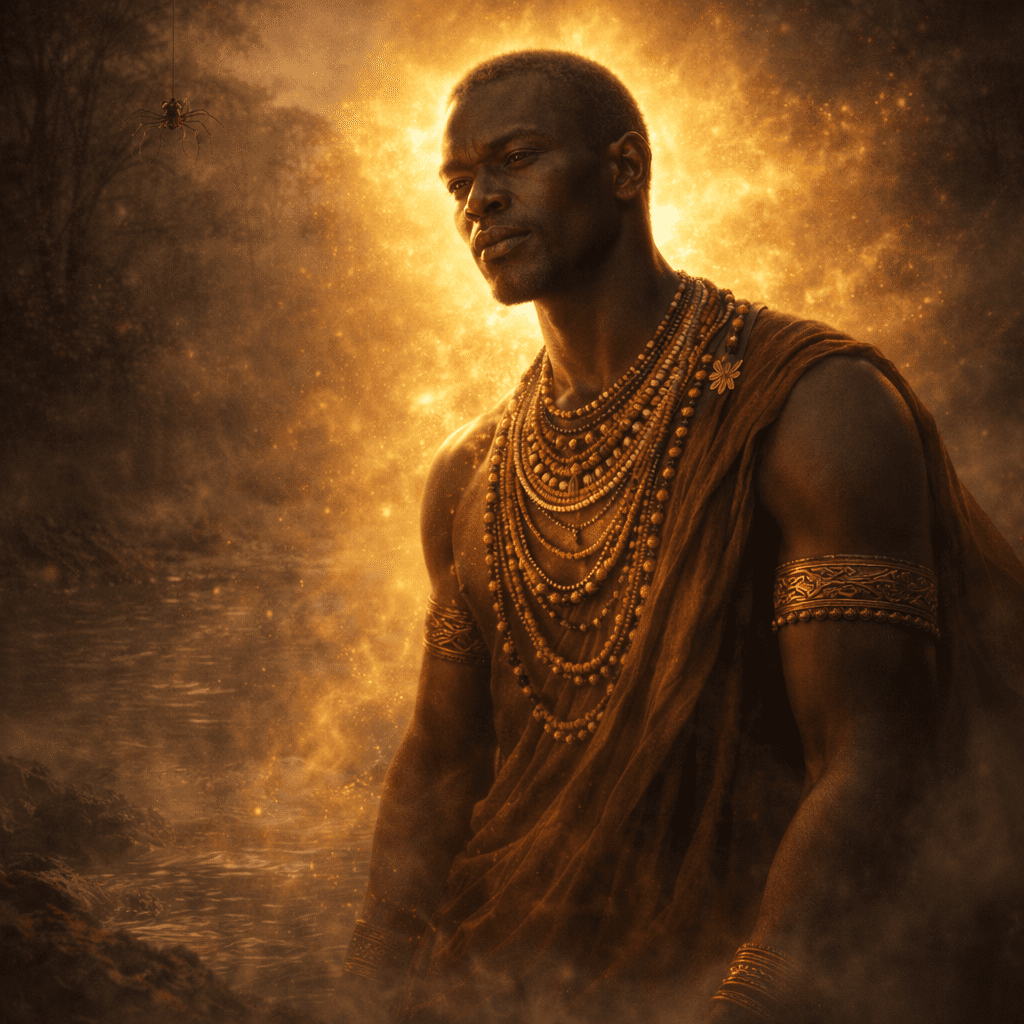
Mebege stands at the heart of Fang and Beti-Pahuin belief systems as the original creator and source of existence. Unlike many creator figures across the world, Mebege does not simply shape the universe from external materials. Instead, creation emerges directly from his own being, making him both the origin and substance of reality itself. Oral traditions describe him as the first conscious presence in a vast, empty expanse, accompanied only by the spider Dibobia, whose role introduces the idea that creation is not purely solitary but guided through interaction.
The most well-known creation account presents Mebege forming an egg using elements taken from himself, including hair, brain matter, and stone. This symbolic act represents multiplicity, intelligence, and permanence coming together to initiate life. From this egg emerge three foundational deities who go on to structure the cosmos. Through this narrative, Mebege becomes more than a creator. He becomes a philosophical concept that explains how existence is both unified and divided, ordered yet alive.
Physical Traits
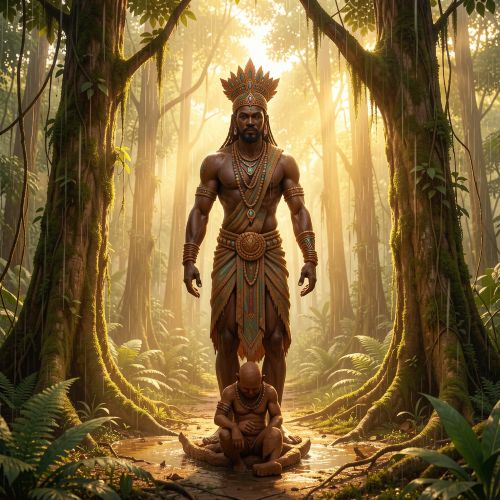
Mebege is not described in physical terms within Fang traditions. This absence is intentional and deeply meaningful. Rather than imagining the creator as a human-like figure, Fang cosmology presents divinity as something beyond form, something that exists through action, presence, and influence rather than appearance.
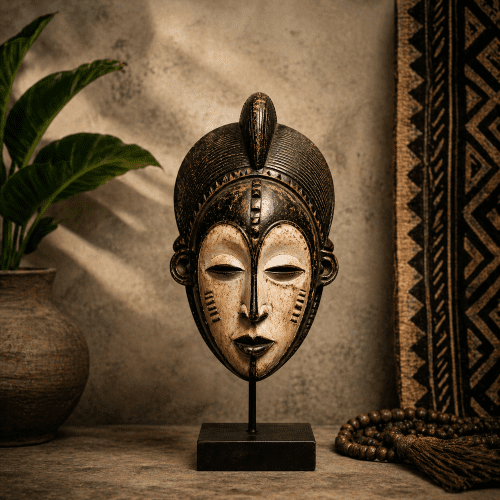
This makes Mebege a purely conceptual force. He is understood through what he does rather than how he looks. His identity is tied to creation, transformation, and authority, not to any visual representation. Even within Fang artistic traditions, such as bieri reliquary figures, the focus is not on depicting Mebege himself but on expressing the continuity between ancestors, spirits, and divine oversight.
This abstraction separates Mebege from many global creator figures and places him closer to the idea of a universal principle. He is not seen, but he is experienced through the structure of existence itself.
Family
Mebege begins as a solitary being, but creation introduces relational existence. Guided by Dibobia, he forms an egg that gives rise to three deities: Zame ye Mebege, Nyingwan Mebege, and Nlona Mebege. Each of these figures governs a different aspect of the cosmos, establishing a division of power that reflects balance within creation.
Zame ye Mebege becomes associated with leadership, the sun, and the shaping of the earth. Nyingwan Mebege embodies fertility, the moon, and generative forces. Nlona Mebege represents more ambiguous or destructive aspects, highlighting that creation includes both harmony and imbalance.
In parallel traditions, Mebege is also linked to a triadic structure consisting of Nzame, Mebere, and Nkwa. These are not separate gods but expressions of a unified divine force representing strength, authority, and beauty. This dual framework shows how Fang cosmology accommodates both narrative storytelling and philosophical abstraction.
Mebege is also credited with the creation of humanity. One account describes the first human being formed from clay and transformed through breath, while another describes the creation of ancestral figures like Zambe and Mbongwe, establishing the origins of human lineage.
Other names
Mebege is known by multiple names across Fang-speaking regions, reflecting linguistic diversity and oral transmission. Common variations include Nzeme, Mebere, and Mebe’e. In some contexts, these names refer directly to the supreme creator, while in others they represent specific aspects of divine authority within the broader cosmic structure.
The name Mebere, for example, is often associated with leadership and command, while Nzeme connects more closely to the overarching creative force. These distinctions are fluid rather than rigid, as oral traditions allow meanings to evolve across regions and generations.
Within syncretic traditions such as Bwiti, Mebege is sometimes integrated into Christian frameworks, where he may be equated with a supreme god figure. This demonstrates the adaptability of Fang belief systems, where new ideas are incorporated without erasing older cosmological foundations.
Powers and Abilities
Mebege’s defining power is creation through self-generation. By forming the cosmic egg from his own substance, he establishes a universe that is inherently connected to him. This act reflects a worldview in which existence is not separate from the divine but is an extension of it.
He also possesses the power to give life, most notably through breath. This ability transforms inert matter into living beings, reinforcing the idea that life is sacred and intentional. In some narratives, early humans undergo transformation before achieving their final form, suggesting that creation is a process rather than a single event.
Mebege’s authority extends beyond creation into governance. Through the establishment of divine aspects such as strength, leadership, and beauty, he defines the moral and structural order of the world. When this order is disrupted, he has the power to withdraw life or reshape existence entirely.
Destruction, in this context, is not chaotic but corrective. It restores balance and reinforces the idea that power must be aligned with responsibility. This moral dimension is central to understanding Mebege’s role, as his authority is both creative and judicial.
Modern Day Influence
Mebege continues to shape the cultural and spiritual identity of Fang communities today. His presence is most visible in oral traditions, where stories of creation, morality, and ancestry are passed down through generations. These narratives are not static myths but living frameworks that guide ethical behavior and community structure.
In Bwiti practices, elements of Mebege’s cosmology are integrated into ritual experiences, often involving music, dance, and sacred plant use. These rituals are seen as pathways to understanding deeper truths about existence and the human soul.
Art also preserves his legacy. Bieri figures and ritual objects reflect the belief that ancestral spirits remain connected to the living world, reinforcing the idea that Mebege’s creation is ongoing through lineage and memory. Even in modern contexts influenced by global religions, the underlying concepts associated with Mebege continue to inform identity, resilience, and cultural continuity.
Related Images
Source
Fernandez, J. W. (1982). Bwiti: An ethnography of the religious imagination in Africa. Princeton University Press.
101 Last Tribes. (n.d.). Fang people. https://www.101lasttribes.com/tribes/fang.html
Lebarty. (n.d.). Fang mythology. https://lebarty.com/fang-mythology/
Talk Africana. (2023, July 15). The creation story of the Fang people of Africa. https://talkafricana.com/the-creation-story-of-the-fang-people-of-africa/
University of Missouri. (n.d.). Fang [PDF]. https://dice.missouri.edu/assets/docs/niger-congo/Fang.pdf
Naturally Crafted. (2025, January 15). The spiritual Fang people. https://www.naturallycrafted.co.uk/blog/the-spiritual-fang-people
Alexandre, P., & Binet, J. (1958). Le groupe dit Pahuin (Fang-Boulou-Beti). PUF.
Frequently Asked Questions
Who is Mebege in Fang belief?
Mebege is the supreme creator deity in Fang and Beti-Pahuin traditions, responsible for the origin of the universe and cosmic order.
How did Mebege create the world?
He formed a cosmic egg using parts of his own being, which later produced deities that shaped the earth, sky, and waters.
Does Mebege have a physical form?
No, Mebege is considered an abstract, formless divine presence rather than a human-like figure.
What role does Dibobia play in Mebege’s story?
Dibobia, the spider, acts as a guiding presence who advises Mebege during the act of creation.
Is Mebege still worshipped today?
Mebege’s influence continues through Fang traditions and Bwiti practices, where his cosmology shapes rituals and cultural identity.