


Malobè : The Giant Whose Defeat United the Sawa
At a glance
| Description | |
|---|---|
| Origin | Sawa Mythology |
| Classification | Hybrids |
| Family Members | N/A |
| Region | Cameroon |
| Associated With | Strength, Immense size, Intimidation, Market disruption, Origins of the Ngondo |
The Mythlok Perspective
In Mythlok’s Perspective, Malobè is compelling because his legend turns physical strength into a warning about unchecked power. Like Antaeus in Greek mythology, whose extraordinary strength made him a formidable opponent, Malobè embodies the intimidating force of a giant. Yet their stories diverge sharply: where Antaeus is ultimately defeated through individual ingenuity, Malobè’s defeat becomes a catalyst for collective unity. His enduring significance lies not simply in his strength, but in how confronting his dominance helped inspire the Sawa to stand together.
Malobè
Introduction
Malobè, also known as Malobè Etamè, is a legendary giant associated with the Sawa peoples of coastal Cameroon, particularly the Pongo region north-west of Douala. His story is closely connected with the traditional origin narrative of the Ngondo, the important cultural and political institution of the coastal peoples. According to Sawa tradition, Malobè became notorious for his behaviour at the markets of Pongo, where traders and canoe operators gathered to exchange goods moving through the coastal trading network.
The legend describes Malobè as a man of extraordinary physical power who exploited his strength to impose himself on the market community. He demanded a personal tithe from canoes arriving at the market, creating fear among the traders and disrupting commerce. Some versions specifically state that he acted with the assistance of his brothers, suggesting that the threat was not simply the actions of an isolated strongman but a wider source of intimidation.
The crisis eventually prompted Ngando Akwa, a leader associated with the Bonambela clan, to call for cooperation among the coastal clan leaders. The meeting is traditionally associated with the Bessèkè River and is presented as an important moment in the formation of the Ngondo. The name Ngondo itself has been interpreted in Sawa tradition through the image of an umbilical cord, representing the bond that connects different clans.
Malobè is therefore important less as a conventional supernatural being and more as a legendary embodiment of uncontrolled power. His story turns a confrontation between individuals into a larger lesson about collective responsibility. The central transformation in the legend is significant: the communities overcome a threat not simply through greater physical strength, but through cooperation and the creation of a shared institution.
The precise historical date of Malobè’s story is difficult to establish. Some accounts place the formation of the Ngondo around 1830, before the arrival of Christian missionaries in Douala, while later cultural sources preserve the Malobè episode as its foundational legend. These dates belong to historical interpretations of the Ngondo’s development and should not be treated as proof that Malobè himself was a historically documented individual.
Physical Traits
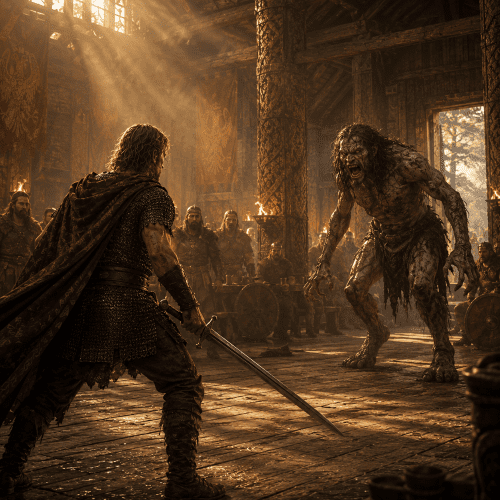
Malobè’s most distinctive characteristic is his enormous size. Sawa accounts describe him as an immense giant or colossus possessing phenomenal strength, presenting his body as the principal source of his intimidating reputation. Unlike many mythological figures whose descriptions include elaborate supernatural anatomy, the surviving accounts focus mainly on his extraordinary stature and physical power.
The tradition does not provide reliable measurements of Malobè’s height or describe precise details such as his facial appearance, clothing, complexion, age or body proportions. For that reason, representations showing him as a fantastical monster with non-human anatomy go beyond what the available traditional descriptions establish.
His gigantic form nevertheless has an important narrative function. In the story, physical size represents an imbalance of power. Malobè’s presence is enough to make traders afraid to approach the market, turning his reputation into a form of control. His body consequently becomes a visual expression of the authority he has taken for himself.
This is also why Malobè is better understood as a legendary giant than as a god or supernatural race. The sources describing his story do not establish divine parentage, immortality or a distinct supernatural species. His extraordinary qualities belong to the legendary tradition surrounding him.
Family
Information about Malobè’s family is limited, but the tradition does provide one significant detail: he is said to have acted with the complicity of his brothers. Their involvement places his actions within a broader kinship network and helps explain how his influence could extend beyond his individual physical strength.
The accounts do not provide a complete genealogy for Malobè. There are no sufficiently established names for his parents, wife, children or descendants in the sources consulted. Consequently, assigning a detailed family tree to him would introduce information that the surviving accounts do not support.
Another important relationship is his connection to Ngomninga, who is described in Sawa tradition as a relative by marriage of Ngando Akwa and a member of the Bakoko community from Yansoki. Ngomninga ultimately becomes Malobè’s opponent in the best-known version of the legend. This relationship should not be confused with Malobè’s immediate family. Ngomninga is significant because he represents the community’s chosen champion rather than because he belongs to Malobè’s household or lineage.
The emphasis on brothers, allied clans and relationships by marriage reflects an important feature of the story: the conflict is embedded in the interconnected social structure of the coastal communities. Malobè’s challenge eventually requires a response that crosses individual and clan boundaries.
Other names
The figure is most commonly known simply as Malobè, while fuller versions of his name include Malobè Etamè and Malobè m’Etame M’etei. Sources discussing the origins of the Ngondo use both Malobè Etamè and Malobè as references to the same legendary figure. The variation in form reflects the transmission of the story through oral tradition, French-language publications and Sawa cultural sources. It is therefore preferable to treat these forms as names or fuller forms of the same figure rather than inventing separate identities.
The expression “Malobè e o don”, also rendered in some sources as “Malobè a o don,” is particularly associated with his legend. It means, broadly, that Malobè is at the market and functions as a warning that a dangerous or overpowering force has appeared. The expression is not another personal name for Malobè; rather, it is a phrase that developed from the story and preserves its cultural memory.
His name is also permanently linked with Ngomninga through the song traditionally associated with the legend. The song recounts Malobè’s inability to withstand Ngomninga and has been described in Sawa cultural sources as an important hymn of the Ngondo tradition.
Powers and Abilities
Malobè’s principal abilities are his extraordinary strength, imposing physical presence and capacity to intimidate others. The tradition does not clearly describe him as possessing magical powers in the manner of a deity or water spirit. Instead, his power is presented through the effects his physical dominance has on ordinary people and commerce.
His most notorious act was demanding a personal tithe from canoes arriving at the Pongo market. Because traders feared confronting him, the normal movement of goods was disrupted. In this sense, Malobè’s strength became a form of economic power: he could control access to the market through fear rather than through legitimate political authority.
The legend eventually introduces a contrasting form of power through Ngomninga. According to the Sawa account, Ngomninga underwent ritual preparation before confronting Malobè. After observing the situation, he faced the giant and defeated him. The traditional account therefore contrasts Malobè’s brute physical dominance with a combination of preparation, ritual knowledge and communal purpose.
Importantly, the available sources do not establish that Malobè possessed immortality, elemental control, shapeshifting or other supernatural abilities. His classification as a legendary giant is better supported than identifying him as a god, spirit, demon or demigod.
Modern Day Influence
Malobè remains culturally significant because his story has become intertwined with the history and identity of the Ngondo, which developed from a traditional Sawa institution into an important annual cultural celebration. Accounts of the Ngondo continue to recount the confrontation with Malobè as part of the tradition explaining the importance of unity among the coastal communities.
The legend is particularly powerful because its conclusion is institutional rather than merely heroic. Faced with Malobè’s domination, clan leaders are said to have joined together and sought a collective solution. The Ngondo consequently became associated with the idea of a common bond among the clans. Historical and cultural accounts place the emergence of the institution around the early nineteenth century, with approximately 1830 frequently cited, although the exact historical development of the institution is more complex than the legend alone suggests.
Malobè’s story has also survived through song and modern literary and artistic reinterpretation. In 2017, Norbass published La légende de Malobè, a 59-page illustrated work that presents the story as part of the history and cultural memory of the Sawa communities.
The legend continues to appear in discussions of Sawa heritage because it expresses several enduring ideas: the danger of unchecked personal power, the importance of defending communal interests and the strength that can emerge from cooperation between different groups. Its continued presence in Ngondo-related cultural material demonstrates how oral traditions can preserve social values even when their historical details cannot be independently verified.
Malobè is therefore best remembered not simply as a giant who terrorised a market, but as the legendary antagonist whose actions provided a powerful narrative for explaining why communities that might otherwise have acted separately needed to stand together.
Related Images




Source
Afrik. (2016, November 28). Cameroun : à découvrir, les origines du “Ngondo”. https://www.afrik.com/cameroun-a-decouvrir-les-origines-du-ngondo
Austen, R. A. (1992). Tradition, invention and history: The case of the Ngondo (Cameroon). Cahiers d’Études Africaines, 32(126), 285–309. https://s1084e755aa436055.jimcontent.com/download/version/1731312159/module/12544951257/name/Tradition,%20Invention%20and%20History%20The%20Case%20of%20the%20Ngondo%20By%20Ralph%20A%20Austen%20in%20Cahiers%20d’%C3%89tudes%20africaines%20%20Ann%C3%A9e%201992%20%20126%20%20pp%20285-309.pdf
Children of Cameroon. (2024, July 11). Ngondo: The water festival of Douala. https://www.childrenofcameroon.co.uk/post/ngondo-festival
Mboasawa. (2025, April 19). La légende : Malobè et Ngomninga. https://mboasawa.com/fr/la-legende-malobe-et-ngomninga/
Mythological Africans. (2021, February 18). Ngondo of the Sawa: Protecting and celebrating ethnic identity. Medium. https://mythologicalafricans.medium.com/ngondo-of-the-sawa-protecting-and-celebrating-ethnic-identity-edb1be3f6cfe
Peuplesawa.com. (n.d.). Ngondo [DOC file]. https://www.peuplesawa.com/downloads/204.doc
UNESCO. (n.d.). Ngondo, worship of water oracles and associated cultural traditions among the Sawa. Intangible Cultural Heritage. https://ich.unesco.org/en/RL/ngondo-worship-of-water-oracles-and-associated-cultural-traditions-among-the-sawa-02140
Wikipedia. (n.d.). Ngondo. https://en.wikipedia.org/wiki/Ngondo
Frequently Asked Questions
Who is Malobè in Sawa mythology?
Malobè is a legendary giant from Sawa traditions of coastal Cameroon, remembered for his extraordinary strength and role in the traditional story explaining the origins of the Ngondo.
What was Malobè known for?
Malobè was known for intimidating traders at the Pongo markets and demanding a personal tithe from canoes. His actions disrupted commerce and prompted the clans to unite.
Who defeated Malobè?
According to Sawa tradition, Ngomninga, a Bakoko man associated with Yansoki, confronted and defeated Malobè after undergoing ritual preparation before the encounter.
Is Malobè a god or spirit?
How is Malobè connected to the Ngondo?
Malobè’s confrontation with the Sawa clans is traditionally linked to the formation of the Ngondo, an institution symbolising unity and collective action among the coastal communities.


