


Lungkata : The Blue-Tongued Lizard Man of Pitjantjatjara
At a glance
| Description | |
|---|---|
| Origin | Pitjantjatjara Mythology |
| Classification | Spirits |
| Family Members | N/A |
| Region | Australia |
| Associated With | Uluṟu, Tjukurpa, Ancestral law, Fire, Lizard |
The Mythlok Perspective
In Mythlok’s Perspective, Lungkata stands apart from many better-known mythological figures because his significance is rooted less in supernatural power and more in the relationship between story, Country and responsibility. Unlike gods such as Zeus or Thor, whose identities are often defined through extraordinary powers and divine authority, Lungkata’s story is remembered through the landscape of Uluṟu and the lessons associated with ancestral law. His story shows how mythology can function not only as a narrative about the past, but also as a living framework for understanding behaviour, ecology and the relationship between people and Country.
Lungkata
Introduction
Lungkata, also written as Lungkaṯa, is a blue-tongued lizard ancestral being associated with the Pitjantjatjara and broader Anangu cultural traditions of Central Australia. His story forms part of the Tjukurpa, the body of Anangu law, knowledge, cultural practice and ancestral history that connects people with Country. Rather than being a mythology detached from the physical world, Tjukurpa is understood as continuing through the landscape, relationships, ceremony, art and responsibilities of Anangu life. UNESCO describes Lungkata as one of the ancestral beings associated with the cultural landscape of Uluṟu-Kata Tjuṯa National Park.
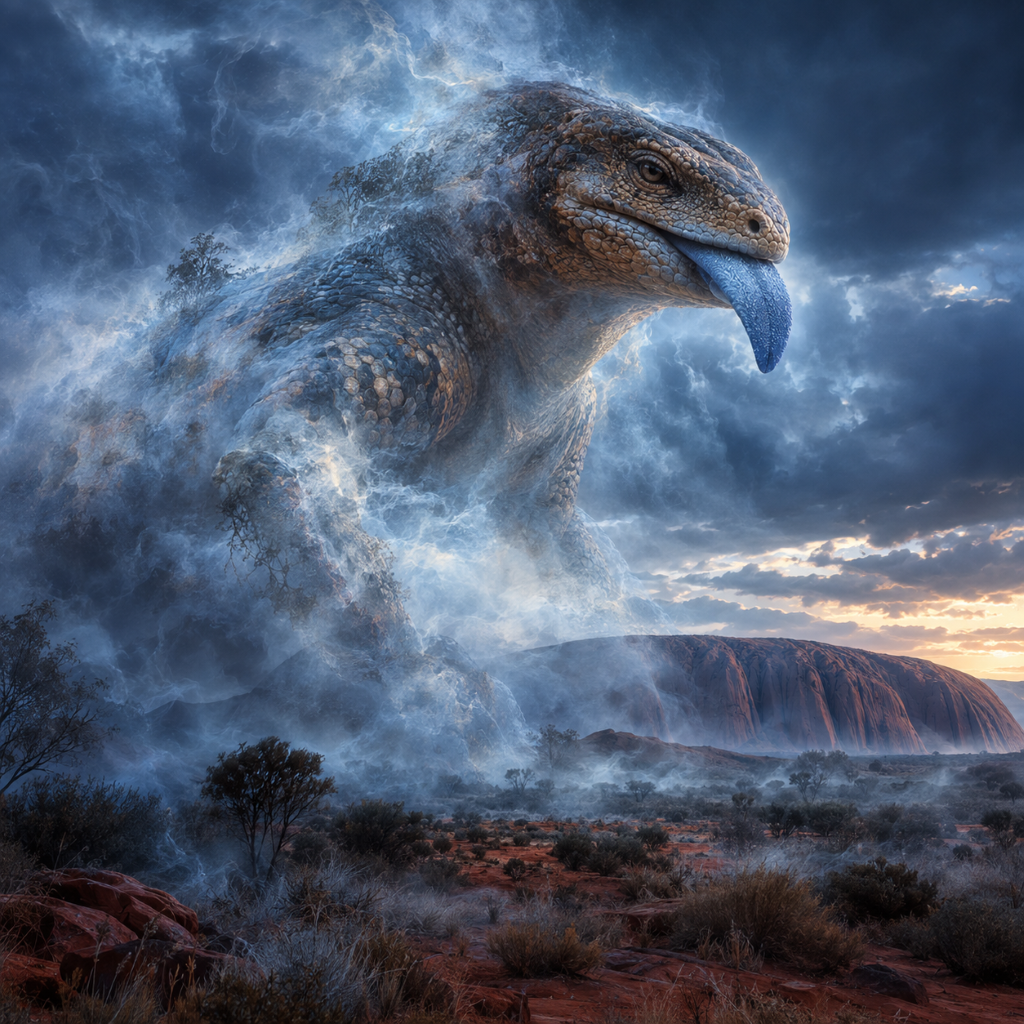
Lungkata is particularly associated with Uluṟu, where physical features of the landscape are understood as evidence of ancestral activity. Parks Australia identifies Lungkaṯa as the blue-tongued lizard man and points to footprints, fire marks and formations on the western side of Uluṟu as Tjukuritja, or physical evidence connected with ancestral activities. A dedicated Lungkaṯa walk allows visitors to encounter this cultural landscape while learning about the story in its proper geographical setting.
Public museum accounts also connect Lungkata with an ethical lesson concerning theft and dishonesty. However, the full Tjukurpa is culturally owned knowledge, and Parks Australia specifically asks visitors not to independently reproduce or retell these stories. Lungkata is therefore best approached as a living ancestral tradition rather than simply as a character from an ancient folktale.
Physical Traits
Lungkata is represented as a blue-tongued lizard or blue-tongued lizard man. The name itself is associated with the blue-tongued lizard in Pitjantjatjara and Yankunytjatjara terminology. Parks Australia identifies the centralian blue-tongue, Tiliqua multifasciata, and the western blue-tongue, Tiliqua occipitalis, as species commonly seen around Uluṟu-Kata Tjuṯa National Park.
The physical characteristics associated with the animal include a large head, long body, short legs and small feet. Its most recognisable feature is its broad blue tongue, which the lizard displays as a warning. Museum Victoria’s collection contains a Pitjantjatjara Lungkata figure carved from mulga wood and describes it as a stumpy-tailed blue-tongued lizard with a large head, short blunt tail, rough scales and a broad blue tongue. The carved figure has a rounded, stylised body with burnt horizontal markings.
These details should not be mistaken for a complete supernatural anatomy. Lungkata is an ancestral figure represented through an animal form, and different artistic traditions may emphasise different aspects of that form. The blue tongue and lizard identity are the most consistently documented physical associations.
Family
Authoritative public sources do not establish a detailed family tree for Lungkata. Parks Australia identifies him as an ancestral blue-tongued lizard man and places his story within the wider network of ancestral beings associated with Uluṟu. UNESCO similarly lists Lungkata alongside other major ancestral figures whose journeys and activities are understood as part of the cultural landscape.
Museum Victoria’s public account of the Lungkata story describes his encounter with two Panpanpalala, or crested bellbird, hunters, after Lungkata takes a wounded emu that they had hunted. The hunters are therefore characters connected to the episode, rather than confirmed relatives of Lungkata.
Some secondary sources attribute additional relatives to Lungkata, including a brother, but those relationships are not established in the principal public sources used here. They should therefore not be presented as definitive facts about the Pitjantjatjara Lungkata tradition.
The absence of a conventional genealogy is significant. Ancestral identity in Tjukurpa is not necessarily organised around the kind of family tree familiar from classical pantheons. Lungkata’s importance is instead strongly connected to Country, ancestral journeys, law and the lessons embedded in the landscape.
Other names
The most common English-language form is Lungkata, while Parks Australia uses the Pitjantjatjara spelling Lungkaṯa. The difference reflects Indigenous-language orthography rather than necessarily indicating different beings. Australian Government documents identify lungkata as the blue-tongued lizard, specifically Tiliqua multifasciata in the Uluṟu-Kata Tjuṯa context.
English descriptions commonly call Lungkata the “blue-tongued lizard man.” Parks Australia uses the expression “blue-tongued lizard man” and also describes him as a “cheeky” blue-tongue lizard man in its information about the Lungkaṯa walk.
The name should not automatically be conflated with every blue-tongued lizard ancestral story from elsewhere in Central Australia. Different Aboriginal language groups have their own cultural traditions, names and relationships with ancestral beings. Lungkata’s strongest documented association in this context is with the Anangu cultural landscape of Uluṟu and the Pitjantjatjara/Yankunytjatjara language tradition.
Powers and Abilities
Lungkata is not documented as possessing a conventional catalogue of magical powers. His significance comes from his status as an ancestral being and from the consequences of his actions within Tjukurpa. UNESCO explains that Anangu ancestral beings shaped the landscape and established behavioural principles that continue to guide life, while Parks Australia describes ancestral activities as leaving physical evidence in the Country.
One of Lungkata’s most important associations is fire. Australian Government material states that burning Country is part of Tjukurpa and specifically connects Lungkata with burning spinifex while travelling towards Uluṟu. The Lungkata Tjukurpa is also connected with Anangu knowledge of patch burning, in which small areas are burned to create a mosaic of regenerated and unburned Country. This traditional knowledge remains important to ecological management at Uluṟu-Kata Tjuṯa National Park.
Lungkata is also associated with moral instruction. Museum Victoria’s public account presents his actions as a warning about greed, theft and dishonesty. In this sense, his “power” is better understood as ancestral and cultural authority rather than supernatural ability in the conventional fantasy sense. His story connects behaviour, consequence, Country and law. The physical landscape is central to this role. Fire marks, tracks and rock formations around Uluṟu are interpreted within the Lungkaṯa Tjukurpa, allowing Country itself to function as a record of ancestral activity.
Modern Day Influence
Lungkata remains visible in contemporary cultural education, heritage interpretation, environmental management and Aboriginal art. At Uluṟu-Kata Tjuṯa National Park, visitors can follow the Lungkaṯa walk, where the landscape provides the setting for learning about the ancestral figure and the Tjukurpa associated with him. The park emphasises that these stories belong to the Country in which they occurred.
His connection with fire also has a practical contemporary dimension. Anangu knowledge of patch burning contributes to land management at the park, combining traditional knowledge with modern conservation methods. Australian Government sources describe this practice as an important ecological management tool, demonstrating that Tjukurpa encompasses knowledge that is both cultural and environmental.
Lungkata also continues to appear in Aboriginal art and material culture. Museum Victoria’s collection includes a carved Lungkata figure from the Pitjantjatjara tradition, while the National Gallery of Victoria documents the continuing presence of Lungkata imagery within Western Desert art.
The most important modern consideration, however, is cultural respect. Parks Australia states that Tjukurpa contains knowledge that is carefully passed on and that some information is restricted to people with the appropriate cultural rights. It specifically asks visitors not to replicate or retell Tjukurpa stories without permission. Lungkata therefore remains more than a mythological character: he is part of a living cultural system in which Country, law, knowledge and responsibility remain connected.
Related Images
Source
Australian Government, Department of Agriculture, Water and the Environment. (n.d.). Tjukurpa.
https://www.agriculture.gov.au/sites/default/files/documents/uktnp-a4factsheet-tjukurpa-small.pdf
Australian Government, Department of Climate Change, Energy, the Environment and Water. (n.d.). Uluru. https://www.dcceew.gov.au/parks-heritage/heritage/places/world/uluru
Director of National Parks. (2021). Uluṟu-Kata Tjuṯa National Park management plan 2021. https://www.dcceew.gov.au/sites/default/files/documents/uluru-kata_tjuta-national-park-management-plan-2021.pdf
Museum Victoria. (2023). Lungkata: Animal figure. Pitjantjatjara, Mulga Park, Desert Central, South Australia, Australia, c. 1965. https://collections.museumsvictoria.com.au/items/241760
Parks Australia. (2023, January 4). Blue tongue lizard. Uluṟu-Kata Tjuṯa National Park. https://uluru.gov.au/discover/nature/animals/reptiles/blue-tongue-lizard/
Parks Australia. (2025, June 4). The Lungkaṯa story. Uluṟu-Kata Tjuṯa National Park. https://uluru.gov.au/discover/culture/stories/lungkata-story/
United Nations Educational, Scientific and Cultural Organization. (2003). Section II: Periodic report on the state of conservation of Uluru-Kata Tjuta National Park, Australia. https://whc.unesco.org/document/162440
Watkins, J. (n.d.). Joe Watkins, PhD, National Park Service. National Park Service. https://www.nps.gov/subjects/tek/joe-watkins-phd-national-park-service.htm
Frequently Asked Questions
Who is Lungkata in Pitjantjatjara mythology?
Lungkata is a blue-tongued lizard ancestral being in Pitjantjatjara Tjukurpa, closely connected with Uluṟu, Country, ancestral law and traditional fire knowledge.
What animal is Lungkata associated with?
Lungkata is associated with the blue-tongued lizard, particularly the centralian blue-tongue, Tiliqua multifasciata, found around the Uluṟu region.
What is Lungkata known for?
Lungkata is known for his connection with Uluṟu, fire and Tjukurpa teachings concerning behaviour, while his story also forms part of Anangu knowledge of Country.
Where is Lungkata's story connected to?
Lungkata’s Tjukurpa is strongly connected with Uluṟu, particularly its western face, where physical features are understood as evidence of ancestral activity.
What does Lungkata represent?
Lungkata represents an ancestral relationship between people, Country, law and fire. His Tjukurpa also communicates lessons about conduct and responsibility.


