


Leza : The Bemba Sky God and Creator Deity
Listen
At a glance
| Description | |
|---|---|
| Origin | Bemba Mythology |
| Classification | Gods |
| Family Members | N/A |
| Region | Zambia |
| Associated With | Creation, Sky, Rain, Thunder, Fertility, Moral Order |
The Mythlok Perspective
In Mythlok’s perspective, Leza represents the archetype of the distant yet sustaining sky father found across cultures. His power lies not in dramatic mythic battles but in elemental authority over rain and moral balance. Unlike pantheon-based systems, Leza’s singularity mirrors the streamlined cosmology of many African traditions. Comparable to Nyambe among the Lozi or Nzambi in Central Africa, and even conceptually parallel to high sky gods like Odin in his cosmic aspect, Leza embodies transcendence without anthropomorphic excess. His abstraction reinforces the idea that divinity can be vast, invisible, and deeply ecological.
Leza
Introduction
Leza is the supreme creator god in the spiritual tradition of the Bemba people of Zambia. Among the Bemba, Leza is not simply a distant sky figure but the ultimate source of life, rain, fertility, and moral order. His name carries immense weight in central African cosmology, where he stands above ancestral spirits and local powers as the singular high god.
The Bemba are a Bantu-speaking people whose religious worldview emphasizes harmony between humanity, nature, and the spiritual realm. Within this framework, Leza occupies the highest position. He is regarded as omnipotent and omniscient, controlling thunder, rainfall, fertility in men and women, and the unseen forces that shape destiny. Storms rolling across the Zambian sky are often interpreted as signs of his presence.
Unlike ancestral spirits known as mizimu or mipashi, Leza remains transcendent. He does not dwell among humans or operate through constant intervention. Instead, he sustains the universe from above, maintaining cosmic balance and moral law. For the Bemba, Leza is both the beginning of existence and the guardian of order.
Physical Traits
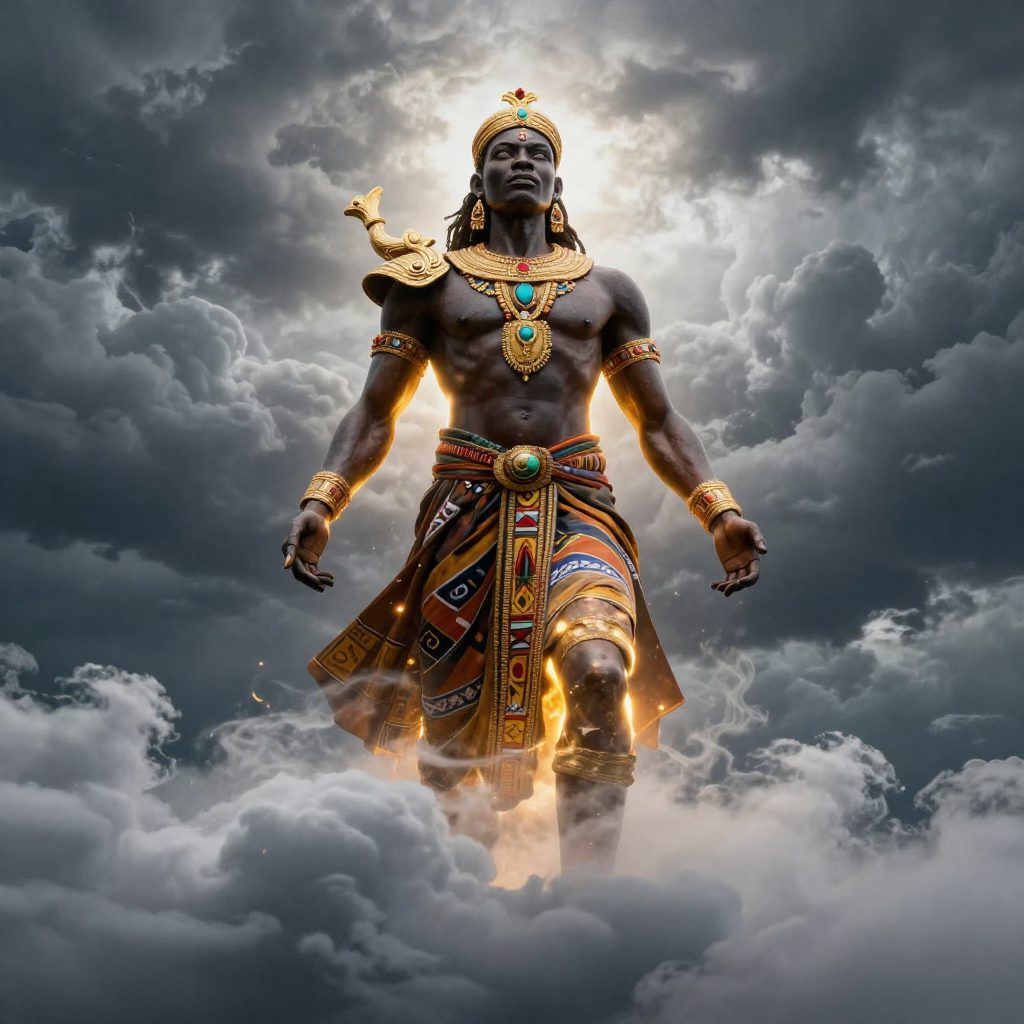
Leza does not possess a detailed physical description in Bemba belief. He is not imagined as a god with a defined face, body, or weapon. Instead, he is understood as a formless and radiant presence associated with the sky.
This absence of anthropomorphic imagery reflects his transcendence. Leza is experienced through natural phenomena such as thunder, lightning, and rainfall rather than through visual representation. The sky itself becomes his symbolic domain, vast and unreachable.
In some related Bantu traditions across central and southern Africa, supreme sky gods may be described in more figurative terms, occasionally linked to serpentine imagery or luminous celestial forms. However, Bemba sources emphasize that Leza exists beyond physical limitation. His power lies in his invisibility and omnipresence, reinforcing his status as an all-encompassing creator rather than a localized deity.
Family
Bemba cosmology does not assign Leza a divine family. He is not portrayed with a consort, children, or rival siblings. Unlike mythologies structured around complex pantheons, Leza stands alone as the singular origin of creation.
This theological structure highlights his independence and supremacy. While ancestral spirits play an important role in everyday spiritual life, they are not considered his equals or offspring in a divine hierarchy. Instead, they function as intermediaries within the human lineage.
Leza created the world and humanity but remains above genealogical narratives. Some traditions among neighboring Bantu groups include myths about primordial humans or ancestral founders, yet these figures are separate from Leza himself. His singularity reinforces the idea that ultimate authority flows from one supreme source.
Other names
Leza is also commonly spelled Lesa, a phonetic variation found in several Bantu languages. Across Zambia and parts of Zimbabwe, Lesa is widely used to refer to the supreme god.
In broader Bantu cosmology, parallels appear in names such as Nyambe and Nzambi. These figures share characteristics with Leza as sky-based creator gods who govern rain, morality, and life itself. While each culture preserves its own narrative traditions, the underlying archetype of a high god residing in the heavens remains consistent.
The continuity of these names across regions reflects shared linguistic and cultural roots among Bantu-speaking communities. Though local myths differ, the concept of a supreme sky creator resonates across central and southern Africa.
Powers and Abilities
Leza’s authority extends over creation, weather, fertility, and moral law. As the creator god, he brought the world and humanity into existence. His dominion over rain is especially significant in agrarian societies where survival depends on seasonal cycles. Rainfall is not merely a weather event but a direct expression of divine will.
Thunder and lightning are also associated with Leza’s presence. Storms serve as reminders of cosmic authority and moral accountability. While Leza is generally perceived as compassionate and just, natural disturbances reinforce the idea that balance must be maintained between humanity and the divine order.
Fertility is another domain under Leza’s control. He governs the continuity of life, ensuring both agricultural abundance and human reproduction. In this sense, Leza is the life-giver whose power sustains communities across generations.
Certain myths from related Bantu traditions describe Leza as a teacher who once imparted knowledge to humanity before ascending permanently to the sky. In some stories, he climbed to heaven using a spider’s web after instructing humans in proper worship and survival skills. Though distant now, his foundational role as provider and instructor remains central to his identity.
Modern Day Influence
Leza continues to shape spiritual consciousness in Zambia today. Although Christianity spread widely during colonial and missionary periods, many Bemba people integrated the concept of Leza into Christian theology. The name Lesa is frequently used in Bible translations to refer to the Christian God, demonstrating a powerful example of religious syncretism.
This blending did not erase traditional beliefs but reshaped them. Leza’s identity as a heavenly father aligned naturally with Christian imagery, allowing continuity rather than displacement. Movements such as the Lumpa Church in the mid-twentieth century combined prophetic Christianity with indigenous spiritual structures, further illustrating this fusion.
In contemporary cultural life, Leza remains embedded in ceremonies, especially those connected to chieftainship and ancestral continuity. Succession rituals often acknowledge the supreme god as the ultimate source of authority.
Philosophically, Leza represents harmony between humanity and the environment. His control over rain and fertility reinforces ecological awareness rooted in spiritual responsibility. Even in urban settings, the invocation of Lesa in daily language reflects enduring reverence.
Leza’s legacy endures not only as a theological concept but as a cultural foundation for identity, morality, and connection to the land.
Related Images

Source
Callaway, H. (1868). The religious system of the Amazulu. J.A. Bright.
Frank, A. (n.d.). MYTH AND RITUAL, DIVINITY AND AUTHORITY IN BEMBA TRADITION. Rice University Repository. https://repository.rice.edu/items/9f389b8b-e6f5-462f-ade2-e6c0b09db2ec
McDermott, C. (1930). Myths and legends of the Bantu. Sacred Texts. https://sacred-texts.com/afr/mlb/mlb05.htm
Mukuka, J. (2022). Ishita – Atemporality in Bemba Eco-existentialism. Zambian Scholarship.
https://scholarship.law.cornell.edu/cgi/viewcontent.cgi?article=1078&context=zssj
Roberts, R. (2018). Bemba. Encyclopedia.com. https://www.encyclopedia.com/social-sciences-and-law/anthropology-and-archaeology/people/bemba
Mbiti, J. S. (1990). African Religions and Philosophy (2nd ed.). Oxford: Heinemann.
Tempels, P. (1959). Bantu Philosophy. Paris: Présence Africaine.
Tylor, E. B. (1920). Primitive Culture: Researches into the Development of Mythology, Philosophy, Religion, Language, Art, and Custom. London: John Murray.
Frequently Asked Questions
Who is Leza in African mythology?
Leza is the supreme creator god of the Bemba people of Zambia, associated with the sky, rain, fertility, and moral authority.
Is Leza still worshipped today?
Leza remains spiritually significant, often integrated into Christian practice in Zambia where the name Lesa is used for God.
Is Leza the same as Lesa?
Yes, Lesa is a common phonetic variation of Leza used in Bantu languages across Zambia and neighboring regions.
What powers does Leza have?
Leza controls rain, thunder, fertility, and creation, and is regarded as the ultimate moral authority in Bemba belief.
Does Leza have a family in mythology?
No, Bemba tradition presents Leza as a singular, self-existent deity without a divine family structure.
