


Kuutkh : The Raven Creator of Chukchi Tradition
At a glance
| Description | |
|---|---|
| Origin | Chukchi Mythology |
| Classification | Gods |
| Family Members | N/A |
| Region | Russia |
| Associated With | Creation |
Mythlok Perspective
In Mythlok’s Perspective, Kuutkh is compelling because his mythology presents creation as something shaped by intelligence, mischief and unpredictability rather than absolute order. Like Raven in the Indigenous mythologies of the Pacific Northwest, Kuutkh combines the roles of creator, culture hero and trickster, using cunning to transform the world and secure what humans need. Yet Kuutkh’s stories remain distinctly rooted in the landscapes and traditions of northeastern Siberia. That combination makes him more complex than a simple creator deity: he creates, disrupts and adapts, often blurring the line between wisdom and foolishness.
Kuutkh
Introduction
Kuutkh, also written as Kutkh or Kutkha, is a powerful Raven culture hero found in the traditional narratives of northeastern Siberia, particularly among the Itelmen and Koryak peoples of Kamchatka. Related Raven traditions are also found among the Chukchi and other Indigenous peoples of the region. His stories combine creation, transformation, mischief, survival and the origins of important aspects of human life.
Rather than behaving like a distant, all-powerful deity, Kuutkh is a remarkably human-like supernatural figure. He can be clever, generous, selfish, foolish and unpredictable, sometimes within the same story. This combination is central to his character. His actions may create something essential to life, but they can also produce disorder or unintended consequences.
Kuutkh belongs to a wider circumpolar tradition in which the Raven is associated with intelligence, adaptability and the ability to move between different parts of the world. In Kamchatkan traditions, his adventures explain elements of the landscape, the availability of light and fire, relationships between humans and animals, and aspects of everyday life. His stories therefore function as both mythology and cultural knowledge, preserving ideas about how the world came to be and how people should live within it.
Physical Traits
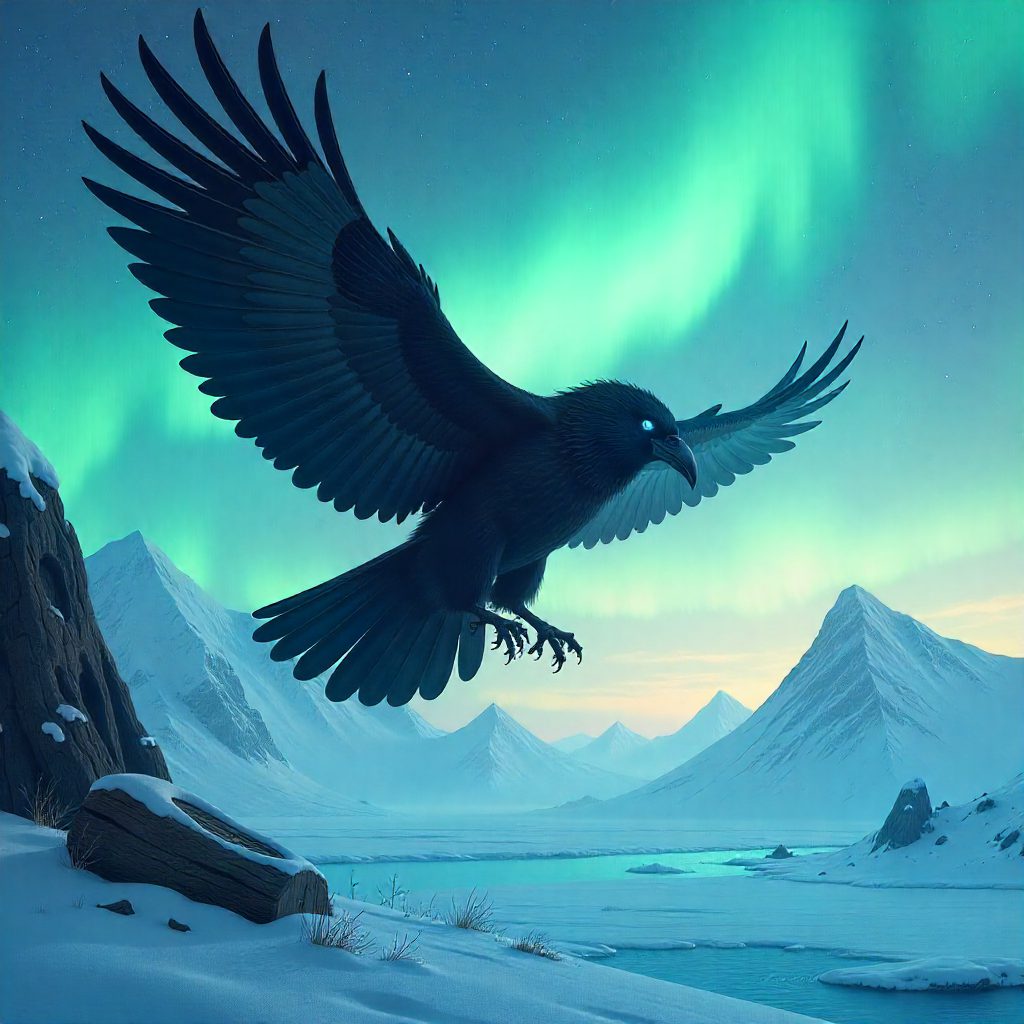
Kuutkh is primarily represented as a Raven, although the precise form and characteristics attributed to him differ between individual traditions and stories. The bird is usually associated with the dark plumage, sharp beak and powerful wings of the common Raven, but his supernatural nature allows him to behave in ways far beyond those of an ordinary bird.
In some narratives, Kuutkh interacts with humans and other supernatural beings in an anthropomorphic manner, blurring the boundary between animal and human. This ability is important because Raven figures in northeastern Siberian mythology are not simply animals elevated into gods. They occupy an intermediate position between the natural and supernatural worlds.
The Raven’s intelligence is particularly significant. Kuutkh relies on cleverness as much as supernatural power, using deception, disguise and improvisation to overcome obstacles. His physical actions can also have enormous consequences. In different stories, the actions of Raven help explain geographical features, natural phenomena and the distribution of living things. This mixture of an ordinary animal form with extraordinary abilities makes Kuutkh a classic culture hero. He is recognisably a Raven, yet his behaviour reflects human strengths and weaknesses.
Family
Kuutkh’s family varies considerably according to the tradition and individual narrative in which he appears. The best-known family relationships belong particularly to the Itelmen Raven cycle from Kamchatka.
Miti is traditionally presented as Kuutkh’s wife in several stories. Their relationship appears in narratives dealing with domestic life, work, food, travel and conflict, giving the supernatural Raven a surprisingly familiar human dimension. Stories involving Kuutkh and Miti are not simply accounts of cosmic creation; they can also explore relationships, responsibilities and everyday behaviour.
Their son Ememkut, also appearing under variant forms of the name, is another important figure in traditions connected with the Raven cycle. Other stories involve Kuutkh interacting with animals, spirits and supernatural adversaries rather than concentrating on a fixed divine family.
This flexibility reflects the nature of oral mythology. There is no single canonical genealogy for Kuutkh comparable to the family trees found in some classical mythological traditions. Different communities and storytellers preserved different episodes, relationships and names. His family should therefore be understood as part of a changing narrative tradition rather than a single universally accepted lineage.
Other Names
Kuutkh is known by several names and spellings, reflecting the different languages and oral traditions of northeastern Siberia. Kutkh and Kutkha are particularly associated with the Itelmen traditions of Kamchatka, where the Raven occupies a central place in traditional narratives.
Among the Koryaks, the Raven culture hero is associated with names such as Quikinna’qu and Kuykynnyaku, depending on the source and transliteration. These figures share many characteristics with the wider Raven tradition but should not automatically be treated as simple translations of the name Kuutkh.
Chukchi traditions also contain important Raven stories. However, the Raven does not consistently appear under the name Kuutkh in Chukchi narratives. This distinction is useful when studying the mythology of northeastern Siberia because the similarities between these traditions coexist with significant differences in names, characters and individual stories.
The different names demonstrate how oral traditions developed across neighbouring Indigenous communities while retaining recurring themes surrounding Raven, creation, intelligence and transformation.
Powers and Abilities
Kuutkh’s abilities are closely connected with his role as creator, trickster and culture hero. His most important power is his ability to transform the world through his actions. In different stories, Raven participates in bringing order to the landscape and establishing conditions necessary for human life.
One recurring theme is the acquisition or distribution of light. Raven stories from the region describe the release or acquisition of light, connecting Kuutkh with the transformation of a world in which essential natural resources are not yet freely available. Fire and fresh water also appear within the wider Raven cycle, along with knowledge and practical skills important to human communities.
Kuutkh’s intelligence is as important as his supernatural abilities. He deceives opponents, outwits animals and spirits, and uses cunning to achieve goals that cannot be accomplished through physical strength alone. His trickery can benefit humans, but his motives are not always noble. Greed, appetite, impatience and foolishness are recurring characteristics of the Raven culture hero.
His ability to cross boundaries is another defining feature. Kuutkh can operate between the worlds of humans, animals and supernatural beings, allowing his stories to connect different aspects of existence. Creation therefore happens through encounters, mistakes, conflicts and acts of ingenuity rather than through a single act of deliberate divine design.
This makes Kuutkh fundamentally different from the image of a perfect creator. His world is created through experimentation and disruption, reflecting a worldview in which order and disorder exist together.
Modern Day Influences
Kuutkh remains an important subject in the preservation and study of Indigenous traditions from Kamchatka and northeastern Siberia. His stories have been recorded by ethnographers and folklorists since the eighteenth and nineteenth centuries, providing valuable evidence of Itelmen, Koryak and related oral traditions.
Raven stories also continue to influence Indigenous artistic traditions. Representations of Kuutkh and other Raven figures appear in carvings, decorative arts and contemporary cultural objects. In Kamchatka, Raven imagery has also become part of the presentation of regional Indigenous heritage to wider audiences.
For researchers of comparative mythology, Kuutkh is particularly significant because his stories belong to a broader network of Raven traditions extending across northeastern Asia and into North America. Similarities between these traditions include Raven’s association with creation, light, trickery and the acquisition of resources. At the same time, each cultural tradition has developed its own characters, names and narratives.
Kuutkh therefore remains more than a character from an old collection of folktales. His stories preserve a distinctive Indigenous understanding of the relationship between humans, animals, landscape and the supernatural. Through the Raven’s adventures, creation becomes something dynamic and unpredictable, shaped by intelligence, mistakes and adaptation. That combination continues to make Kuutkh one of the most distinctive culture heroes of northeastern Siberian mythology.
Related Images

Source
Bogoras, W. (1909). Chukchee mythology. E. J. Brill. https://www.scribd.com/document/47429463/Bogoras-Waldemar-Chukchee-Mythology
Godchecker. (2023). KUTKH – the Siberian Trickster God. https://www.godchecker.com/siberian-mythology/KUTKH/
Kutkh. (2007). Wikipedia. https://en.wikipedia.org/wiki/Kutkh
Living wisdom of the Far North: Tales and legends from Chukotka and Alaska. (n.d.). Arctic Institute of the U.S. https://www.arlis.org/docs/vol1/P/760199228.pdf
Tenhunen, U. (2011). A critical review of the traditional narratives of Chukotka and Kamchatka. Academia.edu. https://www.academia.edu/116620604/A_Critical_Review_of_the_Traditional_Narratives_of_Chukotka_and_Kamchatka
Bogoras, W. (1904–1909). The Chukchee. Publications of the American Museum of Natural History, Memoir of the Jesup North Pacific Expedition. New York: G.E. Stechert.
Krupnik, I. (1993). Arctic Adaptations: Native Whalers and Reindeer Herders of Northern Eurasia. Hanover: University Press of New England.
Jochelson, W. (1905). The Koryak. Memoirs of the American Museum of Natural History. Leiden: Brill.
Vakhtin, N. (2001). Native Peoples of the Russian Far North. London: Routledge.
Balzer, M. M. (1999). The Tenacity of Ethnicity: A Siberian Saga in Global Perspective. Princeton: Princeton University Press.
Frequently Asked Questions
Who is Kuutkh in Chukchi mythology?
Why is Kuutkh depicted as a Raven?
The Raven represents intelligence, adaptability, and the ability to move between the physical and spiritual worlds, making it ideal for a creator-trickster figure.
What powers does Kuutkh possess?
He can shapeshift, create land, command elements, teach humans essential skills, and travel between realms.
Is Kuutkh related to the Raven figures of Alaska?
Yes, they share thematic parallels, but Kuutkh is specifically rooted in Siberian Indigenous cosmology.
Does Kuutkh still influence modern culture?
His image appears in Arctic art, folklore studies, museum exhibits, and contemporary retellings that preserve Indigenous identity.


