


Kuna : The Powerful Water Spirit of Hawaiian Mythology
At a glance
| Description | |
|---|---|
| Origin | Hawaiian Mythology |
| Classification | Spirits |
| Family Members | N/A |
| Region | Hawaii |
| Associated With | Water, Wailuku River |
The Mythlok Perspective
In Mythlok’s Perspective, Kuna demonstrates how mythology transforms a familiar landscape into a place of supernatural meaning. Like the Naga traditions of South Asia, the Hawaiian moʻo connects reptilian beings with powerful waters, yet Kuna’s story remains rooted in the Wailuku River and his conflict with Māui. The comparison reveals a shared human tendency to personify nature without making these beings identical.
Kuna
Introduction
Kuna is a powerful supernatural being in Hawaiian mythology, remembered for his conflict with Māui near the Wailuku River in Hilo, on the island of Hawaiʻi. Described as a moʻo, a supernatural reptilian being associated with water, Kuna represents the dangerous forces that can emerge from the natural world. His story brings together supernatural power, family loyalty and the struggle between a destructive creature and one of Polynesia’s best-known culture heroes.
The legend appears in W. D. Westervelt’s Legends of Ma-Ui, a Demi God of Polynesia and of His Mother Hina, published in 1910. In this account, Kuna threatens Hina, Māui’s mother, by obstructing the river and causing its waters to rise towards her dwelling. When Hina faces danger, Māui intervenes, setting the stage for a dramatic confrontation between the hero and the supernatural creature.
Unlike the dragons familiar from European folklore, Kuna belongs to the Hawaiian tradition of moʻo. These beings are commonly associated with freshwater environments, pools, streams and other significant locations. Their stories often connect supernatural activity with particular landscapes, giving natural features a deeper cultural meaning.
Kuna’s legend is especially tied to the Wailuku River, where his actions and Māui’s response become part of the explanation for the surrounding terrain. His character embodies the threatening side of the natural world, while his encounter with Māui demonstrates the courage and ingenuity expected of a legendary hero.
Physical Traits
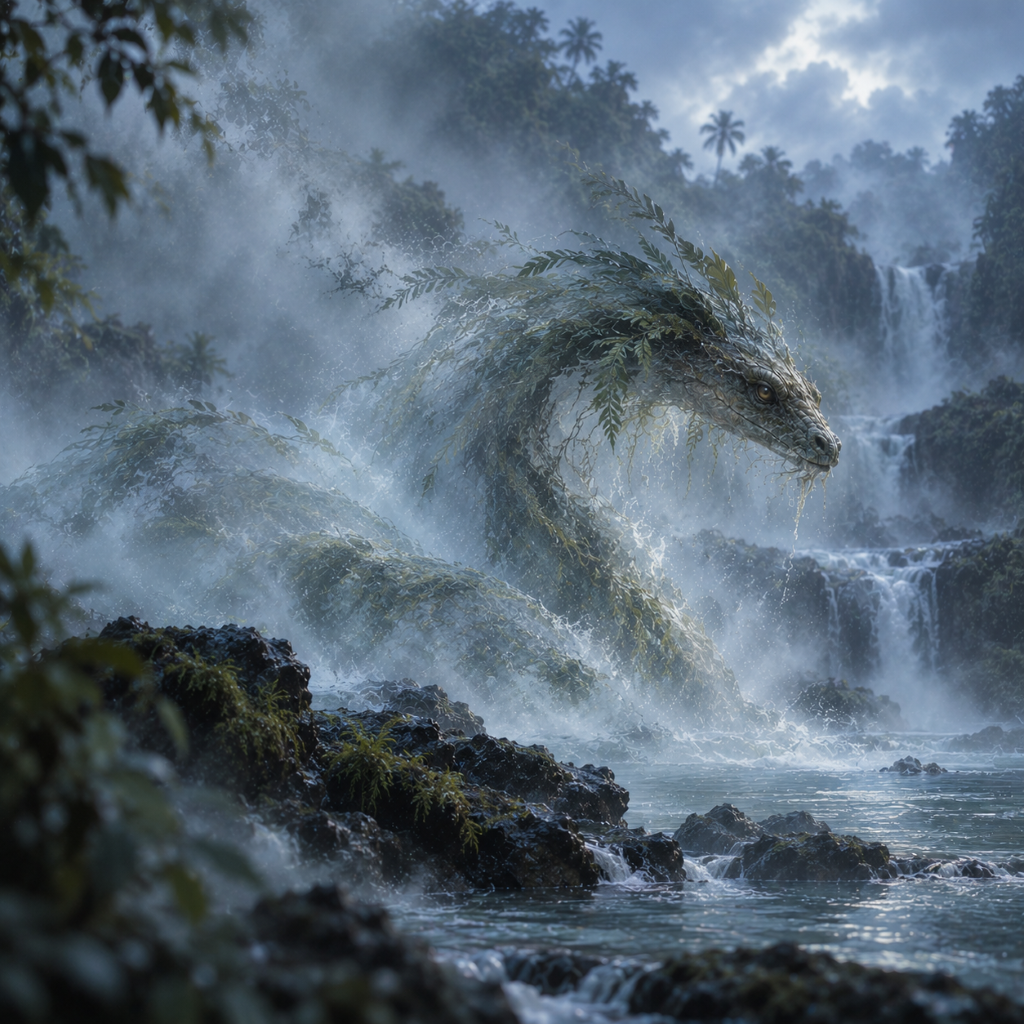
Kuna is portrayed as a formidable, dragon-like reptilian being belonging to the Hawaiian tradition of moʻo. His appearance distinguishes him from ordinary animals and gives him a supernatural presence suited to his role in the Wailuku River legend.
The moʻo are often imagined as powerful lizard-like creatures capable of inhabiting or influencing aquatic environments. Depending on the story, they may appear as dangerous adversaries, guardians of particular places or beings with connections to supernatural forces. Kuna represents the more threatening aspect of this tradition, using his association with the river to endanger Hina.
His surroundings are central to his identity. Deep pools, rocky riverbanks and hidden places along the water provide the setting for his confrontation with Māui. Rather than existing in a distant supernatural realm, Kuna belongs to a recognisable Hawaiian landscape where water and stone become part of the unfolding story. Historical accounts do not establish a single detailed description of his colour, precise dimensions or anatomical features. Nevertheless, his traditional reptilian form provides a clear foundation for understanding his appearance.
Kuna is best envisioned as a powerful Hawaiian moʻo with a commanding presence, a strong reptilian body and a natural affinity for freshwater environments. His appearance should evoke the mystery of the river and the supernatural character of Hawaiian storytelling rather than the armour, wings and exaggerated features of European fantasy dragons.
Family
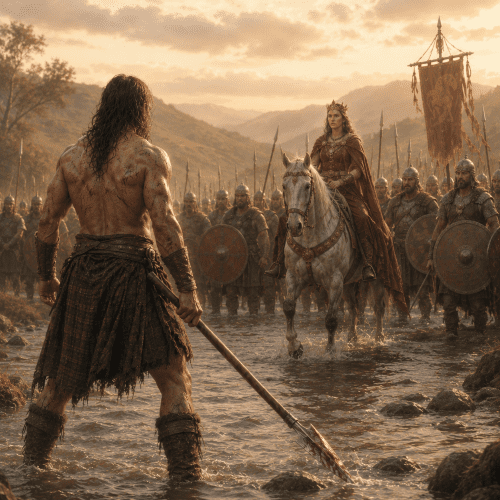
Kuna’s story is closely connected with Hina and her son, Māui. In the Hawaiian narrative recorded by Westervelt, Hina becomes the target of the supernatural creature’s hostility, and her safety drives Māui into action. Hina occupies an important position in Polynesian traditions, where she appears in different stories as a mother, a powerful female figure or a participant in supernatural encounters. In Kuna’s Hawaiian legend, her relationship with Māui establishes the emotional centre of the conflict. Māui does not confront Kuna merely to demonstrate his strength; he acts to protect his mother from a dangerous adversary.
Kuna, meanwhile, is remembered through his opposition to Hina and Māui rather than through an established genealogy of his own. His parents, siblings, descendants and spouse are not identified in the principal Hawaiian account. Other Polynesian stories feature supernatural beings named Tuna who become involved with women called Hina, Sina or Ina. Some of these narratives describe romantic relationships and connect the death of an eel with the origin of the coconut palm. These stories provide valuable comparisons within Polynesian mythology, but they belong to different regional traditions.
For the Hawaiian Kuna narrative, the essential relationships remain clear: Hina is the woman he threatens, and Māui is the hero who rises to confront him. Their conflict drives the legend and connects Kuna’s supernatural nature with the protection of family and the power of the natural world.
Other names
Kuna is the name associated with the supernatural creature in the Hawaiian Wailuku River narrative recorded by Westervelt. The same historical account also uses the form Moo-Kuna, connecting the figure with the wider category of Hawaiian moʻo. Kuna is the most appropriate name when discussing the Hawaiian character and his confrontation with Māui. It connects him directly with the river legend and distinguishes him from similar figures in other Pacific Island traditions.
Moo-Kuna appears in Westervelt’s account as a form associated with the creature. The element moʻo identifies the broader class of supernatural reptilian beings to which Kuna belongs. Tuna is a name found in several Polynesian traditions involving supernatural eels. Some historical comparative accounts connect Tuna with Kuna, drawing attention to similarities between stories about aquatic beings and Māui. However, Tuna also appears in independent regional narratives with different characteristics.
Tuna-roa belongs to particular Māori traditions involving a giant eel confronted by Māui. Although this figure shares narrative motifs with Kuna, the Māori setting and eel-like form distinguish it from the Hawaiian moʻo. These names reflect the interconnected storytelling traditions of the Pacific while preserving their regional identities. Within Hawaiian mythology, Kuna remains the most suitable name for the supernatural being associated with the Wailuku River.
Powers and Abilities
Kuna’s supernatural power becomes apparent through his ability to threaten Hina by interfering with the Wailuku River. In Westervelt’s account, he obstructs the water’s flow and causes it to rise towards her dwelling, transforming the river into a source of immediate danger. This ability makes Kuna more than a powerful reptilian creature. His actions turn the surrounding landscape into an instrument of destruction, demonstrating the influence supernatural beings can exert over the natural world in traditional Hawaiian narratives.
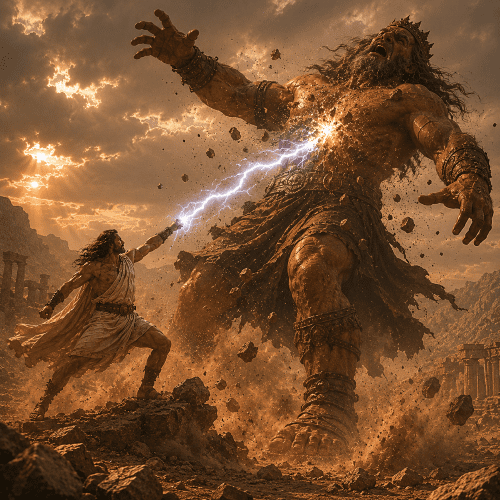
Māui responds with extraordinary strength and determination. He confronts the obstruction, works to release the river’s flow and pursues Kuna through the surrounding waters. Their struggle becomes the central event of the legend, linking the creature’s supernatural actions with the turbulent features of the river. Kuna’s association with water is therefore his defining characteristic. His power is expressed through obstruction, rising waters and the ability to threaten those who live near the river. These actions establish him as a formidable adversary whose presence creates both physical danger and supernatural tension.
The confrontation also reveals an important aspect of Māui’s character. His resourcefulness allows him to challenge a being whose power is closely connected to the environment itself. The encounter is not simply a contest of strength but a struggle to overcome a threat that has turned the natural world against Hina. Unlike some supernatural eel figures in other Polynesian traditions, Kuna’s Hawaiian story centres on his conflict with Māui and his influence over the river. His significance lies in this particular narrative rather than in a universal collection of powers attributed to every aquatic creature across Polynesia.
Modern Day Influence
Kuna remains an intriguing figure for readers exploring Hawaiian mythology, particularly the relationship between traditional stories and the natural landscape. His association with the Wailuku River gives the legend a geographical foundation, connecting supernatural events with a recognisable location near Hilo. One important English-language source is W. D. Westervelt’s Legends of Ma-Ui, a Demi God of Polynesia and of His Mother Hina, published in 1910. The collection preserves a historical retelling of Kuna’s confrontation with Māui and provides a starting point for exploring the character in published Hawaiian folklore.
The University of Hawaiʻi’s Hawaiian Legends Index also catalogues Kuna in connection with traditional narratives. Such collections help readers locate related stories and explore the ways Hawaiian mythology has been recorded and interpreted. Kuna’s story also offers a way to understand how Hawaiian traditions give meaning to rivers, pools and other natural features. In these narratives, the landscape is not simply a backdrop. It becomes an active part of the story, shaped by supernatural forces and the actions of legendary figures.
Modern popular culture has introduced Māui to international audiences through works such as Disney’s Moana. Although the film does not directly adapt Kuna’s legend, its popularity has encouraged wider interest in Polynesian characters and storytelling traditions. For contemporary readers, Kuna offers a more focused introduction to Hawaiian supernatural beings and their connection with particular environments. His legend brings together family protection, supernatural danger and the power of the natural world, preserving a distinctive story within the broader landscape of Polynesian mythology.
Related Images

Source
Beckwith, M. W. (1982). Hawaiian mythology. University of Hawaiʻi Press. (Original work published 1940).
Dixon, R. B. (1916). Oceanic mythology. Marshall Jones Company. https://sacred-texts.com/pac/om/om07.htm
Westervelt, W. D. (1910). Legends of Ma-Ui, a demi god of Polynesia, and of his mother Hina. Hawaiian Gazette Company. https://www.gutenberg.org/files/32601/32601-h/32601-h.htm
University of Hawaiʻi at Hilo Library. (n.d.). Hawaiian Legends Index. https://hilo.hawaii.edu/library/guides/hawaiian-collection/hawaiian-legends-index
Smith, J. (2016, December 2). How the story of Moana and Maui holds up against cultural truths. Smithsonian Magazine. https://www.smithsonianmag.com/smithsonian-institution/how-story-moana-and-maui-holds-against-cultural-truths-180961258/
Westervelt, W. D. (1910). Hina and the Wailuku River. In Legends of Ma-Ui, a demi god of Polynesia, and of his mother Hina. Sacred Texts. https://sacred-texts.com/pac/maui/maui16.htm
Westervelt, W. D. (1910). Maui and Tuna. In Legends of Ma-Ui, a demi god of Polynesia, and of his mother Hina. Project Gutenberg. https://www.gutenberg.org/files/32601/32601-h/32601-h.htm
“Humanity rising from the depths of brine”: An oceanic politics in Disney’s Moana. (2022). Studies in French Cinema. https://www.tandfonline.com/doi/full/10.1080/17400309.2022.2117494
Frequently Asked Questions
Who is Kuna in Hawaiian mythology?
Kuna is a supernatural moʻo associated with the Wailuku River near Hilo, Hawaiʻi. In a traditional narrative recorded by W. D. Westervelt, he threatens Hina and confronts her son, Māui.
Is Kuna a dragon or a spirit?
Kuna is a supernatural moʻo, a reptilian being in Hawaiian tradition. Although he is sometimes described as dragon-like, classifying him as a Hawaiian spirit better reflects his cultural context.
What are Kuna's powers in Hawaiian mythology?
Kuna uses supernatural force to obstruct the Wailuku River and threaten Hina. His actions create a dangerous situation that prompts Māui to intervene and confront him.
What is Kuna's relationship with Māui?
Kuna is Māui’s adversary in the Hawaiian Wailuku River legend. When Kuna threatens Hina, Māui intervenes to protect his mother, leading to a supernatural confrontation.
Is Kuna the same as Te Tuna in Māori mythology?
Kuna and Te Tuna share similarities in Polynesian storytelling, but they belong to distinct regional traditions. Kuna is a Hawaiian moʻo, while Māori stories describe Tuna as a supernatural eel.


