


Konde : The Ancestral King of the Lunda People
At a glance
| Description | |
|---|---|
| Origin | Lunda Mythology |
| Classification | Spirits |
| Family Members | Tianza Ngombe (Mother), Lueji (Daughter), Chinguli, Chinyama (Sons), |
| Region | Angola, Democratic Republic of Congo, Zambia |
| Associated With | Sacred kingship, Ancestral authority, Succession |
The Mythlok Perspective
In Mythlok’s Perspective, Konde represents a fascinating example of how leadership itself can become mythologized. Unlike warrior heroes or powerful gods, his significance comes from decisions that altered the course of history. His story highlights a common theme found across many cultures: the ancestor whose choices define the destiny of future generations. Similar to Kalala Ilunga in Central Africa or Romulus in Roman tradition, Konde serves as a bridge between history and legend. What makes him unique is that his legacy rests not on conquest but on succession, legitimacy, and the enduring power of ancestry to shape collective identity.
Konde
Introduction
Konde is one of the most important ancestral figures in Lunda tradition and occupies a central place in the origin stories of the Lunda people of present-day Angola, the Democratic Republic of Congo, and Zambia. Rather than being remembered as a god or supernatural creature, Konde is revered as a legendary ruler whose decisions shaped the political and cultural landscape of Central Africa for centuries.
The Lunda Kingdom became one of the most influential states in the region, and many of its royal traditions trace their origins to Konde. Oral histories describe him as a wise and respected leader whose reign was marked by justice, stability, and adherence to ancestral customs. His story survives through generations of storytelling and remains deeply intertwined with the identities of several Central African communities.
Konde is best known for passing the sacred Lukano bracelet, a symbol of royal authority, to his daughter Lueji instead of one of his sons. This decision triggered a succession dispute that ultimately led to the formation of new kingdoms and ethnic groups. As a result, Konde is remembered not only as a ruler but also as a foundational ancestor whose actions helped shape the history of the Lunda, Chokwe, Luvale, and related peoples.
Physical Traits
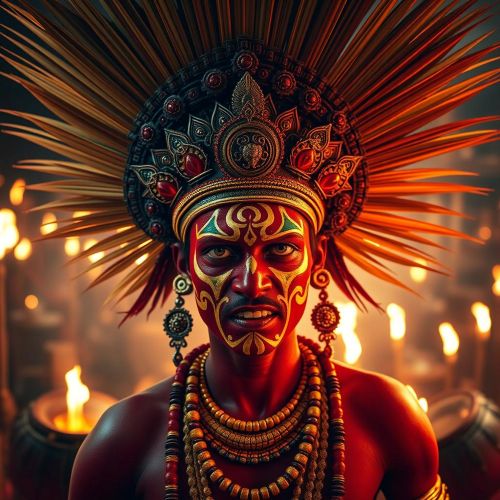
Unlike many mythological heroes whose appearances are described in detail, Konde’s physical characteristics are largely absent from surviving oral traditions. The focus of Lunda storytelling is usually on his authority, wisdom, and role in shaping society rather than on his outward appearance.
Some traditions describe him as having descended from the “white cloud,” a symbolic expression suggesting a celestial or spiritually significant origin. This imagery does not necessarily portray him as a supernatural being but instead emphasizes his elevated status and sacred connection to the ancestral world.
His identity was closely linked to the royal regalia he carried. The Lukano bracelet served as the visible representation of his authority and became one of the most important symbols of leadership within Lunda culture. Oral accounts also credit him with introducing distinctive forms of dress that helped define the identity of his people.
More than his physical form, Konde’s legacy is expressed through his reputation as a just ruler whose actions reflected wisdom, responsibility, and devotion to tradition. In this sense, his character became more important than any specific description of his appearance.
Family
Family relationships are at the heart of Konde’s story because they explain the origins of several important Central African peoples and dynasties. In some versions of the tradition, Konde is connected to Tianza Ngombe and the ancestral lineage of Yala Mwaku. While details vary between oral accounts, there is broad agreement that he belonged to a prestigious ancestral line that helped establish the authority of the Lunda rulers.
Konde is said to have had several children, including his daughter Lueji and his sons Chinguli and Chinyama. Other names associated with his descendants include Ndoji, Lukombo, and Kalumbu. Among all his children, Lueji became the most significant because she inherited the sacred Lukano bracelet and succeeded her father.
This choice was highly unusual in a society where male succession might have been expected. According to tradition, Konde selected Lueji because she best embodied the customs and values of the Lunda people. His decision angered some of his sons, particularly Chinguli and Chinyama, who eventually left and established separate political traditions.
These migrations became foundational narratives for neighboring groups, making Konde the common ancestor of multiple peoples across Central Africa. His family story therefore serves not only as a royal genealogy but also as an explanation for the region’s cultural diversity.
Other names
Konde appears under several names and variations depending on the oral tradition, language, and historical source being consulted. One of the most commonly cited forms is Nkunda Mateti, which some historians and tradition keepers consider the original version of the name. Variants such as Khonde Mateti and Konde Matete also appear in different accounts.
The name Kondi is occasionally found in literary and historical discussions of the Lunda Kingdom. Certain genealogical traditions connect him with Mwaku or Yala Mwaku, reflecting the complex nature of oral history and ancestral lineage in Central Africa.
Although the spellings and pronunciations differ, they generally refer to the same ancestral ruler whose authority established the foundations of the Lunda political system. These variations illustrate how oral traditions evolve while preserving the memory of an important cultural figure.
Powers and Abilities
Konde’s powers are primarily symbolic rather than magical. His importance comes from his role as an ancestral ruler whose authority carried spiritual and political significance. The greatest symbol of his power was the Lukano bracelet. Possession of this sacred object represented legitimate rule over the Lunda people and connected the ruler to ancestral authority. Through the Lukano, Konde became a source of political legitimacy that continued long after his lifetime.
Many traditions also associate him with a sacred origin linked to the heavens or the ancestral realm. This connection elevated his status and reinforced the belief that leadership was guided by spiritual forces rather than merely human ambition.
Konde demonstrated exceptional wisdom through his decision to appoint Lueji as his successor. Whether viewed as a political strategy or a spiritual choice, this act transformed the future of the Lunda world. His influence extended beyond his own reign because the descendants of his children became founders of major ethnic and political communities. In this way, Konde’s greatest power was not supernatural strength but the ability to shape history, establish legitimacy, and create enduring cultural identities that survived for generations.
Modern Day Influence
Konde remains an important figure in the cultural memory of the Lunda people and neighboring communities. His legacy continues through oral traditions, ceremonies, and historical narratives that celebrate the origins of Central African kingdoms. Many Lunda, Chokwe, Luvale, and Luchazi communities trace aspects of their royal heritage to Konde and his descendants. This ancestral connection remains an important source of identity and historical continuity.
Traditional ceremonies often emphasize respect for ancestors and the preservation of customs linked to the founding generations. Through these practices, Konde continues to occupy a symbolic place within community life. His influence can also be seen in the enduring prestige of traditional leadership institutions. The title of Mwant Yav, which emerged through the line of Lueji and Chibinda Ilunga, remains one of the most respected traditional authorities in the region.
Beyond cultural traditions, Konde’s story has inspired literature, historical studies, dance performances, and artistic works exploring the origins of Central African states. The continued retelling of his life demonstrates how ancestral figures can remain relevant long after the societies that first celebrated them have changed. Today, Konde is remembered as a symbol of leadership, ancestry, and unity whose decisions helped shape the history of an entire region.
Related Images





Source
Belcher, S. (2004). African myths of origin. Harvard University Press. Retrieved from https://bookreadfree.com/360716/8872001
Biebuyck, D. P. (2019). Cokwe. Daniel P. Biebuyck Manuscripts. Retrieved from https://danielbiebuyck.com/manuscripts/cockwe
Metropolitan Museum of Art. (2003). Kingdoms of the savanna: The Luba and Lunda empires. Heilbrunn Timeline of Art History. Retrieved from https://www.metmuseum.org/essays/kingdoms-of-the-savanna-the-luba-and-lunda-empires
National Museum of African Art. (n.d.). Spirits. Smithsonian Institution. Retrieved from https://africa.si.edu/exhibits/spirits/cho.htm
Women’s History Museum of Zambia. (2018). Lueji wa Nkonde. Retrieved from https://www.whmzambia.org/lueji-wa-nkonde
Vansina, J. (1980). Owners of the land and Lunda lords: Colonial chiefs in the Belgian Congo and Northern Rhodesia. Journal of African History, 21(3), 309-348. Retrieved from https://www.jstor.org/stable/3097484
Wikipedia. (2007). Lunda people. Retrieved from https://en.wikipedia.org/wiki/Lunda_people
Wikipedia. (2006). Lunda Empire. Retrieved from https://en.wikipedia.org/wiki/Lunda_Empire
Frequently Asked Questions
Who was Konde in Lunda mythology?
Konde was a legendary ancestral ruler of the Lunda people whose leadership and succession decisions shaped several Central African kingdoms.
Was Konde a god or a king?
Konde is generally remembered as a legendary king and cultural ancestor rather than a deity.
What is the Lukano bracelet?
The Lukano is a sacred royal bracelet that symbolizes legitimate authority and kingship in Lunda tradition.
Why is Lueji important in Konde's story?
Lueji inherited the Lukano bracelet from Konde and became his successor, a decision that transformed Lunda history.
How does Konde influence modern Lunda culture?
Konde remains important through oral traditions, ancestral ceremonies, royal genealogies, and the cultural identities of several Central African peoples.


