


Gitche Manitou : The Great Spirit of the Cree People
At a glance
| Description | |
|---|---|
| Origin | Cree Mythology |
| Classification | Spirits |
| Family Members | N/A |
| Region | United States of America |
| Associated With | Creation |
Mythlok Perspective
In Mythlok’s Perspective, Gitche Manitou represents a different understanding of spiritual power from anthropomorphic creator gods such as Zeus or Odin. Rather than focusing on a clearly defined divine personality, the concept of the Great Spirit is associated with creation, spiritual presence and humanity’s relationship with the world. This distinction makes Gitche Manitou important for understanding Cree and broader Algonquian spiritual traditions, where the sacred cannot always be separated from the natural world or reduced to a single, universal image of divinity.
Gitche Manitou
Introduction
Gitche Manitou, commonly translated as the Great Spirit, is a sacred concept associated with Cree and other Algonquian-speaking Indigenous peoples of North America. The name represents a powerful spiritual presence and, in some traditions, the Creator responsible for the existence of the world. Although often described as a supreme spiritual being, Gitche Manitou does not have one universally accepted definition across every Indigenous community that uses the term.
The word manitou refers broadly to spiritual power or presence in several Algonquian languages. The addition of gitche, meaning great or powerful, conveys the exceptional significance of this spiritual force. For many Indigenous communities, the concept reflects a worldview in which human beings exist within a larger network of relationships involving animals, plants, land, water, and the spirit world.
Gitche Manitou is also significant in the history of Indigenous-language Christianity. Missionaries adopted forms of the name when translating the Christian concept of God into Indigenous languages. This usage introduced another layer of meaning, bringing Indigenous spiritual vocabulary into contact with European religious traditions. However, the Christian use of the term should not be confused with every traditional Indigenous understanding of the Great Spirit.
Understanding Gitche Manitou therefore requires attention to both its spiritual significance and its cultural diversity. Rather than treating it as a single deity with an identical role throughout North America, it is more accurate to recognise a concept whose interpretation depends on the language, community, and tradition in which it appears.
Physical Traits
Gitche Manitou does not have one universally established physical appearance across the Indigenous traditions associated with the name. Descriptions of the Great Spirit frequently emphasise spiritual significance rather than a fixed bodily form. This makes conventional representations of Gitche Manitou as a human-like god potentially misleading when they are presented as authentic or universally accepted Indigenous imagery.
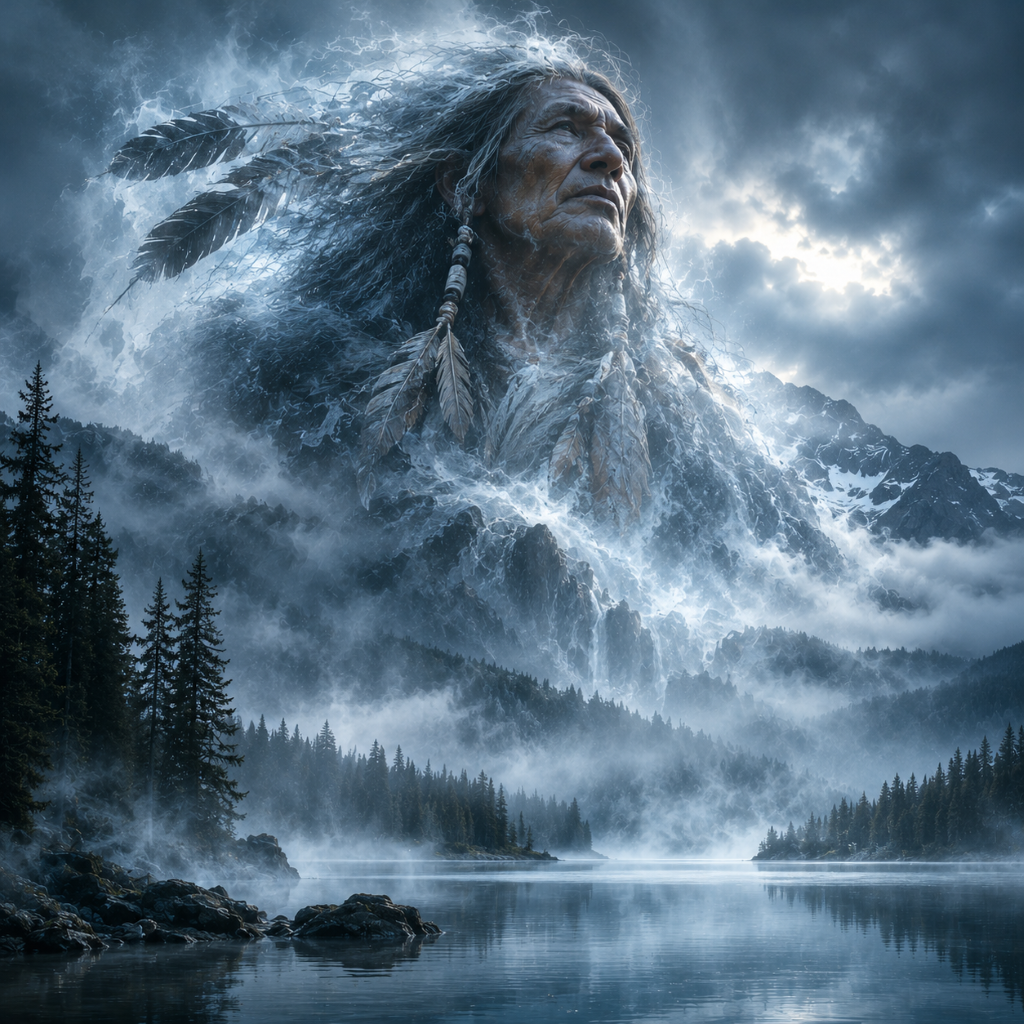
In artistic interpretations, the Great Spirit may appear as an imposing elder, a radiant figure, or a presence associated with the natural world. Such representations can communicate wisdom, authority, and the relationship between spiritual power and creation. However, these images should be understood as artistic interpretations unless they can be traced to a specific Indigenous narrative or cultural teaching.
The natural world is important to many Indigenous spiritual traditions, and the relationship between human beings and their surroundings often carries spiritual significance. Nevertheless, it would be inaccurate to claim that the wind, sun, stars, and seasons are universally understood as physical manifestations of Gitche Manitou in every Cree or Anishinaabe community.
For a visual representation, Gitche Manitou is best approached through cultural sensitivity rather than an invented supernatural anatomy. A restrained portrayal that conveys spiritual presence through atmosphere, natural light, and the surrounding landscape can communicate the concept without implying that a particular artistic depiction defines the beliefs of all Indigenous peoples.
Family
Gitche Manitou does not have a single, consistently documented family structure that can be applied across all the traditions associated with the name. Unlike mythological figures whose stories provide detailed genealogies, the Great Spirit is frequently discussed in terms of spiritual authority, creation, or the relationship between existence and sacred power.
Cree and other Algonquian traditions include numerous spiritual beings and cultural figures whose stories explain aspects of the natural world, human behaviour, and the relationship between people and the spirit world. Their roles differ between communities, and they should not automatically be classified as children, relatives, or subordinate creations of Gitche Manitou.
Wisakedjak, for example, is an important trickster and cultural figure in Cree traditions. Stories about Wisakedjak explore the consequences of human actions, the nature of the world, and the complicated relationship between wisdom and foolishness. His role belongs to a distinct body of traditional narratives rather than establishing a universal family relationship with Gitche Manitou.
Nanabush, also known by related names such as Nanabozho, is an important cultural hero and trickster in Anishinaabe traditions. Although some broader accounts of Indigenous spirituality discuss these figures alongside concepts of the Great Spirit, their presence in the same cultural landscape does not establish a direct genealogical connection. The relationship between Gitche Manitou and other spiritual beings is therefore better understood through the particular stories and teachings of individual Indigenous communities. Without a specific narrative establishing a family connection, assigning Gitche Manitou parents, a consort, or offspring would introduce details that the available evidence does not securely support.
Other Names
Gitche Manitou appears in several forms across Algonquian languages. These variations reflect differences in pronunciation, spelling, dialect, and historical language documentation. Although the expressions are related, they should not all be treated as interchangeable names used by the same community.
Kihci-manitô, Kise-manitô, and Kise-manitow are forms recorded in historical Cree-language Christian publications. Their appearance in different translations illustrates how Indigenous spiritual vocabulary was used to communicate Christian religious concepts. These publications are valuable historical evidence, although missionary translations do not necessarily capture the full range of meanings that a term carries within traditional Indigenous spirituality.
Among Anishinaabe-speaking communities, related forms include Gichi-manidoo and Gizhe-manidoo. The spelling and meaning of these expressions depend on the particular language variety and context. The shared linguistic elements connect them to the broader concept of spiritual power, but cultural differences remain important.
Chisa-manitu is another form recorded in Naskapi-language Christian scripture. Its inclusion demonstrates that related expressions extend beyond Cree and Anishinaabe contexts, although the precise meaning and usage should be understood within the language and community in which the term occurs.
A comparison can also be made with Wakan Tanka, an expression associated with Lakota spirituality and commonly translated as Great Mystery. However, Wakan Tanka belongs to a different Indigenous language and cultural tradition. It is a useful comparison when discussing Indigenous concepts of sacred power, but it is not another name for Gitche Manitou. These linguistic variations reveal how Indigenous communities have expressed spiritual ideas through their own languages. They also demonstrate why the cultural origin and historical context of each term matter when interpreting the Great Spirit.
Powers and Abilities
Gitche Manitou is associated with creation and spiritual authority in traditions that understand the Great Spirit as the source of existence. In these interpretations, the concept provides a way to understand the relationship between the world, the forces that sustain life, and the sacred dimensions of existence.
Creation is one of the most prominent themes associated with the Great Spirit in broader descriptions of Algonquian spirituality. The natural world is understood as more than a collection of resources, with relationships between people, animals, plants, and the environment carrying moral and spiritual significance. However, the precise account of creation differs between Indigenous nations and should not be reduced to one universal story.
Gitche Manitou is also associated with the idea of spiritual power. The Algonquian term manitou can refer to spiritual presence or power, although its meaning varies according to language and context. Understanding this concept requires more than imagining a supernatural being with a list of extraordinary abilities. It involves recognising how spiritual significance is expressed through relationships, traditional teachings, and the interpretation of the world.
Dreams, visions, ceremonies, and oral traditions have important roles in various Indigenous spiritual systems. They can communicate knowledge, reinforce cultural relationships, or shape an individual’s understanding of spiritual responsibilities. Nevertheless, the specific ways these practices relate to Gitche Manitou must be established through the teachings of the relevant community rather than assumed to be identical everywhere.
Descriptions of Gitche Manitou as omniscient, omnipresent, or the absolute owner of everything often reflect particular theological interpretations. These attributes should not be presented as universally established characteristics without supporting evidence from a specific tradition. The most defensible understanding is that Gitche Manitou represents profound spiritual authority in the traditions that recognise the Great Spirit in this way. The concept encourages attention to the relationship between existence and spiritual power, while the precise nature of that relationship remains rooted in individual Indigenous worldviews.
Modern Day Influences
Gitche Manitou remains an important term in discussions of Indigenous spirituality, language, literature, and cultural history. Its continued use reflects the survival and adaptation of Indigenous religious vocabulary through periods of colonisation, missionary activity, and cultural change. However, its contemporary significance differs between communities and individuals.
One important influence is the history of Christian translation. Missionaries used forms of Gitche Manitou and related expressions when translating the Christian concept of God into Indigenous languages. Some Indigenous Christians continue to use this vocabulary within their religious lives. At the same time, the term’s Christian usage should not erase its broader Indigenous linguistic and spiritual context.
Gitche Manitou also became widely known through nineteenth-century literature. Henry Wadsworth Longfellow’s The Song of Hiawatha, published in 1855, helped popularise the name among non-Indigenous audiences. The poem presents a literary interpretation of Indigenous spiritual traditions and draws on material associated with Henry Rowe Schoolcraft. It also includes romanticised and invented elements, meaning that it should not be treated as a definitive account of Cree or Anishinaabe beliefs.
Today, Indigenous writers, artists, educators, and cultural organisations continue to examine how Indigenous spiritual concepts have been represented and interpreted. Their work can help distinguish community-based teachings from stereotypes and assumptions that developed through colonial literature. For readers encountering Gitche Manitou through popular culture, this distinction is particularly important.
The concept also appears in wider discussions about relationships with the natural world. Some contemporary interpretations connect Indigenous spiritual traditions with environmental responsibility and respect for living systems. These connections can be meaningful, but they should be presented as interpretations rather than universal beliefs shared by every Indigenous community.
Ultimately, Gitche Manitou’s modern significance lies in the continuing use and interpretation of a term with deep Indigenous linguistic and spiritual associations. Understanding it requires respect for the communities that preserve these traditions, recognition of the historical circumstances that shaped its representation, and a willingness to acknowledge that Indigenous spirituality cannot be reduced to a single, uniform system of belief.
Related Images


Source
Bennett, J. (2004). Algonquian Spirituality and the Great Spirit. University of Manitoba Press.
Johnston, B. (1990). The Manitous: The Spiritual World of the Ojibway. HarperCollins.
Longfellow, H. W. (1855). The Song of Hiawatha. Ticknor and Fields.
Nichols, J. D., & Nyholm, E. (1995). A Concise Dictionary of Minnesota Ojibwe. University of Minnesota Press.
Sperber, D. (2011). Manitou: The Great Spirit in Algonquian Culture. Algonquin Books.
Wikipedia contributors. (2024, April 15). Gitche Manitou. Wikipedia. https://en.wikipedia.org/wiki/Gitche_Manitou
Walker, R. (2017). Native American Religious Traditions and the Great Spirit. Journal of Indigenous Studies, 22(3), 45-62.
Frequently Asked Questions
Who is Gitche Manitou in Cree mythology?
Gitche Manitou is the Great Spirit, the supreme creator and life force in Cree and Algonquian traditions, representing the source of all existence and spiritual balance.
Is Gitche Manitou the same as God?
Missionaries used “Gitche Manitou” to translate “God,” but in Indigenous teachings, it refers to a broader spiritual force rather than a single anthropomorphic deity.
Does Gitche Manitou have a physical form?
No, Gitche Manitou is formless and genderless, understood as an all-pervading spiritual presence expressed through nature and creation.
What role does Gitche Manitou play in modern Indigenous spirituality?
The Great Spirit remains central in ceremonies, healing practices, cultural revitalization, and Indigenous ecological philosophies.
How is Gitche Manitou connected to other spirits?
Gitche Manitou is the source of all manitous—spirits associated with animals, elements, landscapes, and cultural heroes that maintain the balance of the world.


