

Nanabozho : The Anishinaabe Trickster Spirit of Creation
At a glance
| Description | |
|---|---|
| Origin | Aashinabwe Mythology |
| Classification | Spirits |
| Family Members | Sun/West Wind (Father), Nokomis (Grandmother), Jiibayaabooz (Brother) |
| Region | Canada, United States of America |
| Associated With | Creation, Trickster |
The Mythlok Perspective
In Mythlok’s Perspective, Nanabozho represents the wisdom of imperfection. He is not a flawless creator but a learning force, showing that balance emerges through trial and error. Unlike rigid divine figures, he evolves with experience, reflecting a worldview where growth is continuous. When compared to figures like Loki from Norse tradition or Anansi from West African lore, Nanabozho stands apart by aligning his mischief with creation rather than destruction, emphasizing harmony over chaos.
Nanabozho
Introduction
Nanabozho is one of the most important figures in the sacred storytelling traditions of the Anishinaabe people, including the Ojibwe, Odawa, and Potawatomi. Known as both a trickster and a culture hero, he exists at the center of creation stories, moral teachings, and spiritual philosophy. His tales are part of aadizookaan, a system of traditional narratives that explain how the world came to be and how humans should live within it.
Unlike purely chaotic tricksters found in other traditions, Nanabozho operates with purpose. His actions, even when foolish or mischievous, ultimately guide humanity toward balance with nature. He is often described as being sent by the Great Spirit, Gitche Manitou, to shape the world, name its elements, and teach survival. Through his stories, the Anishinaabe worldview emerges clearly: life is a continuous negotiation between wisdom and error, and harmony comes through experience rather than perfection.
Nanabozho is not distant or divine in an unreachable sense. He is deeply relatable, flawed, and evolving. This makes him not just a mythic figure, but a living teacher whose lessons continue to resonate across generations.
Physical Traits
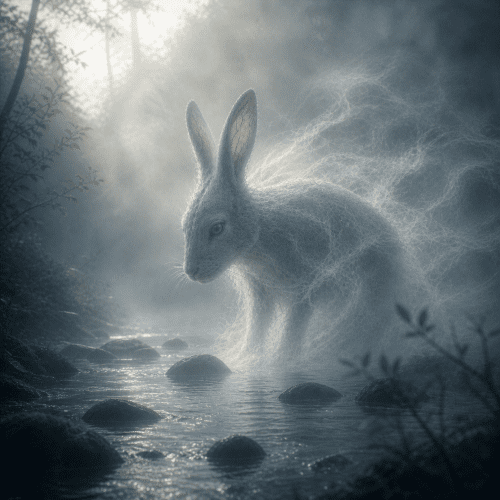
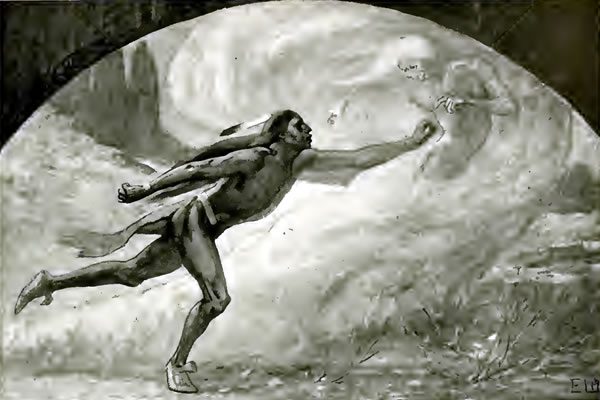
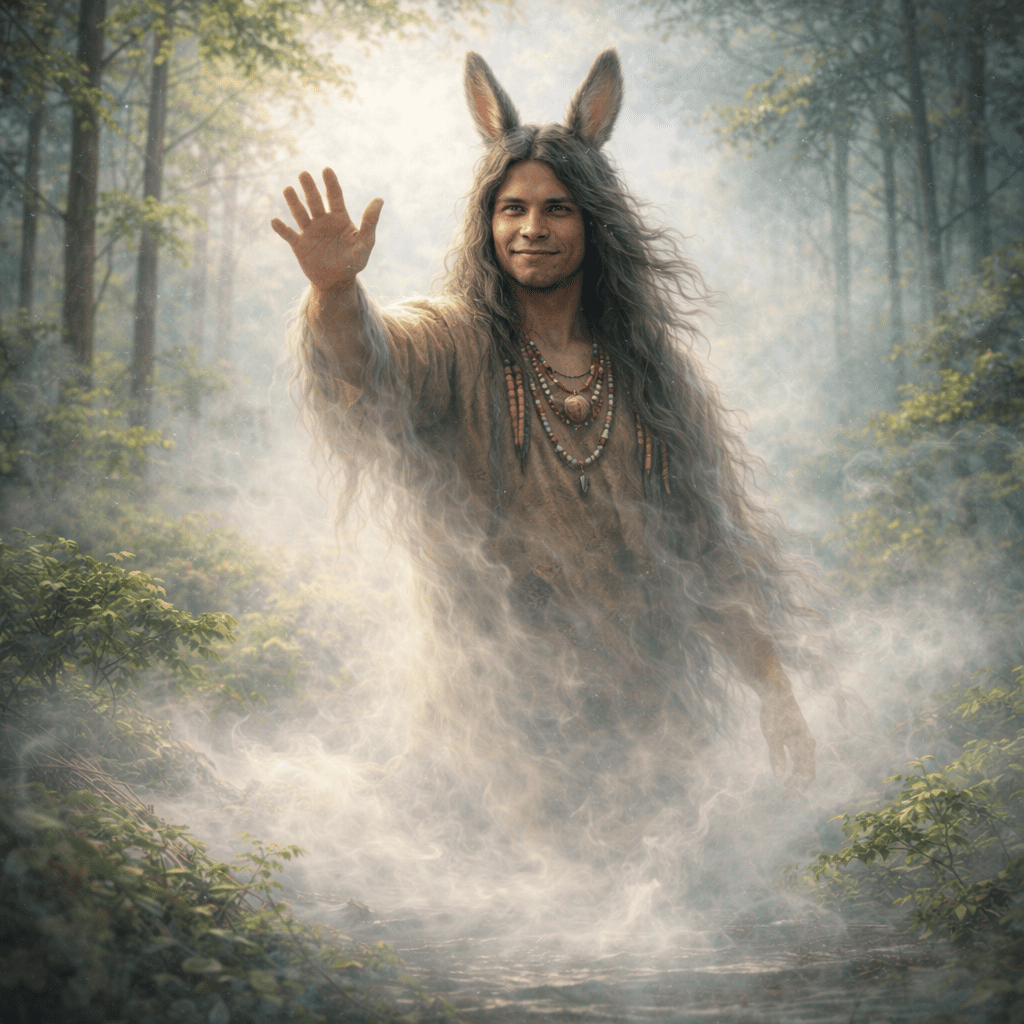
Nanabozho is most commonly associated with the form of a rabbit or hare, a creature known for its speed, alertness, and unpredictability. This animal identity reflects his trickster essence, always moving between situations and adapting to circumstances. In many stories, he appears as a human with subtle rabbit-like features, while in others he fully transforms into animals.
His shapeshifting ability is central to his identity. He can become male or female, human or animal, young or old. Across different traditions, he appears as a raven, coyote, spider, wolverine, or even an elderly man. This fluidity is not random but symbolic. It represents his role as a being who crosses boundaries, existing between worlds rather than belonging to one.
This constant transformation reflects a deeper philosophical idea within Anishinaabe thought. Identity is not fixed but responsive. Nanabozho embodies this principle, showing that adaptability is a form of wisdom and survival.
Family
Nanabozho’s origins vary across stories, but most traditions describe him as having both spiritual and human lineage. His father is often linked to powerful natural forces such as the Sun or the West Wind, while his mother is a mortal woman who dies shortly after his birth. This dual heritage defines his nature, giving him both extraordinary abilities and human vulnerability.
He is raised by his grandmother, Nokomis, a wise and nurturing figure who plays a crucial role in guiding him during his early life. Her presence grounds Nanabozho, providing him with knowledge and discipline while he learns to navigate his powers.
Nanabozho is also connected to siblings, most notably Jiibayaabooz, who is often portrayed as his brother or twin. This figure represents the realm of the dead and becomes its ruler after a tragic death involving water spirits. The relationship between the two reflects a broader balance between life and death, creation and loss. In some traditions, Nanabozho is one of multiple brothers associated with directional or cosmic forces, reinforcing his role within a larger spiritual framework.
Other names
Nanabozho is known by many names, reflecting the diversity of Anishinaabe languages and oral traditions. Variations such as Nanabush, Wenabozho, Manabozho, Nanapush, and Nenabozho appear across different regions and dialects.
These variations are not simply linguistic differences but carry contextual meaning. Prefixes may change depending on who is speaking or how the story is being told. For example, certain forms reflect personal or relational perspectives, indicating how closely the speaker identifies with the figure.
Other related names, such as Michabo and Wisakedjak, appear in broader Algonquian traditions, showing that Nanabozho is part of a larger cultural network of trickster figures. Despite the variations, the core identity remains consistent. He is always a transformer, a teacher, and a being who exists between order and chaos.
Powers and Abilities
Nanabozho’s powers are vast but deeply symbolic. His most defining ability is shapeshifting, which allows him to move freely between forms and worlds. This ability represents adaptability, intelligence, and survival rather than domination.
He is also credited with shaping the physical world. In one of the most important creation stories, a great flood covers the Earth. Nanabozho works with animals to retrieve soil from beneath the waters. When a muskrat succeeds, Nanabozho places the soil on a turtle’s back and breathes life into it, creating what is known as Turtle Island.
Beyond creation, he is a cultural teacher. He names plants and animals, introduces fishing techniques, and establishes the Midewiwin, a spiritual and healing tradition. These acts position him as a bridge between knowledge and practice.
However, his greatest power lies in his imperfections. Nanabozho makes mistakes, gets tricked, and sometimes causes harm. These failures are not weaknesses but essential lessons. They demonstrate that wisdom is earned through experience and that growth comes from understanding one’s own flaws.
Modern Day Influence
Nanabozho continues to play a vital role in contemporary Indigenous life and thought. His stories are still shared in traditional settings, especially during winter storytelling seasons, preserving cultural knowledge and values.
In literature, he has influenced both Indigenous and non-Indigenous works. While early interpretations, such as those by Henry Wadsworth Longfellow, often misunderstood or altered his identity, modern authors have reclaimed and reinterpreted his character with authenticity. Works like Braiding Sweetgrass by Robin Wall Kimmerer present Nanabozho as a teacher of ecological wisdom, connecting traditional knowledge with modern science.
He also appears in contemporary fiction, theater, and visual art, where his character is used to explore themes of identity, resilience, and environmental responsibility. His teachings about reciprocity and respect for nature have become increasingly relevant in discussions about sustainability and climate awareness. Nanabozho’s enduring presence reflects his adaptability. Just as he transforms within stories, his meaning evolves across generations while remaining rooted in the same core truths.
Related Images




Source
Benton-Banai, E. (1988). The Mishomis book: The voice of the Ojibway. Indian Country Communications.
Buck, C., & Locke, K. (2021, February 18). Nanabush, the Anishinaabe (Ojibway) sacred teacher and trickster. Baha’i Teachings. https://bahaiteachings.org/nanabush-anishinaabe-ojibway-sacred-teacher-trickster/
Johnston, B. (1976). Ojibway heritage. McClelland and Stewart.
Kimmerer, R. W. (2013). Braiding sweetgrass: Indigenous wisdom, scientific knowledge, and the teachings of plants. Milkweed Editions.
Longfellow, H. W. (1855). The song of Hiawatha. Ticknor and Fields.
Schoolcraft, H. R. (1839). Algic researches: Comprising inquiries respecting the mental characteristics of the North American Indians (Vol. 1). Harper.
Smith, T. S. (1995). The island of the Anishnaabeg: Thunderers and water monsters in the traditional Ojibwe life-world. University of Idaho Press.
Winfrey, S. (2023). Nanabozho. In Religion and philosophy research starters. EBSCO.
https://www.ebsco.com/research-starters/religion-and-philosophy/nanabozho
Frequently Asked Questions
Who is Nanabozho?
Nanabozho is a trickster spirit and culture hero in Anishinaabe traditions, known for shaping the world and teaching humans how to live in balance with nature.
Is Nanabozho a god or a spirit?
Nanabozho is best understood as a spirit with both divine and human qualities rather than a traditional god.
What animal is Nanabozho associated with?
He is most commonly associated with the rabbit or hare, symbolizing agility and trickster behavior.
What did Nanabozho create?
He is credited with helping recreate the Earth after a great flood, forming Turtle Island, and naming plants and animals.
Why is Nanabozho important today?
His teachings about balance, respect for nature, and learning through mistakes remain relevant in modern cultural and environmental discussions.