
Garmr : The Hellhound Who Guards the Norse Underworld Helheim
At a glance
| Description | |
|---|---|
| Origin | Norse Mythology |
| Classification | Animals |
| Family Members | N/A |
| Region | Iceland, Norway, Denmark |
| Associated With | Underworld, Guardianship, Death |
The Mythlok Perspective
In Mythlok’s Perspective, Garmr represents the ancient idea that death must be guarded. Many cultures imagined the entrance to the underworld protected by a monstrous dog, emphasizing that the boundary between life and death cannot be crossed easily. The Norse hound closely mirrors the Greek Cerberus and the Zoroastrian two-headed dogs that guard the Chinvat Bridge. Across cultures, these creatures symbolize vigilance at the threshold of the afterlife. Garmr fits squarely within this archetype, representing not merely a monster but a cosmic gatekeeper who maintains the balance between worlds.
Garmr
Introduction
Garmr is one of the most ominous creatures in Norse tradition, a terrifying hound associated with death, the underworld, and the cataclysmic events of Ragnarök. In the surviving Old Norse sources, particularly the Poetic Edda, Garmr appears as a blood-stained guardian chained before the cave of Gnipahellir, located at the entrance to Helheim, the realm of the dead ruled by the goddess Hel. His presence marks the boundary between the world of the living and the silent domain of the departed.
The myths portray Garmr as a creature of relentless vigilance. His duty is to guard the gates of Helheim, ensuring that the dead remain within their realm while preventing intruders from entering. Unlike many figures in Norse myth whose stories span multiple narratives, Garmr appears only briefly in surviving texts. Yet those few references establish him as a symbol of doom and inevitability.
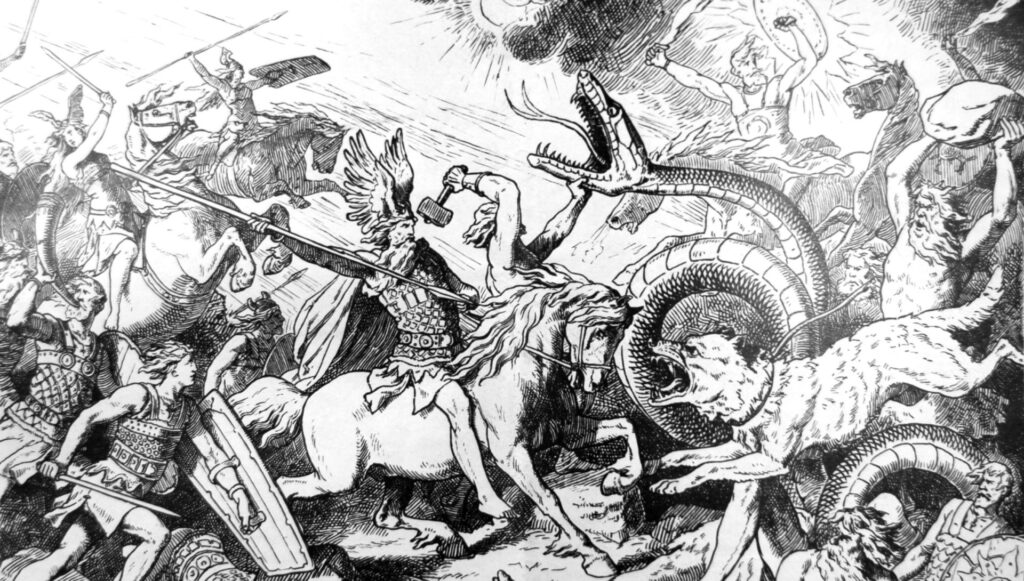
Garmr’s importance becomes clear during Ragnarök, the prophesied destruction of the cosmos. When the final battle approaches, the hound breaks free from his chains and howls loudly across the worlds. His release signals that the forces of chaos have begun to overwhelm the established order. In the climactic battle that follows, Garmr confronts the god Týr, the divine figure associated with law and heroic sacrifice. Their duel ends in mutual destruction, reflecting the Norse theme that even gods cannot escape fate.
Because of his role as a guardian of the underworld, scholars often compare Garmr to mythological hellhounds from other cultures. The most famous parallel is Cerberus from Greek tradition, the multi-headed dog who guards the gates of Hades. Both creatures embody the same ancient idea: the threshold between life and death must be protected by a powerful and terrifying beast.
Physical Traits
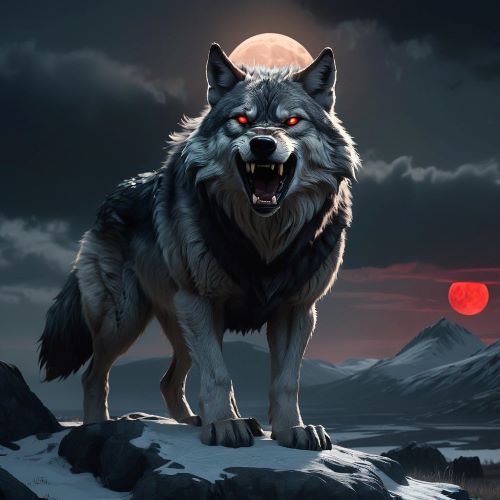
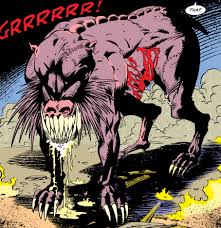
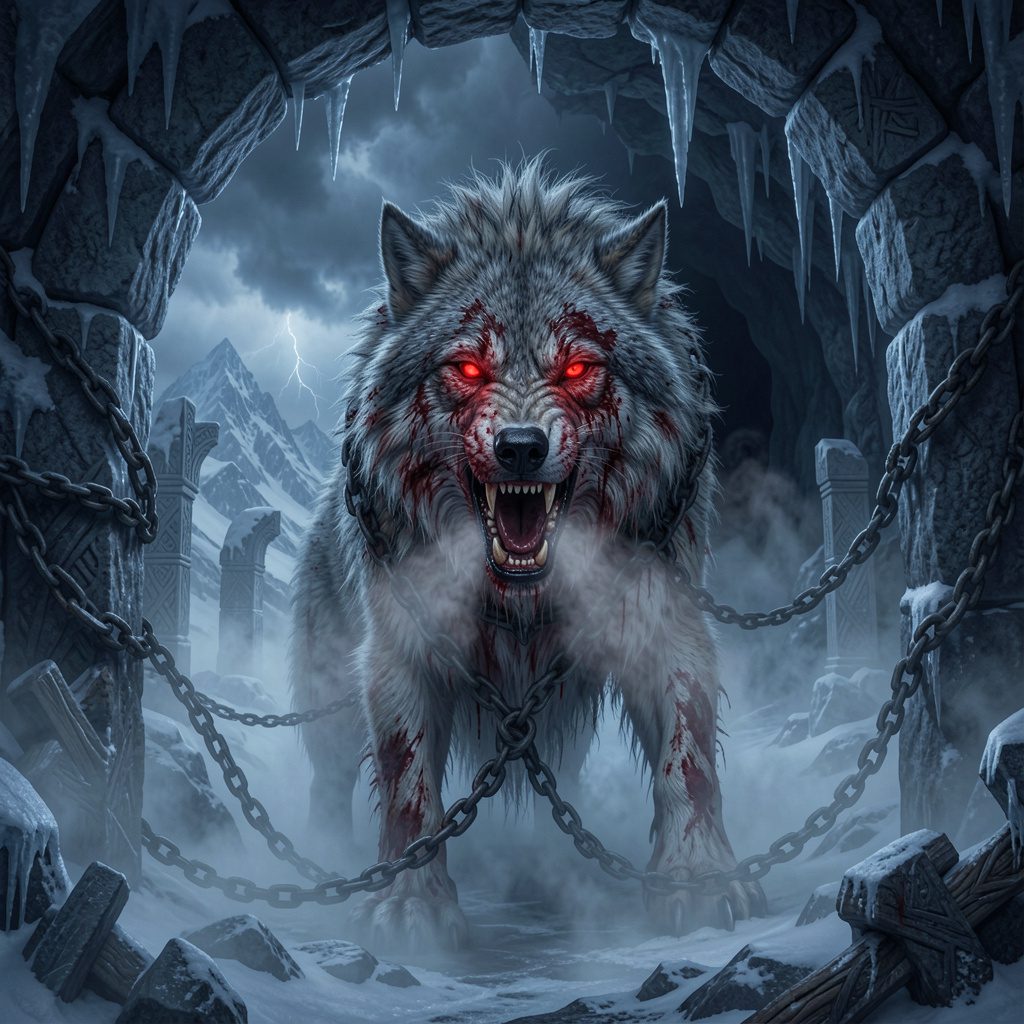
Descriptions of Garmr in Norse literature are brief but striking. He is typically portrayed as a massive wolf or hound, covered in blood and chained before the cave known as Gnipahellir. This location stands near the entrance to Helheim, reinforcing his role as the guardian of the underworld.
The Poetic Edda repeatedly emphasizes his terrifying appearance. His fur is described as blood-stained, suggesting that he has either fought countless battles or stands amid the violence surrounding death. His eyes are imagined as fierce and burning, while his teeth are large enough to tear apart even divine opponents. The image of blood on his coat reinforces the idea that he exists in constant proximity to death and destruction.
Unlike Fenrir, the colossal wolf destined to devour Odin, Garmr is not portrayed as roaming the worlds. Instead, he remains bound in place, chained near the cave entrance to Helheim. This restraint suggests that his strength is so great that even the gods considered it dangerous to leave him unbound.
Another defining trait is his howl. In Norse poetry, Garmr’s howling echoes across the realms, especially as Ragnarök approaches. The sound is not merely the cry of an animal but a cosmic warning. When the hound begins to howl, it signals that the balance of the world is collapsing.
Though the myths never provide an exact size, later interpretations often imagine Garmr as an enormous creature towering above ordinary wolves. Whether depicted as a giant dog or a monstrous wolf, his terrifying form reinforces his role as the ultimate guardian of death’s domain.
Family
Unlike many figures in Norse mythology, Garmr has no clearly defined lineage in the surviving texts. The Eddas do not name his parents or descendants, leaving his origins largely mysterious.
Because he resembles Fenrir and other monstrous wolves, some scholars speculate about possible connections between them. Fenrir, the giant wolf who will devour Odin during Ragnarök, is known to be the son of Loki and the giantess Angrboda. Since Garmr also appears during the final battle and possesses immense strength, some interpretations propose that he might belong to the same family of monstrous wolves.
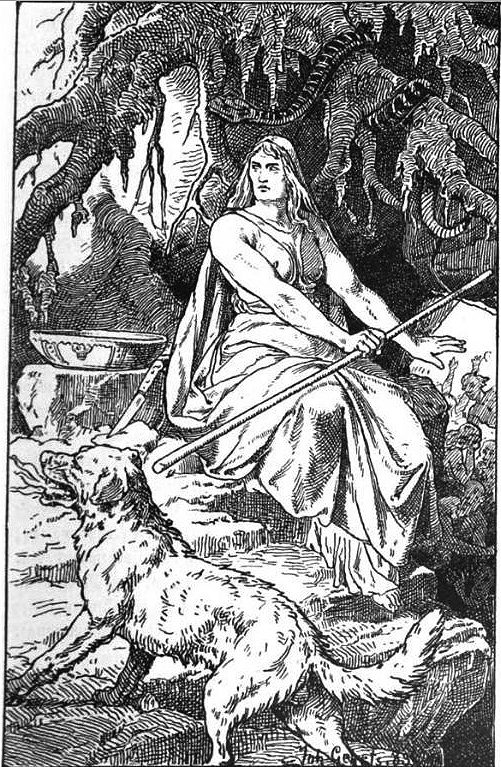
However, the primary sources never confirm such a relationship. Most scholars today treat Garmr as a separate creature whose role is tied specifically to Helheim rather than to Loki’s lineage. The only clear association in the myths is with Hel, the goddess who rules the realm of the dead. Garmr serves as the guardian of her domain, standing watch over the entrance to her kingdom. In this sense, his “family” connection is more symbolic than biological. He functions as Hel’s sentinel, ensuring that the cosmic order governing life and death remains intact.
Another interesting connection appears in the Eddic poem Baldrs Draumar. In this story, Odin travels to Helheim seeking knowledge about the fate of his son Baldr. As Odin approaches the underworld, a fierce dog chained near the cave barks loudly at him. Many scholars believe this unnamed hound is Garmr. Even without a detailed genealogy, Garmr remains deeply connected to the underworld and its ruler, reinforcing his identity as the guardian of death’s realm.
Other names
The name Garmr comes from Old Norse and is sometimes simplified to Garm in modern writings. Linguistically, the name likely relates to words meaning “to howl,” “to bark,” or “to growl.” This interpretation fits well with the mythic image of the creature whose terrible howls announce the coming of Ragnarök. Because of this meaning, Garmr is often translated as “the barker” or “the howling one.” These interpretations emphasize the terrifying cry that echoes across the worlds as the end of the cosmos approaches.
Outside of Norse texts, similar figures appear in other Germanic traditions. In some Low Saxon folklore, a spectral hound called the helhond or kardoes appears as a companion of underworld deities. While not identical to Garmr, these figures share the same role as guardians of death’s domain.
Modern scholars also frequently compare Garmr to Cerberus from Greek mythology. Both creatures guard the entrance to the underworld and prevent the dead from escaping. Although they arise from different mythological traditions, the resemblance highlights a recurring theme across Indo-European mythology: powerful dogs guarding the threshold of the afterlife.
Powers and Abilities
Garmr’s most important ability is his role as the guardian of Helheim. He stands watch at the entrance to the underworld, ensuring that the boundary between life and death remains secure. This duty makes him one of the most important protectors of cosmic order in Norse mythology.
His physical strength is immense. During Ragnarök, Garmr breaks free from the chains that bind him and enters the battlefield. In the chaos of the final war, he confronts the god Týr, a deity known for courage and martial skill. Their battle ends with both figures killing each other, demonstrating that Garmr possesses enough power to destroy even a god.
Another important aspect of his power lies in symbolism rather than physical ability. Garmr represents the inevitability of death and the unstoppable march of fate. His howling serves as a warning that the end of the world has begun. Later interpretations and modern adaptations sometimes expand his abilities further, portraying him as a supernatural hellhound capable of immense destruction or even travel between realms. However, the original Norse texts focus primarily on his role as a guardian and a harbinger of Ragnarök.
Modern Day Influence
Although Garmr appears only briefly in ancient Norse texts, his terrifying imagery has captured the imagination of modern storytellers. Today he frequently appears in fantasy literature, video games, and popular culture inspired by Norse mythology.
One of the most notable modern portrayals appears in the video game Hellblade: Senua’s Sacrifice (2017), where players face Garmr as a massive and terrifying boss creature. The depiction draws heavily on the idea of the monstrous guardian of the underworld. Garmr also appears in God of War Ragnarök (2022), where he is presented as a giant wolf imprisoned in Helheim. The game expands on his mythology by exploring his connection to the realms and the chaos unleashed when he breaks free.
Beyond video games, the image of Garmr often appears in fantasy novels, tabletop role-playing games, and artistic interpretations of Norse mythology. His connection to death and the underworld makes him a powerful symbol for stories involving fate, apocalypse, and cosmic battles. These modern interpretations demonstrate how even lesser-known mythological figures can continue to inspire new generations of storytelling. Garmr remains a haunting symbol of the final boundary between life and death.
Related Images
Blogs & Opinions
Glorious Epics
Mythical Events

Source
Lindow, J. (2002). Norse mythology: A guide to the gods, heroes, rituals, and beliefs. Oxford University Press. https://global.oup.com/academic/product/norse-mythology-9780195153828
Orchard, A. (1997). Dictionary of Norse myth and legend. Cassell. https://www.cassell.co.uk/titles/9780304363851/
Simek, R. (2007). Dictionary of Northern Mythology (A. Hall, Trans.). D.S. Brewer. https://boydellandbrewer.com/9780859915137/dictionary-of-northern-mythology/
Sturluson, S. (1995). The Prose Edda (J. Byock, Trans.). Penguin Classics. https://www.penguinrandomhouse.com/books/176116/the-prose-edda-by-snorri-sturluson-translated-by-jesse-l-byock/
Unknown. (2018). Garm. Norse Mythology for Smart People. https://norse-mythology.org/garm/
Unknown. (2025). Garmr in Norse mythology: Myths, powers, and symbolism. Centre of Excellence.
https://www.centreofexcellence.com/garmr-in-norse-mythology/
Unknown. (n.d.). Poetic Edda. Sacred Texts. https://www.sacred-texts.com/neu/poe/index.htm
Turville-Petre, E. O. G. (1964). Myth and religion of the North: The religion of ancient Scandinavia. Holt, Rinehart and Winston.
Frequently Asked Questions
Who is Garmr in Norse mythology?
Garmr is a monstrous hound that guards the entrance to Helheim, the Norse realm of the dead ruled by the goddess Hel.
Is Garmr the same as Fenrir?
No. Fenrir is the giant wolf destined to devour Odin during Ragnarök, while Garmr guards Helheim and fights the god Týr in the final battle.
What happens to Garmr during Ragnarök?
During Ragnarök, Garmr breaks free from his chains and battles the god Týr. Both are destined to kill each other in the final conflict.
Where is Garmr chained in Norse mythology?
Garmr is chained before the cave of Gnipahellir, located near the entrance to Helheim.
Is Garmr similar to Cerberus?
Yes. Both Garmr and Cerberus are mythological hounds that guard the underworld and prevent the dead from escaping.