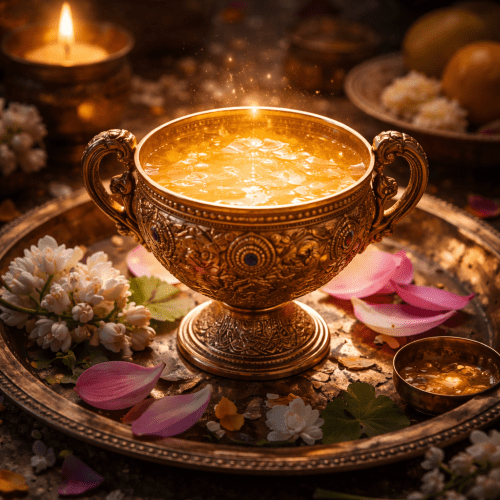


Yashiori-no-Sake : The Mythic Brew That Defeated Orochi
| Description | |
|---|---|
| Origin | Japanese Mythology |
| Availability | Specially brewed by humans under Susanoo’s divine instruction |
| Associated Characters | Susanoo, Yamata-no-Orochi, Kushinadahime, Ashinazuchi & Tenazuchi |
| Symbolism | Purification, Divine strategy, Bridging mortal and divine |
| Source Texts | Kojiki, Nihon Shoki |
Mythlok Perspective
In Mythlok’s View, Yashiori-no-Sake represents the transformation of an everyday substance into a tool of cosmic balance. It reflects a worldview where intelligence and ritual precision overcome overwhelming force. This idea appears across cultures. In Greek tradition, substances like ambrosia elevate gods, while in Indian narratives, soma carries divine significance. Yashiori-no-Sake stands apart by functioning not as nourishment but as a strategic equalizer, turning intoxication into a deliberate act of control.
Yashiori-no-Sake
Introduction
Yashiori-no-Sake is one of the most intriguing ritual elements in early Japanese tradition, appearing in the ancient chronicles Kojiki and Nihon Shoki. Far from being an ordinary drink, it is portrayed as a carefully crafted, highly potent sake that becomes the turning point in a legendary battle. In the story, the storm deity Susanoo uses Yashiori-no-Sake to defeat the monstrous serpent Yamata no Orochi.
This association elevates Yashiori-no-Sake beyond a beverage into a symbol of intelligence, ritual knowledge, and divine intervention. It reflects how ancient Japanese narratives often placed everyday elements like rice wine into sacred and transformative roles, bridging human ingenuity with cosmic order.
Mythological Context
The story unfolds in the province of Izumo after Susanoo is cast out from the heavenly realm. There, he encounters an elderly couple grieving the fate of their daughters, who have been sacrificed one by one to Yamata no Orochi. Their last remaining child, Kushinadahime, is next in line.
Susanoo offers a solution that relies not on brute strength alone but on strategy. He instructs the couple to brew Yashiori-no-Sake and construct a structure with eight gates, each holding a vat of the drink. Kushinadahime is hidden safely, while the plan is set in motion.
When Yamata no Orochi arrives, each of its eight heads drinks from a separate vat. The effect is immediate and overwhelming. The creature becomes deeply intoxicated, loses its awareness, and collapses into a vulnerable state. Seizing this moment, Susanoo slays the serpent. During the battle, he discovers the legendary sword Kusanagi-no-Tsurugi within the creature’s tail, a finding that later becomes central to imperial symbolism in Japan.
Symbolism
Yashiori-no-Sake carries layered symbolic meaning within the narrative. At its core, it represents purification and ritual control. In early Japanese belief systems, sake was not merely consumed but offered to deities, acting as a medium between humans and the divine.
The repeated use of the number eight throughout the myth reflects completeness and ritual precision. The eight heads of Orochi, the eight vats, and the eight gates all reinforce a sense of totality, suggesting that the solution was not random but meticulously aligned with cosmic order.
The drink also represents strategy over force. Rather than confronting chaos directly, Susanoo neutralizes it through preparation and knowledge. The transformation of danger into opportunity is central here. Even the aftermath carries symbolic weight, as the discovery of Kusanagi suggests that order and legitimacy can emerge from the defeat of chaos.
Origin and Source
The earliest references to Yashiori-no-Sake come from the Kojiki and Nihon Shoki, texts compiled in the 8th century to document Japan’s mythic past and imperial lineage. These works blend oral traditions with political intent, linking divine narratives to royal authority.
The term “Yashiori” is generally interpreted as “eightfold refinement” or “eight times brewed,” indicating an unusually strong and carefully prepared form of sake. While exact brewing techniques are not described in detail, the emphasis on repetition suggests a process designed to increase potency and purity.
The geographical setting of the myth, often associated with the Hii River region in modern Shimane Prefecture, has led some scholars to interpret the serpent as a symbolic representation of natural forces such as flooding. In this reading, Yashiori-no-Sake becomes not just a weapon but a ritual response to environmental challenges.
Maker or Provider
Although Susanoo devises the plan, the creation of Yashiori-no-Sake is entrusted to the elderly couple, Ashinazuchi and Tenazuchi. Their role is essential, as they carry out the brewing under divine instruction.
This collaboration highlights a recurring theme in Japanese narratives: the partnership between human effort and divine guidance. The gods may provide knowledge or direction, but humans execute the process. In this case, the couple transforms raw materials into a substance capable of influencing even a monstrous being, demonstrating the power of ritual craftsmanship.
Recipe and Content
Yashiori-no-Sake is described as an exceptionally strong form of rice wine, likely produced through multiple stages of fermentation or refinement. Traditional sake is made from rice, water, and koji mold, but the myth implies a more intensive process designed to amplify its intoxicating effects.
The idea of “eightfold brewing” suggests repeated cycles that concentrate flavor and alcohol content. While historical brewing methods from that era were less standardized than modern techniques, the narrative clearly emphasizes potency as the defining characteristic. Rather than focusing on exact ingredients, the myth highlights intention. The sake is not created for enjoyment but for a specific purpose, making it a ritual tool shaped by necessity and precision.
Instances of Serving and Procurement
The preparation and serving of Yashiori-no-Sake occur within a carefully constructed setting. The eight vats are placed behind gates, ensuring that each head of the serpent encounters a dedicated source of the drink.
This arrangement is not incidental. It demonstrates an understanding of the creature’s nature and a deliberate effort to control the situation. The procurement of the sake is immediate and localized, relying on available resources and the urgency of the moment.
The act of serving transforms the drink into a strategic offering. It is presented not as a trap in the conventional sense but as something the creature willingly consumes, reinforcing the idea that the solution lies in subtle manipulation rather than direct confrontation.
Effects
The primary effect of Yashiori-no-Sake is profound intoxication. Yamata no Orochi, despite its immense size and power, is rendered completely helpless after consuming the drink. Its loss of awareness allows Susanoo to carry out the decisive attack.
Beyond the physical impact, the effect carries symbolic meaning. The drink subdues chaos without destroying it outright, creating a moment of balance that can be acted upon. This reflects a broader cultural understanding of sake as something capable of altering states of being, whether in ritual, celebration, or myth. The outcome also leads to revelation. The discovery of Kusanagi within the serpent reinforces the idea that hidden truths and treasures often emerge only after chaos has been subdued.
Modern Influence
The story of Yashiori-no-Sake continues to influence modern culture in Japan and beyond. It appears in traditional performances such as Iwami Kagura, where the battle with Yamata no Orochi is reenacted with dramatic flair.
In contemporary media, references to the myth appear in video games and films. The term “Yashiori” has even been used in modern storytelling, such as in the operation name in the film Shin Godzilla, where a similar concept of neutralizing a powerful entity is explored.
Local geography also reflects the legend, with roads and landmarks in Izumo named after Orochi. These connections show how Yashiori-no-Sake has moved beyond myth into cultural identity, remaining a symbol of ingenuity and tradition.



Sources
Craft Sake World. (2025, May 12). Yashiori no Sake in Japanese mythology: How Susanoo defeated the serpent with sacred sake. https://craftsakeworld.jp/en/sake-kojiki-susanoo-2/
Philippi, D. L. (Trans.). (1968). Kojiki. University of Tokyo Press.
Rath, E. B. (2025). Kanpai: The history of sake. Reaktion Books.
Tsunetsugu, M. (Trans.). (1970). Nihon shoki. Kodansha.
Kikkoman Corporation. (2015, July 1). Sake in Japanese food culture (No. 2). https://www.kikkoman.com/en/culture/foodforum/the-japanese-table/29-2.html
Midorinoshima. (2019, November 4). The dragon, the sake and the hero. https://midorinoshima.com/en/sake-blog/post/82/the-dragon-the-sake-and-the-hero
Hoshi-yuki. (n.d.). Kojiki chapter translation. https://hoshi-yuki.livejournal.com/18215.html
Sake Inn. (2024, April 29). The tale of the brewery that created the Godzilla sakes. https://sakeinn.com/blogs/news/godzilla-sake
Frequently Asked Questions
What is Yashiori-no-Sake?
A legendary Japanese sake brewed eight times, used by Susanoo to intoxicate and defeat Yamata no Orochi in ancient myth.
Why is Yashiori-no-Sake important in Japanese tradition?
It symbolizes ritual purity, strategy, and the connection between humans and divine forces in early Japanese belief systems.
Is Yashiori-no-Sake based on real brewing methods?
While inspired by sake production, its eightfold refinement is symbolic rather than a documented historical technique.
Who created Yashiori-no-Sake?
It was brewed by Ashinazuchi and Tenazuchi under Susanoo’s guidance, combining human effort with divine planning.
What does “Yashiori” mean?
The term suggests “eightfold brewing” or repeated refinement, indicating a highly potent and carefully prepared sake.