
Deng : The Rain God of the Dinka People
At a glance
| Description | |
|---|---|
| Origin | Dinka Mythology |
| Classification | Gods |
| Family Members | Abuk (Mother), Garang (in some traditions), Nhialic (Father) |
| Region | South Sudan |
| Associated With | Rain, Fertility, Storms, Lightning, Mediation, Healing |
The Mythlok Perspective
In Mythlok’s Perspective, Deng represents a form of divinity that is inseparable from nature rather than personified beyond it. His identity as rain and storm places him closer to elemental forces than human-like gods. This reflects a worldview where survival and spirituality are deeply intertwined. This idea finds echoes across cultures. Deng’s role as a rain-bringer parallels figures like Indra from Indian traditions and Tlaloc from Mesoamerican belief systems, both of whom govern storms and fertility. At the same time, his function as an intermediary resembles Hermes in Greek thought or Orunmila in Yoruba belief. Deng stands at the intersection of these archetypes, embodying both the unpredictability of nature and the accessibility of divine guidance.
Deng
Introduction
Deng stands as one of the most important spiritual figures in the belief system of the Dinka people of South Sudan. Deeply rooted in oral tradition, Deng is not simply a god of rain but a living presence that shapes the rhythm of life itself. In a land where survival depends heavily on seasonal rains, cattle health, and fertile land, Deng represents the force that sustains existence.
Within Dinka cosmology, Deng occupies a unique position between humanity and the supreme creator, Nhialic. He is often understood not just as a separate deity, but as an expression or extension of divine will. This dual role makes Deng both accessible and powerful, a figure who listens to human prayers while carrying the authority of the heavens.
The very identity of the Dinka people reflects this connection. They often refer to themselves as “the people of Deng,” highlighting how deeply his presence is woven into their culture, spirituality, and worldview. Deng is not distant or abstract. He is experienced through rain, storms, and moments of both blessing and loss.
Physical Traits
Deng is not described in human terms in traditional Dinka belief. Unlike mythologies where gods have defined physical forms, Deng exists primarily as an elemental force. His presence is revealed through the sky, particularly in rain, thunder, and lightning.
This absence of a fixed physical body is significant. It reflects a worldview where divine power is not confined to shape or image but expressed through nature itself. When storms gather and lightning strikes, it is understood as Deng acting in the world.
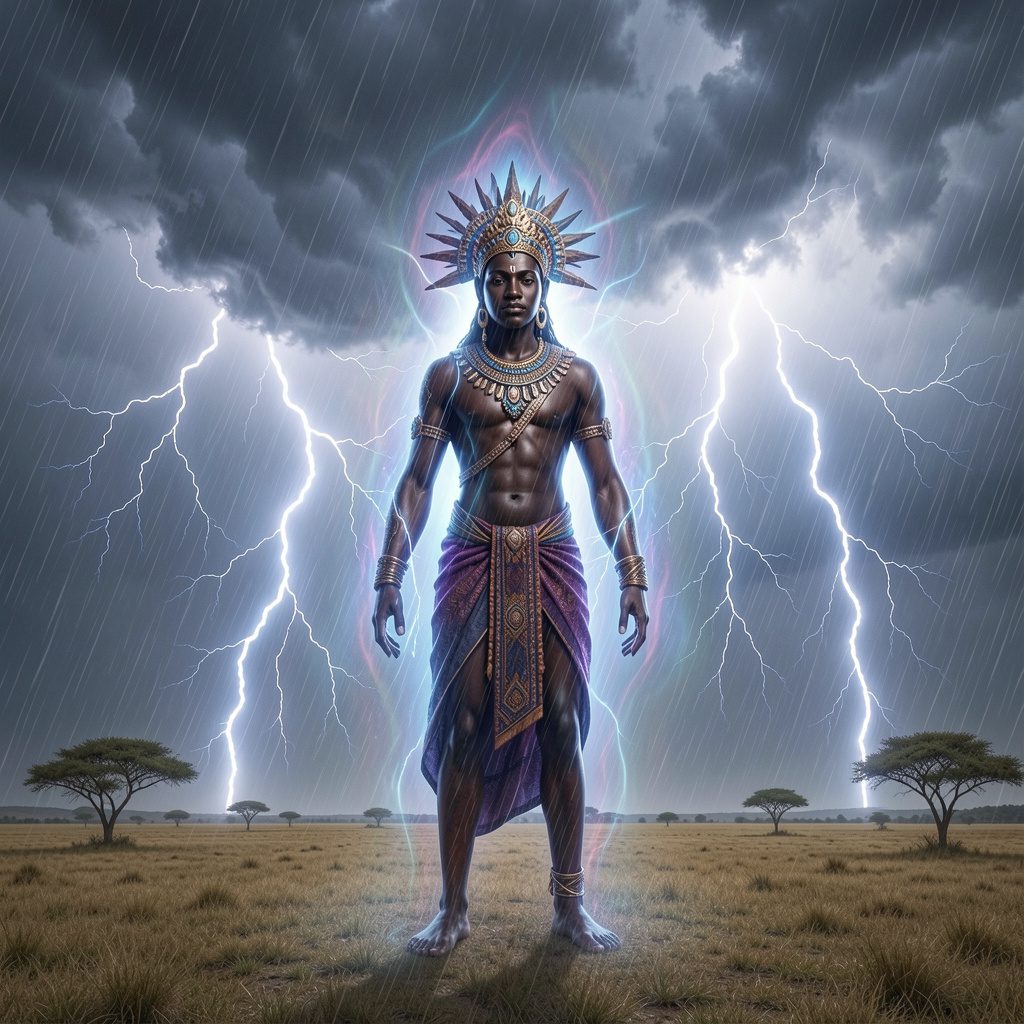
In some modern artistic interpretations, Deng is imagined as a towering sky figure surrounded by clouds and light. However, these are contemporary visualizations rather than traditional descriptions. For the Dinka, Deng’s “form” is the environment itself, making him both invisible and ever-present.
Family
Deng’s origins vary across different oral traditions, reflecting the fluid nature of Dinka storytelling. In many accounts, he is closely connected to Abuk, the first woman and a foundational figure associated with fertility, agriculture, and the nurturing of life. Abuk is often symbolized by a snake, representing renewal and continuity.
Some traditions describe Deng as the son of Abuk and Garang, placing him within the first generation of humanity. Others suggest a more direct connection to Nhialic, the supreme sky god, either as his son or as a manifestation of his power.
There are also narratives that speak of Deng Det, a divine or ancestral figure linked to Deng, sometimes described as having descended from the heavens. These variations do not contradict each other but instead show how Deng exists across multiple layers of belief, as both a deity and an ancestral presence.
Other names
Deng is known by several names, each reflecting a different aspect of his identity. Variations such as Denka and Dengdit appear across regions and dialects, while Deng Det carries a more elevated meaning, often interpreted as “great” or “supreme” Deng.
The name itself holds deep significance. In the Dinka language, Deng is closely associated with rain and the sky, reinforcing his role as a life-giving force. The Dinka people’s self-identification as “Muonyjang,” or “people of Deng,” further emphasizes how his name extends beyond religion into cultural identity.
Among neighboring groups like the Nuer, Deng is understood differently. In some cases, he is seen as a powerful but foreign spirit, occasionally linked to disease or misfortune. These contrasting interpretations highlight how regional perspectives shape the understanding of shared spiritual figures.
Powers and Abilities
Deng’s power is inseparable from the natural world. His most important role is as the bringer of rain, which directly affects crops, grazing lands, and the survival of cattle. In a pastoral society, this makes Deng central to both physical and economic well-being.
Storms are another expression of his presence. Thunder and lightning are not random events but signs of divine action. Lightning, in particular, is often described as Deng’s weapon or tool, capable of both creation and destruction. A lightning strike is sometimes interpreted as a direct act of divine selection, where a person is taken by Deng.
Beyond his control over weather, Deng serves as a mediator between humans and Nhialic. People turn to him in prayer, seeking protection, healing, and relief from hardship. His role as an intermediary makes him approachable, unlike the more distant supreme creator.
Deng is also associated with fertility in a broader sense, influencing not only the land but also human life and community continuity. Rituals, songs, and invocations are often directed toward him during times of drought, illness, or uncertainty. His influence extends beyond the Dinka. Historical accounts mention figures like the Nuer prophet Ngundeng, who claimed spiritual power connected to Deng, showing how his presence transcends cultural boundaries.
Modern Day Influence
Despite the spread of Christianity and Islam in South Sudan, Deng remains an enduring figure in Dinka cultural life. While some parallels have been drawn between Deng and figures like Jesus, traditional beliefs continue to exist alongside newer religious practices rather than being fully replaced.
Deng’s presence is preserved through oral traditions, ritual songs, and community practices. He is invoked during agricultural cycles, ceremonies, and times of crisis, reflecting a belief system that remains deeply tied to the land.
The cultural importance of cattle, often seen as sacred gifts, continues to reinforce the relevance of Deng’s role as a provider. In many ways, Deng represents a living philosophy rather than a static myth, guiding how people understand nature, responsibility, and survival.
Even in modern contexts, Deng symbolizes resilience. His mythology reflects a worldview where humanity is not separate from nature but dependent on and connected to it. This perspective continues to shape identity and cultural continuity among the Dinka people.
Related Images
Source
Encyclopedia Britannica. (2023). Dinka. https://www.britannica.com/topic/Dinka
Fanack. (2023, October 30). Dinka people: Mythic life in Sudan. https://fanack.com/sudan/society-of-sudan/dinka-people-mythic-life-in-sudan/
Godchecker. (2023). DENG: The Dinka God of Creation. https://www.godchecker.com/african-mythology/DENG/
Occult World. (2018, March 9). Deng. https://occult-world.com/deng/
Stanislaw, W. (2018). The Dinka of the Sudan: Case studies in cultural anthropology. (PDF resource). https://www.rahs-open-lid.com/wp-content/uploads/2024/02/The-Dinka-of-the-Sudan-Case-studies-in-cultural-anthropology-PDFDrive-.
Wikipedia. (2010). Deng (god). https://en.wikipedia.org/wiki/Deng_(god)
Evans-Pritchard, E. E. (1956). Nuer Religion. Oxford: Clarendon Press.
Johnson, D. H. (1994). Nuer Prophets: A History of Prophecy from the Upper Nile in the Nineteenth and Twentieth Centuries. Oxford University Press.
Deng, F. M. (1972). The Dinka of the Sudan. Holt, Rinehart and Winston.
Seligman, C. G., & Seligman, B. Z. (1932). Pagan Tribes of the Nilotic Sudan. Routledge.
Frequently Asked Questions
Who is Deng in Dinka belief?
Deng is a major spiritual figure associated with rain, fertility, and storms, acting as a mediator between humans and the supreme god.
Is Deng a god or a spirit?
Yes, he is traditionally regarded as Pele’s elder brother and often serves as her protector during ocean journeys.
Is Deng still worshipped today?
Yes, Deng remains culturally and spiritually significant, especially through rituals and oral traditions.
What does Deng control?
He controls rain, lightning, storms, and fertility, all essential for survival in Dinka society.
Who are Deng’s parents?
He is commonly linked to Abuk and sometimes Garang, while also associated with Nhialic.