


Daphne : The Greek Nymph Who Turned into a Laurel Tree
At a glance
| Description | |
|---|---|
| Origin | Greek Mythology |
| Classification | Spirits |
| Family Members | N/A |
| Region | Greece |
| Associated With | Laurel, Freshwater, Nature, Hunting, Chastity, Metamorphosis, Escape |
The Mythlok Perspective
In Mythlok’s Perspective, Daphne is more compelling as a figure of transformation than as a simple victim of Apollo’s pursuit. Unlike Syrinx, another Greek nymph who escapes unwanted desire through metamorphosis, Daphne becomes permanently incorporated into the identity of the god she sought to escape. Her laurel form turns resistance into religious symbolism, showing how Greek mythology could preserve a story of refusal while simultaneously absorbing it into the mythology of divine power.
Daphne
Introduction
Daphne is a figure in Greek mythology best known for the story of her transformation into the laurel tree while escaping the pursuit of Apollo. Her name, Daphnē, means “laurel” in Greek, making the tree central to both her identity and her mythology. The story exists in several forms, with different traditions giving Daphne different parents and backgrounds. The version most familiar today comes from Ovid’s Metamorphoses, where she is the daughter of Peneus, the river god of Thessaly.
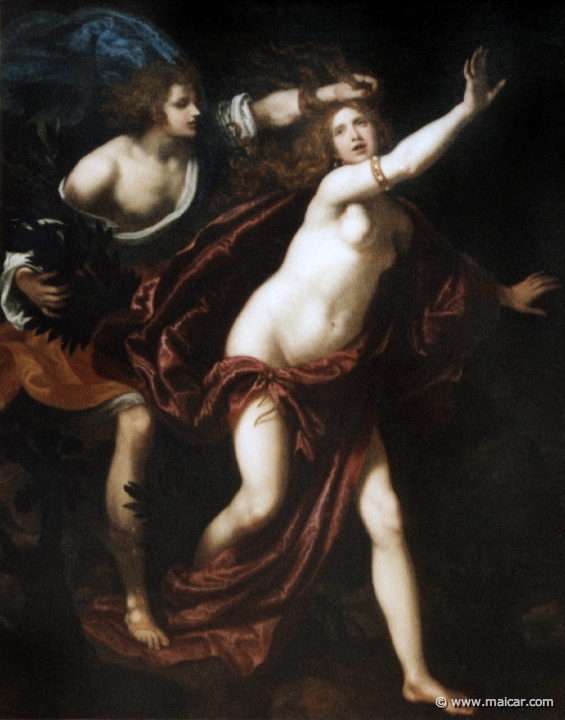
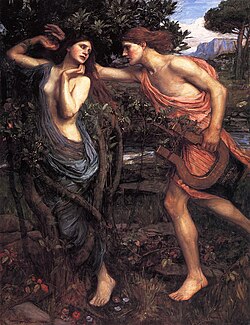
In Ovid’s account, Apollo falls desperately in love with Daphne after Cupid strikes him with a golden arrow. Daphne, struck by a leaden arrow, rejects love and wants to preserve her independence and virginity. Apollo pursues her despite her refusal, and when he is about to catch her, Daphne calls for protection. Her father Peneus transforms her into a laurel tree, allowing her to escape Apollo’s pursuit. Apollo then adopts the laurel as his sacred tree and wears its leaves as a wreath.
Earlier Greek traditions are less uniform. Pausanias connects a Daphne with the Arcadian river god Ladon, while other traditions identify her as the daughter of Amyclas. One tradition also connects her with Gaia and the ancient Delphic oracle. These variations show that Daphne was not originally represented through one fixed biography. Instead, different Greek communities and later writers adapted her story to local landscapes, religious traditions, and ideas about the laurel.
The myth consequently brings together several themes: divine desire, rejection, escape, metamorphosis, nature, and the creation of a sacred symbol. Daphne is not primarily remembered for ruling a supernatural domain or possessing a collection of magical abilities. Her importance lies in the transformation that permanently links her identity with one of Apollo’s most recognizable symbols.
Physical Traits
Ancient sources do not provide Daphne with a detailed standardized physical description. She is generally presented as a beautiful young woman and a nymph associated with the natural world. In Ovid’s version, she is also portrayed as a devoted huntress who prefers a life of chastity rather than marriage or romantic relationships.
Her connection with Artemis, the Greek goddess of the hunt and virginity, is important to this characterization. Daphne’s preference for hunting and independence places her within the same cultural sphere as Artemis and her female companions, although Daphne is not herself a goddess of the hunt.
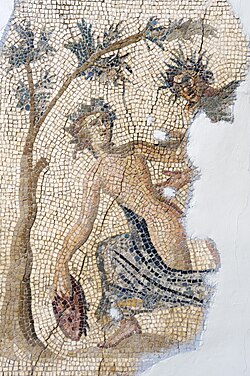
The defining physical characteristic of Daphne is ultimately her metamorphosis. As Apollo closes in, her human body begins changing into a laurel tree. Her feet become rooted to the ground, her body hardens into wood, her arms develop into branches, and her hair becomes foliage. Ovid presents the transformation as a gradual change from human form into tree rather than an instantaneous disappearance.
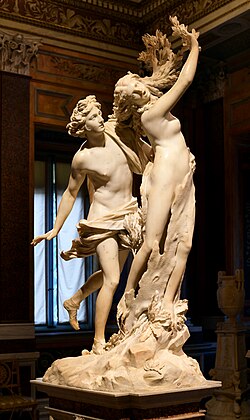
This moment has become particularly important in Western art because it allows artists to portray transformation as something physically visible. Gian Lorenzo Bernini’s Apollo and Daphne, created between 1622 and 1625, captures Daphne at precisely this stage, with roots emerging from her feet and branches and leaves developing from her hands and hair. The sculpture is housed in the Galleria Borghese in Rome.
Family
Daphne’s family background changes according to the tradition being followed. The most influential literary version is Ovid’s, in which Daphne is the daughter of Peneus, the river god associated with Thessaly. Her relationship with a river deity reinforces her connection with the natural landscape and explains why her story is often associated with nymph traditions.
Another important Greek tradition identifies Ladon, the river god of Arcadia, as Daphne’s father. Pausanias specifically connects Daphne with the Arcadian river and notes that the river was famous for the story associated with her. In this tradition, Daphne belongs to the mythology of Arcadia rather than Thessaly.
A third tradition makes Amyclas, a figure associated with Amyclae in Laconia, her father. These different genealogies are not necessarily contradictions within a single canonical story. Greek mythology frequently preserved regional versions of the same mythological figure, with local communities connecting figures to their own rivers, landscapes, cults, and traditions.
Daphne is also connected with Apollo, although not as his wife or lover. Apollo desires her, but Daphne rejects him. In Ovid’s version, Cupid’s arrows create the imbalance: Apollo becomes consumed by love, while Daphne becomes resistant to it. The resulting pursuit drives the narrative toward her transformation. Another version introduces Leucippus, who disguises himself as a woman so that he can accompany Daphne and her companions. His deception is discovered, and he is killed. This episode belongs to a different strand of the Daphne tradition and is not part of Ovid’s principal narrative.
Other names
Daphne’s principal name is Daphnē, the Greek word for “laurel.” Unlike many mythological figures who accumulate numerous formal epithets, Daphne’s most significant alternate designation comes from the plant with which she becomes identified.
She is commonly described as a nymph, although the exact type of nymph varies between traditions and modern classifications. Some accounts associate her with rivers and therefore with Naiads, the freshwater nymphs. Other traditions place her in woodland or mountainous settings, while Pausanias preserves a tradition in which Daphne was an ancient priestess associated with the Delphic oracle.
Daphne is also presented as a huntress and follower of Artemis in traditions emphasizing her rejection of marriage and romantic relationships. This association helps explain why later interpretations frequently connect her with virginity, independence, and chastity.
The word “laurel” is therefore more than a translation of her name. It becomes the defining symbol of her mythology. After her transformation, Apollo declares the laurel sacred and adopts its leaves as a personal emblem. Through this association, Daphne becomes indirectly connected with victory, poetry, music, achievement, and remembrance.
Powers and Abilities
Daphne is not generally portrayed as a goddess possessing a defined supernatural power set. Her mythological status is that of a nymph or nature spirit, and the surviving traditions focus much more on her character and transformation than on magical abilities. Her most notable personal quality is her speed and physical ability as a huntress. In Ovid’s narrative, Daphne runs from Apollo in an attempt to escape his pursuit. Her athleticism allows her to delay him, but Apollo’s divine nature ultimately gives him the advantage.
Her defining supernatural event is metamorphosis. Importantly, Daphne does not normally transform herself through an ability she consciously controls. In Ovid’s account, she appeals for rescue and is changed into a laurel tree. The transformation is therefore better understood as divine intervention than as an innate shapeshifting power.
Once transformed, however, Daphne acquires enormous symbolic importance. Apollo adopts the laurel as his sacred plant, and the tree becomes associated with his identity. Laurel wreaths subsequently become symbols of victory and distinction in Greek and Roman culture, particularly in contexts involving athletic, artistic, musical, and poetic achievement. Daphne’s significance therefore comes less from supernatural strength and more from metamorphosis, resistance, and symbolic transformation. Her story turns an individual escape into a lasting religious and cultural symbol.
Modern Day Influence
Daphne remains one of the most recognizable figures from classical mythology because her story has continued to inspire sculpture, painting, literature, opera, and modern interpretations of myth. The most famous artistic representation is Gian Lorenzo Bernini’s Apollo and Daphne, produced between 1622 and 1625. The marble sculpture depicts the precise moment when Daphne changes from woman into laurel tree. The Galleria Borghese identifies the metamorphosis as the central subject of the work, with the sculpture designed so that viewers can follow the transformation visually as they move around it.
The laurel itself became one of the most enduring consequences of Daphne’s story. Apollo’s association with the plant helped establish the laurel wreath as a symbol of victory and achievement. Its cultural legacy eventually extended beyond ancient religious practice into artistic, literary, academic, and ceremonial traditions. Daphne has also remained important in literature. Ovid’s Metamorphoses became the principal source through which Renaissance and later European artists encountered her story, making the Apollo-Daphne episode particularly influential in European art and poetry.
Music has provided another major reinterpretation. Richard Strauss composed the one-act opera Daphne, with a German libretto by Joseph Gregor. The opera premiered in 1938 and adapts the ancient story considerably, incorporating elements from other classical traditions rather than simply reproducing Ovid.
Modern interpretations often examine Daphne through the themes of unwanted pursuit, consent, autonomy, bodily transformation, and escape. These are interpretive approaches rather than claims about what the ancient Greeks themselves intended. What remains constant in the mythology is the narrative structure: Apollo pursues Daphne, Daphne refuses him, and her transformation into the laurel prevents the pursuit from reaching its intended conclusion.
Daphne’s lasting importance comes from this unusual combination of myth and symbol. She is simultaneously a nymph, a hunted woman, a transformed figure, and the mythological explanation for Apollo’s sacred laurel. Her story demonstrates how Greek mythology could use a transformation in nature to explain the origins of a religious symbol while leaving later generations with a story open to radically different interpretations.
Related Images






Source
Bernini, G. L. (1622–1625). Apollo and Daphne [Marble sculpture]. Galleria Borghese, Rome.
https://www.collezionegalleriaborghese.it/en/opere/apollo-and-daphne
Encyclopaedia Britannica. (n.d.). Daphne. Retrieved September 11, 2026, from
https://www.britannica.com/topic/Daphne-Greek-mythology
Encyclopaedia Britannica. (n.d.). Metamorphoses. Retrieved September 11, 2026, from https://www.britannica.com/art/Metamorphoses-poem-by-Ovid
Hamilton, E. (1942). Mythology: Timeless tales of gods and heroes. Little, Brown and Company.
National Gallery of Art. (n.d.). Apollo pursuing Daphne. Retrieved September 11, 2026, from
https://www.nga.gov/educational-resources/greco-roman-origin-myths/apollo-pursuing-daphne
Ovid. (2004). Metamorphoses (D. E. Hill, Trans.). Aris & Phillips. (Original work published ca. 8 CE)
Pausanias. (1918). Description of Greece (W. H. S. Jones, Trans.). Harvard University Press. https://www.perseus.tufts.edu/hopper/text?doc=Perseus:text:1999.01.0160
Strauss, R. (1938). Daphne, Op. 82 [Opera]. Bärenreiter-Verlag.
Frequently Asked Questions
Who is Daphne in Greek mythology?
Daphne is a Greek nymph best known for escaping Apollo’s pursuit by transforming into a laurel tree, which later became sacred to Apollo and a symbol of victory.
Why did Daphne turn into a laurel tree?
Daphne was transformed into a laurel tree to escape Apollo’s unwanted pursuit. In Ovid’s version, she appeals to her father Peneus for protection.
Who was Daphne’s father?
Daphne’s father varies by tradition. Ovid names Peneus, the Thessalian river god, while other Greek traditions identify Ladon or Amyclas as her father.
Was Daphne a goddess in Greek mythology?
No. Daphne is generally described as a nymph or nature spirit rather than a goddess. Her traditions variously connect her with rivers, wilderness, hunting, and the laurel.
Why is Daphne associated with the laurel?
Daphne became a laurel tree while escaping Apollo. Apollo then made the laurel sacred to himself, linking it with victory, poetry, achievement, and remembrance.


