


Birrangulu : The Gamilaraay Spirit of Fertility and Water
At a glance
| Description | |
|---|---|
| Origin | Koori Mythology |
| Classification | Spirits |
| Family Members | Baiame (husband), Daramulum (Son) |
| Region | Australia |
| Associated With | Fertility, Water, Flooding, Renewal |
The Mythlok Perspective
Kamohoaliʻi represents a departure from the traditional humanised deity. Within the Mythlok framework, he is understood less as a god who governs the sea and more as the ocean itself choosing to be known. Unlike Mediterranean deities such as Poseidon or Neptune, shaped in the human image to be bargained with, Kamohoaliʻi remains fundamentally elemental. While he shares the predatory divinity of the Fijian shark god Dakuwaqa, he is defined by his sacred role as a navigator, marking the limits of human dominion.
Birrangulu
Introduction
Birrangulu, also recorded as Birrahgnooloo, is a female spiritual figure associated with the Gamilaraay (Kamilaroi) people of northern New South Wales and southern Queensland. She is principally remembered in recorded traditions as a figure connected with fertility, water and flooding, and as one of the wives of Baiame, a major ancestral figure in several Aboriginal traditions of southeastern Australia.
Birrangulu is particularly significant because her stories connect spiritual relationships with the natural landscape. Water is not simply a background element in her mythology. Springs, rivers, lakes, floods and underground waterways become part of the events through which ancestral beings shape and explain Country.
One of the best-known stories involving Birrangulu appears in K. Langloh Parker’s early twentieth-century collection The Euahlayi Tribe. In the story of the origin of Narran Lake, Birrangulu and Baiame’s other wife become involved in an encounter with crocodile-like beings known as kurreahs. Their disappearance, rescue and the movement of water through the landscape become part of the explanation for the formation of Narran and related waterways.
The surviving material about Birrangulu is relatively limited, and different sources preserve different spellings and details. She is therefore better understood through the relationships, landscapes and natural forces associated with her than through a fixed character biography.
Physical Traits
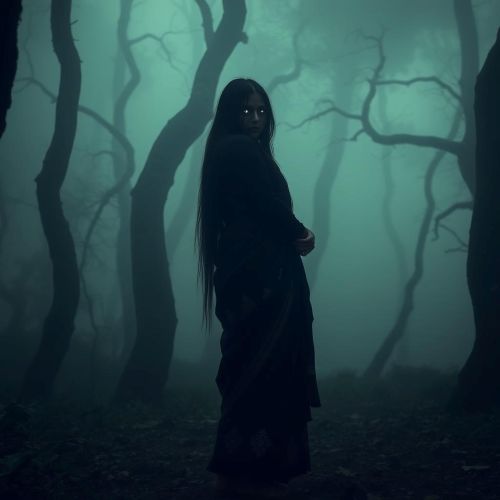
Birrangulu is one of those Aboriginal spiritual figures for whom the surviving sources provide relatively little standardized physical description. The most frequently repeated description concerns her face. The name Birrangulu or Birrahgnooloo has been interpreted in some sources as meaning “face like an axe handle”, with the Gamilaraay elements birra, associated with an axe handle, and ngulu, associated in the recorded interpretation with the forehead. This has led to descriptions of Birrangulu as having a long, thin face.
Beyond this, there is no sufficiently consistent evidence for a detailed physical portrait that can confidently be treated as traditional. Modern summaries sometimes associate Birrangulu with an emu, but that detail is not sufficiently consistent across the principal sources to present it as an established defining characteristic.
This distinction matters when representing Birrangulu visually. Her importance does not depend upon an elaborate supernatural appearance. The strongest surviving descriptions concern her identity, relationships and connection with water and fertility rather than clothing, weapons or dramatic physical features. As with many Aboriginal ancestral traditions, stories about beings such as Birrangulu can operate through relationships between people, animals, landscape and Country rather than through the character designs familiar from European mythology.
Family
Birrangulu is traditionally described in recorded accounts as one of Baiame’s two wives. The other wife is variously recorded as Cunnunbeillee, Ganhanbili or related forms, reflecting differences between sources and spellings.
Birrangulu and Baiame are also commonly identified as the parents of Daramulum, although family relationships involving Daramulum vary between Aboriginal traditions. Some accounts describe Daramulum as Baiame’s son, while other traditions preserve different relationships. The association between Birrangulu and Daramulum should therefore be understood within the particular traditions in which it is recorded rather than applied universally across Aboriginal Australia.
One of the most important stories involving Birrangulu concerns the origin of Narran Lake. According to Parker’s recorded account, Baiame left Birrahgnooloo and his other wife while he went hunting for honey. The women went to Coorigel Spring, where they encountered crocodile-like beings called kurreahs. The creatures swallowed them and carried them through an underground watercourse toward the Narran River. The movement of the water through this underground passage caused the spring and parts of the river to become dry.
Baiame eventually discovered what had happened and followed the watercourse. He confronted the creatures, rescued his wives and killed the kurreahs. In the story, the struggle of the dying creatures contributes to the formation of lakes in the region. The narrative is therefore not simply a family story. It links Birrangulu directly to a landscape in which water, animals and ancestral actions are interconnected.
Other names
Birrangulu appears under several spellings because early researchers recorded Aboriginal languages using different orthographic systems. The most familiar alternative is Birrahgnooloo, the form used by K. Langloh Parker in her published accounts. Birrangulu is the form commonly used in more recent reference material. Other spellings, including Birrangula and Birrahgnulu, may also appear in secondary sources. These variations do not necessarily represent different beings. They often reflect differences in pronunciation, transcription and the conventions used by researchers recording Aboriginal languages during different periods.
There is also a potentially confusing linguistic similarity with Birrangula, a name recorded in relation to the Guwamu language and identified in some sources with the Creator. This should not automatically be treated as another name for the Gamilaraay Birrangulu. The two should remain distinct unless a source establishes a connection. The spelling Birrahgnooloo remains particularly useful when researching older ethnographic material because it is the form under which some of the earliest published accounts can be found.
Powers and Abilities
Birrangulu is principally associated with fertility, water and flooding. Secondary reference works describe her as a fertility spirit who could send floods when properly asked. The association with fertility is significant because water is fundamental to the productivity and renewal of Country. Her connection with flooding should not be reduced to the idea of a conventional “rain goddess.” The available sources specifically emphasize floods and water, rather than giving her a broad catalogue of weather powers. There is also insufficient evidence to attribute unrelated abilities such as control over the sun, storms generally, animals or the underworld.
Her role in the Narran Lake tradition gives her another important association: the transformation of landscape through water. The story places Birrangulu within a chain of events involving springs, underground waterways, rivers and lakes. Water becomes an active force through which the landscape is explained and remembered.
Her fertility association also makes Birrangulu a figure connected with renewal and the continuation of life. Rather than treating fertility purely as human reproduction, it is more useful to understand the concept through the broader relationship between water, Country and living things. This makes Birrangulu an especially interesting figure within Aboriginal traditions because her mythology demonstrates how ancestral narratives can connect spiritual identity with particular places and natural processes.
Modern Day Influence
Birrangulu’s modern significance comes primarily through the preservation and study of Gamilaraay cultural traditions, language and historical records. Much of what is known about her in written English comes through ethnographic publications, particularly the work of K. Langloh Parker, whose recordings preserve stories associated with the Euahlayi and neighbouring Aboriginal communities. Her work is valuable as a historical record, but it should also be read with awareness that nineteenth- and early twentieth-century ethnographic accounts were created through the perspectives and recording practices of outsiders.
Modern scholarship has also contributed to a better understanding of Gamilaraay language and culture. The Gamilaraay, Yuwaalaraay & Yuwaalayaay Dictionary, for example, provides important linguistic material for interpreting names and terminology associated with the region. Birrangulu consequently remains relevant not because she has become a major figure in modern popular culture, but because her story forms part of the surviving record of Aboriginal understandings of Country, water, family and ancestral action.
Her story also demonstrates why Aboriginal mythology should not be treated as one uniform Australian belief system. Birrangulu belongs to a particular cultural and linguistic context, and details associated with her should not automatically be transferred to every Aboriginal community. For modern readers, Birrangulu is best understood as a spiritual figure whose story brings together fertility, water and landscape. Her mythology shows how a story about an ancestral woman and her family can simultaneously preserve cultural memory about a river system, a lake and the forces that shape Country.
Related Images




Source
Austin, P. K. (2014). A grammar of Yuwaalaraay and Gamilaraay: A description of two New South Wales languages based on 160 years of records [Doctoral dissertation, Australian National University]. ANU Open Research Repository. https://openresearch-repository.anu.edu.au/items/9b691427-fb9f-4f1f-bd4a-518f0c940953
Austin, P. K. (2017). Yaluu: A recovery grammar of Yuwaalaraay and Gamilaraay: A description of two New South Wales languages based on 160 years of records. Australian National University Press.
https://openresearch-repository.anu.edu.au/items/851c191e-94ef-4049-b0d1-d363b440f622
Fuller, R. S., Norris, R. P., & Trudgett, M. (2014). The astronomy of the Kamilaroi people and their neighbours. Journal of Astronomical History and Heritage, 17(2), 171–179. https://arxiv.org/pdf/1311.0076.pdf
Giacon, J. (2020). Wiidhaa: An introduction to Gamilaraay. Australian National University Press. https://press.anu.edu.au/publications/textbooks/wiidhaa
General Books LLC. (2010). Australian mythology: Aboriginal goddesses, Aboriginal gods, Australian Aboriginal deities, Australian Aboriginal mythology. General Books LLC.
MythMania. (n.d.). Birrahgnooloo—Aboriginal Australian deity. Retrieved October 1, 2026, from https://www.mythmania.com/codex/birrahgnooloo
Nair, V. (2020, August 31). Developing a Gamilaraay Bariyan Ngama standpoint theory for qualitative research. Australian Association for Research in Education. https://www.aare.edu.au/publications/aare-conference-papers/show/15133/developing-a-gamilaraay-bariyan-ngama-standpoint-theory-for-qualitative-research
Sveiby, K.-E., & Skuthorpe, T. (2006). Treading lightly: The hidden wisdom of the world’s oldest people. Allen & Unwin.
Frequently Asked Questions
Who is Birrangulu in Aboriginal mythology?
Birrangulu is a Gamilaraay spiritual figure associated with fertility, water and flooding. She is also recorded as one of Baiame’s wives.
What is Birrangulu the goddess of?
Birrangulu is traditionally described as a fertility spirit associated with water and floods, linking her with renewal and the productivity of Country.
Who is Birrangulu's husband?
Birrangulu is recorded as one of Baiame’s two wives. Baiame is an important ancestral figure in several Aboriginal traditions of southeastern Australia.
Is Birrangulu the mother of Daramulum?
Some recorded Gamilaraay-related traditions identify Birrangulu as Daramulum’s mother. Family relationships vary across different Aboriginal traditions.
What is Birrangulu's connection to Narran Lake?
Birrangulu appears in a recorded story about the origin of Narran Lake, involving Baiame, another wife, crocodile-like beings and the movement of water.


