


Raven Mocker : The Cherokee Witches Who Stole Life
At a glance
| Description | |
|---|---|
| Origin | Cherokee Mythology |
| Classification | Spirits |
| Family Members | N/A |
| Region | United States of America |
| Associated With | Death |
Mythlok Perspective
In Mythlok’s Perspective, the Raven Mocker feels more unsettling than many familiar death spirits because it does not merely announce death, it exploits it. Like the Banshee, it is associated with the ominous approach of death, while its hunger for stolen life makes it closer to the vampire. Yet unlike both, the Raven Mocker is rooted in Cherokee traditions of witchcraft and spiritual protection. That combination makes it less a conventional monster and more a powerful expression of fear surrounding the boundary between life and death.
Raven Mocker
Introduction
The Raven Mockers are among the most feared supernatural beings in Cherokee tradition. Known in Cherokee as Kâ’lanû Ahkyeli’skï, they are described not as a single individual but as a class of particularly dangerous witches who prey upon people who are sick or approaching death. James Mooney, whose late nineteenth-century ethnographic work remains one of the principal written records of Cherokee traditions, describes the Raven Mocker as the most dreaded of Cherokee witches. He records that they may be either male or female and are feared because they can take the remaining life of a dying person and add those years to their own existence.
The Raven Mockers occupy a disturbing place within Cherokee beliefs about illness, death, witchcraft and the unseen forces that can affect human life. Their approach is marked by a supernatural flight through the night, accompanied by fire, sparks, rushing wind and a distinctive cry resembling that of a raven. Their stories therefore combine the fear of death with the fear of a hidden enemy who cannot ordinarily be seen.
Physical Description
Raven Mockers do not have one fixed physical appearance. Mooney records that they may be either men or women and that they usually appear withered and old, a condition associated with the many lives they have taken and added to their own. Their apparent age is therefore connected directly to their supernatural activity rather than simply being a natural characteristic.
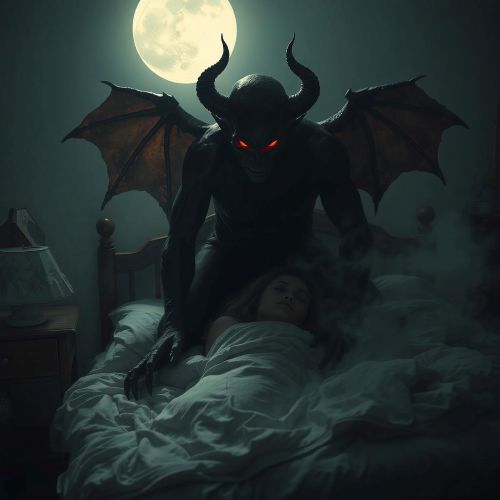
Their most striking appearance occurs when they travel at night. According to Mooney’s account, a Raven Mocker takes to the air in a fiery form, extending the arms like wings while sparks trail behind. The movement is accompanied by the sound of rushing wind. During the flight, the being produces a cry resembling the sound of a raven diving through the air. Hearing that cry was considered an ominous sign because it indicated that someone’s life was about to end.
Once at the home of a dying person, Raven Mockers become invisible. This invisibility makes them particularly difficult to confront, allowing them to enter and torment the sick without being detected by ordinary observers. Mooney’s account emphasizes this unseen quality rather than the black feathers, glowing eyes, claws or other monstrous features sometimes added in modern retellings.
Mythological Context
The Raven Mocker belongs to the broader Cherokee tradition concerning witchcraft and supernatural causes of illness and death. In the traditional worldview recorded by Mooney, witches could interfere with the lives of others, and the Raven Mockers represented an especially dangerous form of this power. Their defining activity was not simply killing someone but taking the person’s remaining life for themselves.
A Raven Mocker typically targets someone already weakened by illness or approaching death. At night, it travels to the victim’s home and joins other Raven Mockers who may already be there. They enter invisibly and frighten or torment the sick person until death occurs. Afterward, the Raven Mockers take the victim’s heart, while the body may show no obvious external wound.
This makes the Raven Mocker different from a conventional monster that attacks healthy travelers or hunts people in the wilderness. Its particular domain is the threshold between life and death, where an already vulnerable person becomes the target of supernatural predation.
Origins
There is no surviving Cherokee creation story that explains the Raven Mockers as a species with a single point of origin. Instead, they appear within the older Cherokee traditions surrounding witchcraft, medicine, disease and death.
Mooney recorded the Raven Mocker tradition in Myths of the Cherokee, published as part of the Bureau of American Ethnology’s nineteenth annual report. His Sacred Formulas of the Cherokees, based on manuscripts written by Cherokee medicine people, also identifies the Raven Mocker as the most feared of the witches and connects it with the practice of shortening another person’s life to extend one’s own.
These records should be understood as historical documentation of Cherokee traditions rather than as evidence of a single, unchanged version of Cherokee belief extending unchanged through all periods and communities.
Notable Members
Unlike mythological traditions centered on named gods or heroes, Cherokee accounts do not provide a genealogy or established roster of individual Raven Mockers. The Raven Mocker is a category of supernatural witch rather than a single named personality.
Mooney’s account consequently refers to Raven Mockers collectively. It even describes several of them gathering at the home of a dying person. This collective portrayal reinforces the distinction between the Raven Mocker as a type of being and figures such as a named culture hero or deity.
Later Cherokee literature and storytelling have sometimes created individual Raven Mocker characters. These should be treated as later creative interpretations rather than as named members of the traditional class.
Relationship with Other Beings
Raven Mockers exist within the wider Cherokee supernatural world of witches, medicine people and other beings associated with illness, death and spiritual power. They are particularly notable because they are feared not only by ordinary people but also by other witches. Mooney’s Sacred Formulas describes the Raven Mocker as the most dreaded among them.
Their principal opposition comes from Cherokee medicine people. A knowledgeable medicine person could remain with a sick individual and prevent Raven Mockers from entering the house. Traditional accounts further state that someone possessing the necessary spiritual knowledge could recognize a Raven Mocker and that the witch would then die within seven days.
This creates a supernatural conflict between two forms of power: the Raven Mocker seeks to shorten another person’s life, while the medicine person protects the vulnerable and attempts to preserve the proper course of life.
Similar Beings
The Raven Mockers can be compared with other Cherokee witch traditions, particularly owl witches, because both belong to a wider category of malevolent supernatural practitioners associated with harm and death. They should not, however, be treated as interchangeable beings.
The Raven Mocker has a distinctive identity defined by its predation upon the dying, its theft of remaining years, its fiery nocturnal flight and its raven-like cry. The raven itself also has a separate place in Cherokee tradition. Mooney notes that the bird was not especially prominent in Cherokee folk belief apart from its association with the Raven Mocker.
Consequently, the Raven Mocker is better understood as a particular form of witchcraft figure rather than simply a supernatural raven or bird monster.
Symbolism and Interpretations
The Raven Mocker’s central symbolism revolves around death, vulnerability and the violation of the natural boundary between life and death. Its victims are already weakened, yet the Raven Mocker is portrayed as actively hastening their passing in order to gain something for itself.
The theft of remaining years gives the figure an especially striking moral dimension. Life is treated almost as something that can be stolen, accumulated and extended at another person’s expense. The Raven Mocker therefore represents an extreme form of selfishness in which another person’s death becomes the source of one’s own continued existence.
Its invisibility also reinforces the idea of an unseen threat. The sick person and their family cannot necessarily identify what is causing the suffering, while the medicine person represents knowledge capable of recognizing and resisting that hidden danger.
These interpretations should be regarded as analytical readings of the tradition rather than definitive statements about what every Cherokee storyteller or community understands the Raven Mocker to symbolize.
Modern Influence
The Raven Mocker continues to appear in modern Cherokee and broader Indigenous storytelling, literature and artistic representation. Contemporary treatments have sometimes adapted the traditional figure for new historical settings and narratives.
One notable example is Cherokee writer and storyteller Sequoyah Guess’s novel Kholvn, published in 1992, whose title refers to the Raven Mocker. Scholarship on Cherokee literature identifies the novel as an example of the figure being carried into modern storytelling while retaining its association with cannibalism, witchcraft and the theft of life.
The Raven Mocker has also been adapted in works dealing with Cherokee history and removal. In historical drama concerning the Trail of Tears, for example, the figure has been reinterpreted as a symbolic presence associated with death and suffering. Scholars have noted that such portrayals can differ considerably from the traditional Raven Mocker recorded by Mooney.
Its continued appearance in modern creative works demonstrates the adaptability of Cherokee supernatural traditions. At the same time, the Raven Mocker is best understood through its Cherokee context: not simply as an Appalachian monster or a horror creature, but as a powerful witch figure connected to traditional understandings of illness, death, spiritual danger and the protection offered by medicine people.
Related Images



Sources
Mooney, J. (1995). Myths of the Cherokee. Dover Publications. (Original work published 1902).
Norton, T. L. (2014). Cherokee myths and legends: Thirty tales retold. McFarland & Company.
Duncan, B. R. (Ed.). (1998). Living stories of the Cherokee. University of North Carolina Press.
King, L. H. (1977). The Cherokee story-teller: The Raven Mocker. Journal of Cherokee Studies, 2(1), 190–194.
Cherokee Historical Association. (n.d.). Legendary fears. https://cherokeehistorical.org/attractions/qualla-ween/legendary-fears/
United Keetoowah Band of Cherokee Indians. (2019). Guess named Lifetime Achievement winner by American Book Awards. https://www.ukb-nsn.gov/post/guess-named-lifetime-achievement-winner-by-american-book-awards
Appalachian Historian. (2026). The Raven Mocker: Cherokee death spirit of the Southern Appalachians. https://appalachianhistorian.org/the-raven-mocker-cherokee-death-spirit-of-the-southern-appalachians/
Smithsonian Institution. (n.d.). The Swimmer Manuscript: Cherokee sacred formulas and medicinal prescriptions. Smithsonian Libraries and Archives. https://www.si.edu/object/swimmer-manuscript-cherokee-sacred-formulas-and-medicinal-prescriptions%3Aslasro_89754
Frequently Asked Questions
What is a Raven Mocker in Cherokee mythology?
A Raven Mocker is a feared type of Cherokee witch believed to prey on the sick and dying, stealing their remaining life to extend its own existence.
What does a Raven Mocker look like?
Raven Mockers are traditionally described as withered old men or women. They can become invisible and are said to take a fiery form when flying at night.
What powers does a Raven Mocker have?
Raven Mockers can become invisible, fly through the night in fiery form, steal a dying person’s remaining life, and take the victim’s heart after death.
How do Raven Mockers attack their victims?
Raven Mockers target people who are close to death, entering their homes unseen and draining their life force. They are associated with a chilling raven-like cry.
How are Raven Mockers defeated?
Cherokee tradition holds that knowledgeable medicine people could recognize and confront Raven Mockers. Once identified in their true form, a Raven Mocker was believed to die within seven days.



JM Gunn
Hello Nitten Nair,
I am a book author. Not a good one and no one knows me.. I enjoy writing about myths and ledges , bringing them into modern day.
I have been learning about the raven mocker and it would make for a great story. I found your page very helpful.
I saw the first picture of the raven mocker over a fire under the moon to be perfect for a book cover.
I was wondering where it came from and how I could get permission to use it.
thank you