


Ay-Khuuchin : The Khahass Warrior Maiden of the Three Realms
At a glance
| Description | |
|---|---|
| Origin | Khakass Mythology |
| Classification | Mortals |
| Family Members | N/A |
| Region | Russia |
| Associated With | Warrior maidens, Courage, Cosmic struggle, Shamanic journeys, Protection |
The Mythlok Perspective
In Mythlok’s Perspective, Ay-Khuuchin represents one of the strongest examples of the warrior-maiden archetype in Siberian folklore. Unlike many legendary heroines whose stories revolve around romance or tragedy, her narrative focuses on resistance, leadership, and survival across cosmic realms. Her connection to birds, horses, and transformation reflects the deep shamanic roots of Khakass spiritual traditions. What makes her especially compelling is the balance between human vulnerability and mythic scale, allowing her to confront gods and monsters without fully becoming divine herself. Similar to figures like Mulan or Atalanta, Ay-Khuuchin embodies a culture’s admiration for women who transcend social limitations through courage and skill. Yet her Siberian setting gives her legend a uniquely spiritual and elemental atmosphere rarely seen in more widely known epics.
Ay-Khuuchin
Introduction
Among the many heroic figures preserved in the oral traditions of Siberia, Ay-Khuuchin stands out as one of the most fascinating female warriors in Khakass folklore. The Khakass people, a Turkic-speaking indigenous community from southern Siberia, preserved their myths and epics through generations of oral storytelling. These narratives were not simply entertainment. They carried spiritual beliefs, cultural memory, and ancient understandings of the universe.
Ay-Khuuchin, sometimes written as Ai-Khuuchin or Ai-Huuchin, is the central heroine of one of the most celebrated Khakass heroic epics. Her story belongs to the tradition of the alyp-khys, the legendary “fighter maidens” who appear throughout Turkic and Siberian mythology. Scholars often compare the structure and scale of her tale to the Yakut Olonkho epics because of its cosmic themes, heroic trials, and layered symbolism.
The epic gained wider academic attention after folklorist V. E. Mainogasheva published collected versions of the tale in 1997, based on performances by traditional storytellers including P. V. Kurbizhekov. This publication helped preserve one of the finest examples of Khakass oral literature for future generations.
Ay-Khuuchin’s narrative moves through the three realms of Khakass cosmology: the Upper World of celestial beings, the Middle World of humans, and the Lower World inhabited by monstrous and destructive forces. Throughout these journeys, she acts as both protector and challenger, confronting enemies that threaten balance and order. Unlike many mythological heroines defined solely through beauty or romance, Ay-Khuuchin is remembered primarily for courage, leadership, and resistance against overwhelming powers.
Her story also reflects the blending of ancient Turkic beliefs, shamanic traditions, and older Scytho-Iranian cultural influences that shaped the spiritual landscape of Siberia. Today, Ay-Khuuchin remains an important symbol of Khakass identity and one of the strongest female figures in Central Asian folklore.
Physical Traits
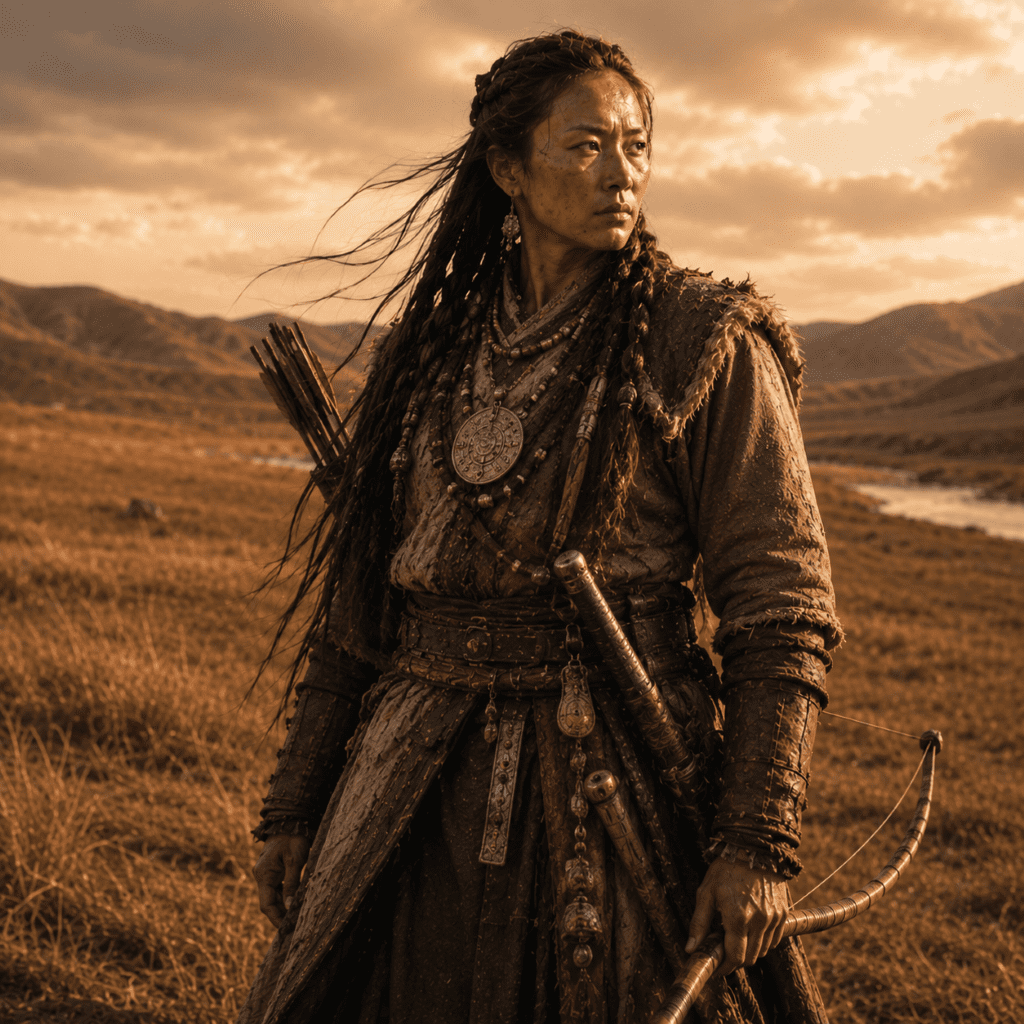
Ay-Khuuchin is portrayed as a warrior maiden of extraordinary beauty and immense strength. In Khakass heroic poetry, physical descriptions are intentionally exaggerated to elevate legendary figures beyond ordinary humans. Her appearance combines grace and terrifying power, emphasizing her unique role as both protector and destroyer.
Traditional storytellers describe her through poetic formulas commonly used in Siberian Turkic epics. She possesses the imposing stature of a bogatyr, a heroic warrior capable of battling supernatural enemies. Despite her femininity, she matches or surpasses male heroes in combat ability, reflecting the respected role of warrior women in some ancient steppe traditions.
Her clothing and armor are often linked to nature and animal symbolism. Some versions of the epic associate her with birds such as swallows or cuckoos, imagery connected to ancient totemic beliefs and shamanic transformation. These avian associations suggest speed, spiritual mobility, and the ability to move between worlds.
Ay-Khuuchin’s physical presence is designed to inspire awe. The epic repeatedly contrasts her radiant appearance with the monstrous beings of the Lower World. This visual opposition symbolizes the struggle between order and chaos, civilization and destruction.
Although she possesses immense strength, her beauty is never treated as passive decoration. Instead, it reinforces her authority and heroic status. In Khakass folklore, Ay-Khuuchin represents the ideal balance of wisdom, courage, and physical power.
Family
The family background of Ay-Khuuchin varies across different oral versions of the epic. Like many heroic traditions preserved through storytelling rather than written texts, details shifted depending on the narrator and regional dialect.
Some versions describe her origins as supernatural. One particularly striking narrative claims her parents were a light-brown mare and stallion, reflecting the sacred importance of horses in Turkic culture. Horses were viewed not only as companions in battle but also as spiritual beings capable of intelligence and communication. Their connection to Ay-Khuuchin reinforces her destiny as a legendary protector.
Other variants focus less on biological lineage and more on symbolic kinship. In these tales, Ay-Khuuchin serves as guardian of her brother and sister, placing her within a family structure tied to duty and sacrifice. These relationships highlight her role as a defender of both household and homeland.
Khakass heroic epics frequently include themes of miraculous birth, divine intervention, or childlessness overcome through supernatural means. In some versions, heavenly beings known as the Chaiaan gods influence the heroine’s destiny before birth, marking her as someone chosen for extraordinary deeds.
Unlike many mythological heroes whose stories revolve around dynasties or royal succession, Ay-Khuuchin’s tale centers more on personal heroism and cosmic struggle. Her family exists mainly to reinforce her responsibilities rather than define her identity.
Other names
The heroine is most commonly known as Ay-Khuuchin, though several alternate spellings exist due to transliteration differences between Khakass, Russian, and English scholarship. Variants such as Ai-Khuuchin and Ai-Huuchin are also widely used in academic texts. Her name appears in Khakass script as “Алыптың нымах Ай Хуучын,” referring to the heroic tale itself. The word “Ay” or “Ai” may carry associations with the moon, radiance, or celestial light in Turkic linguistic traditions.
Ay-Khuuchin is also associated with the broader archetype of the alyp-khys, meaning “fighter maiden.” This classification places her among a larger tradition of female warrior heroes found across Siberian and Central Asian folklore. In some narratives, storytellers describe her as a piligchi or kerigchi, terms referring to women who possess secret knowledge and understanding of all three cosmic realms. These titles connect her not only to warfare but also to wisdom and spiritual insight.
The existence of multiple names and titles reflects the fluid nature of oral storytelling. As epics passed through generations, pronunciations and descriptions evolved while preserving the core identity of the heroine.
Powers and Abilities
Ay-Khuuchin’s abilities combine martial skill, spiritual knowledge, and supernatural transformation. Unlike gods who command reality itself, her powers are rooted in extraordinary courage and mastery gained through struggle. Her greatest strength is combat. She battles heavenly beings, monsters of the Lower World, and destructive enemies that threaten cosmic balance. The epic often portrays her victories through dramatic hyperbole, emphasizing her ability to overcome impossible odds.
One of her most fascinating abilities is transformation. Some versions describe her changing into birds or beasts, especially swallows and cuckoos. These transformations connect her to shamanic traditions in Siberia, where spiritual practitioners symbolically traveled between worlds through animal forms.
Ay-Khuuchin is also linked to magical healing and resurrection. The epic references sacred items such as living water, triple-joint grass, and white silk cloths capable of restoring fallen warriors. These elements reveal the strong spiritual dimension of Khakass mythology. Another important aspect of her power is wisdom. She understands the structure of the three realms and can foresee danger or guide others through spiritual challenges. This knowledge places her somewhere between warrior and shaman.
In several tales, she is aided by a talking horse capable of giving advice and warnings. Intelligent horses appear throughout Turkic epics as companions who bridge the human and supernatural worlds. Some scholars also note themes of symbolic rebirth in her story. Certain variants portray Ay-Khuuchin adopting the role of a male warrior or ruler after transformation, reflecting shifting ideas about authority, gender, and heroism within ancient societies.
Modern Day Influence
Kamohoaliʻi continues to hold cultural relevance in Hawaiʻi today, not as a distant myth but as a living symbol of ancestral memory and environmental responsibility. Sharks are still regarded as aumakua, family guardians who watch over descendants, and this belief is deeply rooted in his legacy. His stories are preserved through hula, storytelling, and educational programs that emphasize respect for marine life and traditional ecological knowledge. In modern literature, visual art, and even conservation movements, Kamohoaliʻi is often invoked as a reminder that the ocean is not a resource to be exploited but a relative to be honored. For many Hawaiians, his presence endures in the waves, reinforcing the sacred bond between people, ancestors, and the sea.
Related Images
Source
Aeva, M. A., et al. (Eds.). (2022). Khakas folklore. [Bibliographic index]. Tsinghua Journal. https://tsj.enu.kz/index.php/new/article/view/588
Koryoglou, Kh. G., & Mainogasheva, V. E. (2014). Olonkho and the Khakass heroic epos “Ai-Khuuchin”. Gramota.net. https://www.gramota.net/en/article/phil20150112/fulltext
Lvova, E. (2020). Biomorphic images of comparison in Yakut Olonkho and other Siberian epics. Agathos International Review. https://www.agathos-international-review.com/issues/2020/21/Lvova.pdf
Mainogasheva, V. E. (Ed.). (1997). Khakasskii geroicheskii epos Ai-Khuuchin = Alyptyng nymakh Ay Khuuchyn (Pamyatniki folklora narodov Sibiri i Dal’nego Vostoka, Vol. 16). Nauka, Sibirskoe predpriyatie RAN. https://new.nlrs.ru/open/104549
Potapova, L. (2025). “Blesk, siyanie” v altayskom i khakasskom geroides. Sibirskii philologicheskii zhurnal. https://www.philology.nsc.ru/journals/spj/pdf/2025_3/17.pdf
Sibirya Arastirmalari Dergisi. (2014). The legend: Peculiarities of plot and poetics of Khakass heroic epos “Three times married Khan-Mirgen”. https://dergipark.org.tr/en/pub/sad/issue/11202/133786
Mainogasheva, V. E. (1997). Ay-Khuuchin: Khakass Heroic Epic. Novosibirsk: Nauka.
Shevtsov, V. N. (1997). Musicological commentary and recordings in Ay-Khuuchin. Novosibirsk: Nauka.
Kurbizhekov, P. V. (1997). Oral performance of Ay-Khuuchin. In Mainogasheva (Ed.), Ay-Khuuchin. Novosibirsk: Nauka.
Frequently Asked Questions
Who is Ay-Khuuchin in Khakass mythology?
Ay-Khuuchin is a legendary warrior maiden from Khakass folklore known for battling supernatural enemies across the three cosmic realms.
Is Ay-Khuuchin a goddess?
No, Ay-Khuuchin is usually portrayed as a heroic mortal warrior rather than a full goddess, though she possesses extraordinary abilities.
What powers does Ay-Khuuchin have?
She possesses immense strength, combat skill, spiritual knowledge, transformation abilities, and access to magical healing artifacts.
What does Ay-Khuuchin represent?
Ay-Khuuchin symbolizes courage, resistance, protection, and the preservation of balance against destructive forces.
Why is Ay-Khuuchin important today?
Her epic preserves Khakass cultural identity and remains important in folklore studies, indigenous heritage, and discussions about female heroes in mythology.
