
Apedemak : The Lion-Headed War God of Nubia
At a glance
| Description | |
|---|---|
| Origin | Nubian Mythology |
| Classification | Gods |
| Family Members | Amesemi (Wife) |
| Region | Sudan |
| Associated With | War, Kingship, Protection, |
The Mythlok Perspective
In Mythlok’s Perspective, Apedemak represents a rare example of a civilization asserting its identity through divine imagery. Unlike many war gods who derive their authority from chaos or destruction, he embodies structured power tied to kingship and protection. His lion form reflects natural dominance, but his role in coronation rituals reveals a deeper political significance. When compared to Sekhmet from Egypt or Ares from Greek tradition, Apedemak stands apart by combining warfare with statecraft. He is closer in spirit to figures like the Mesopotamian Ninurta, where war serves order rather than chaos.
Apedamak
Introduction
Apedemak, also spelled Apademak, stands as one of the most distinctive and powerful deities of ancient Nubia and the Kingdom of Kush. Worshipped primarily during the Meroitic period from around the 3rd century BCE to the 4th century CE, he was a uniquely indigenous god who represented the strength, independence, and identity of the Kushite civilization. Unlike many Nubian deities influenced by Egyptian traditions, Apedemak retained a deeply local character, reflecting the cultural confidence of Meroe at its height.
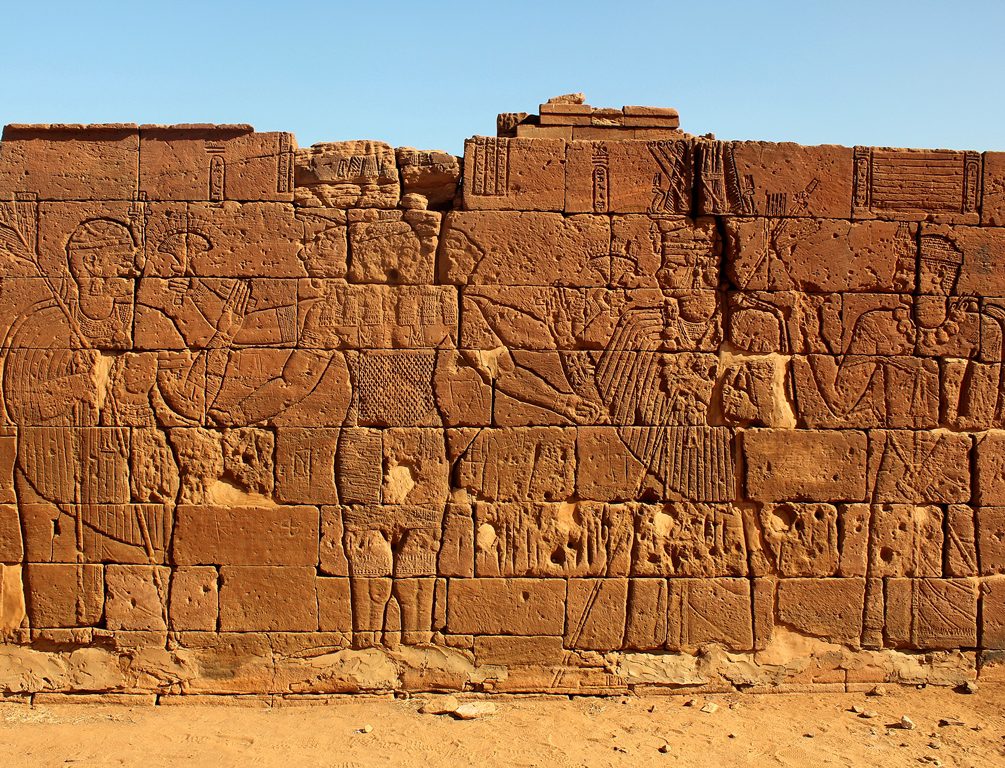
He was primarily revered as a god of war, conquest, and royal authority. His presence is strongly attested in temple complexes such as Naqa and Musawwarat es-Sufra, where elaborate carvings portray him as a divine protector of kings and a force behind military success. In several depictions, Apedemak appears almost equal in stature to Amun, highlighting his importance within the Kushite religious hierarchy. More than just a war deity, Apedemak embodied the spirit of sovereignty. He was seen not only as a bringer of victory but also as a divine force that legitimized rulers and safeguarded the stability of the kingdom.
Physical Traits
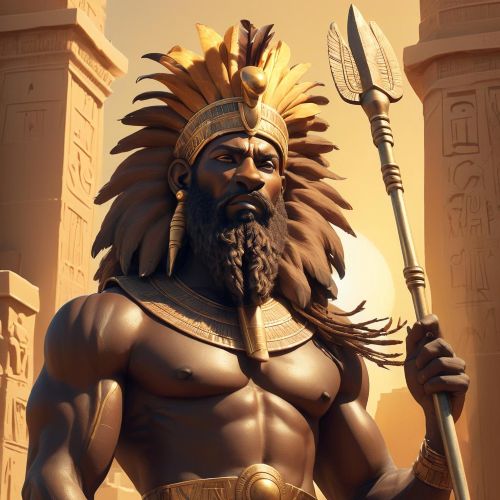
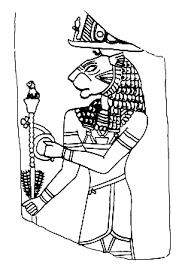
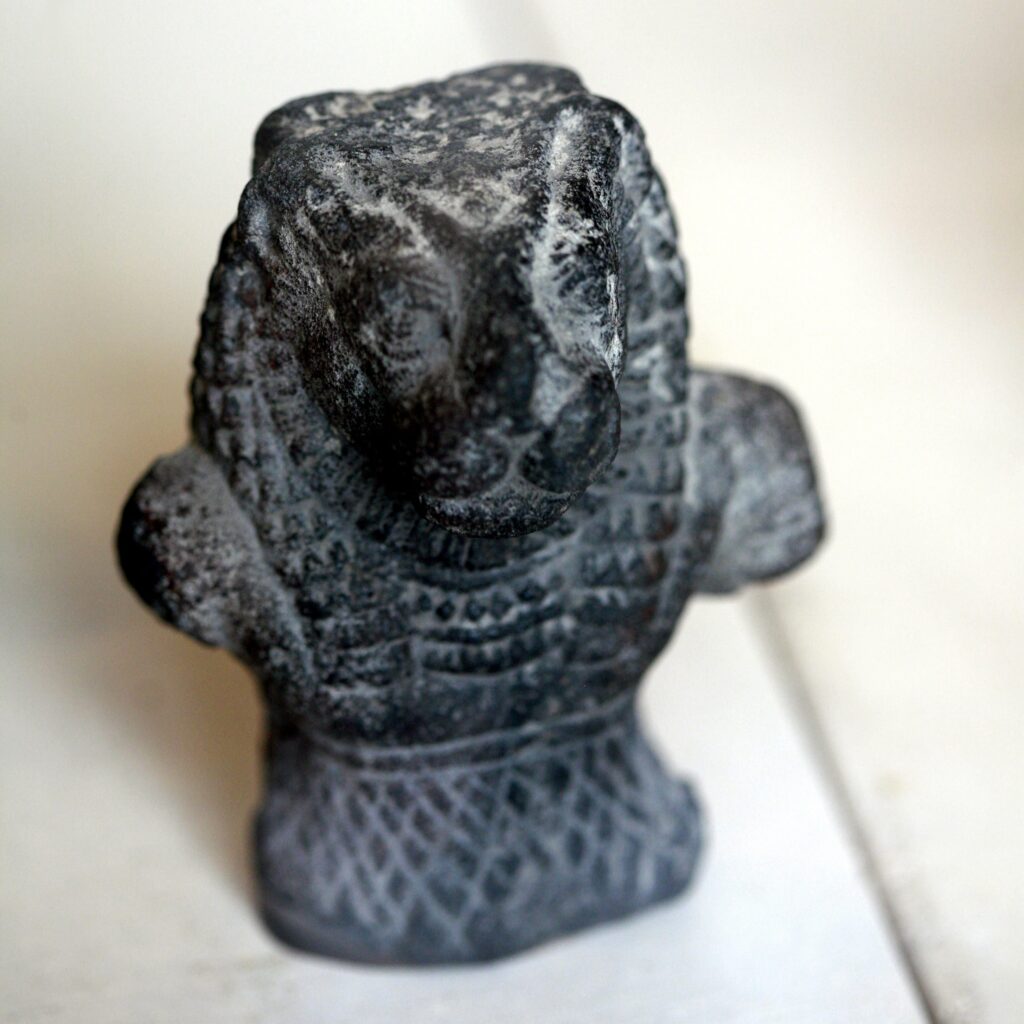
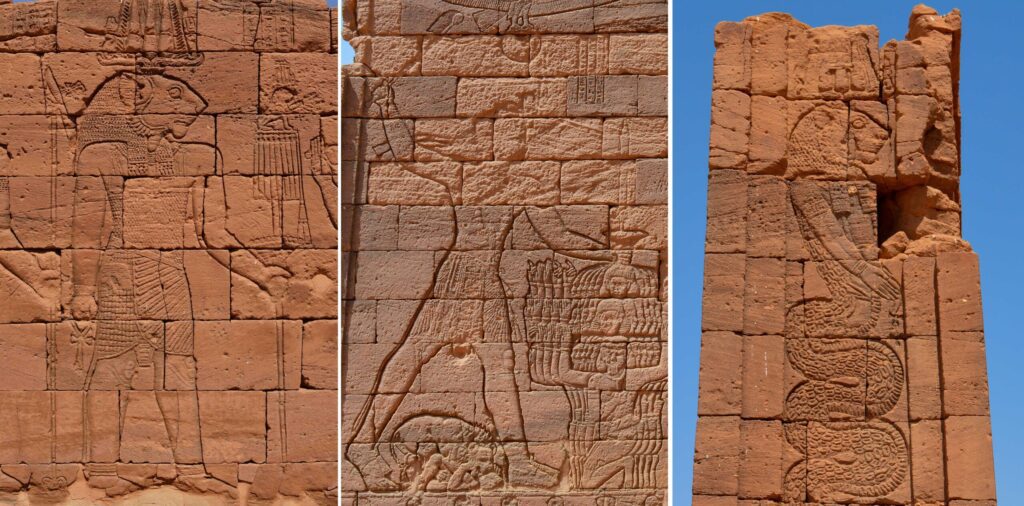
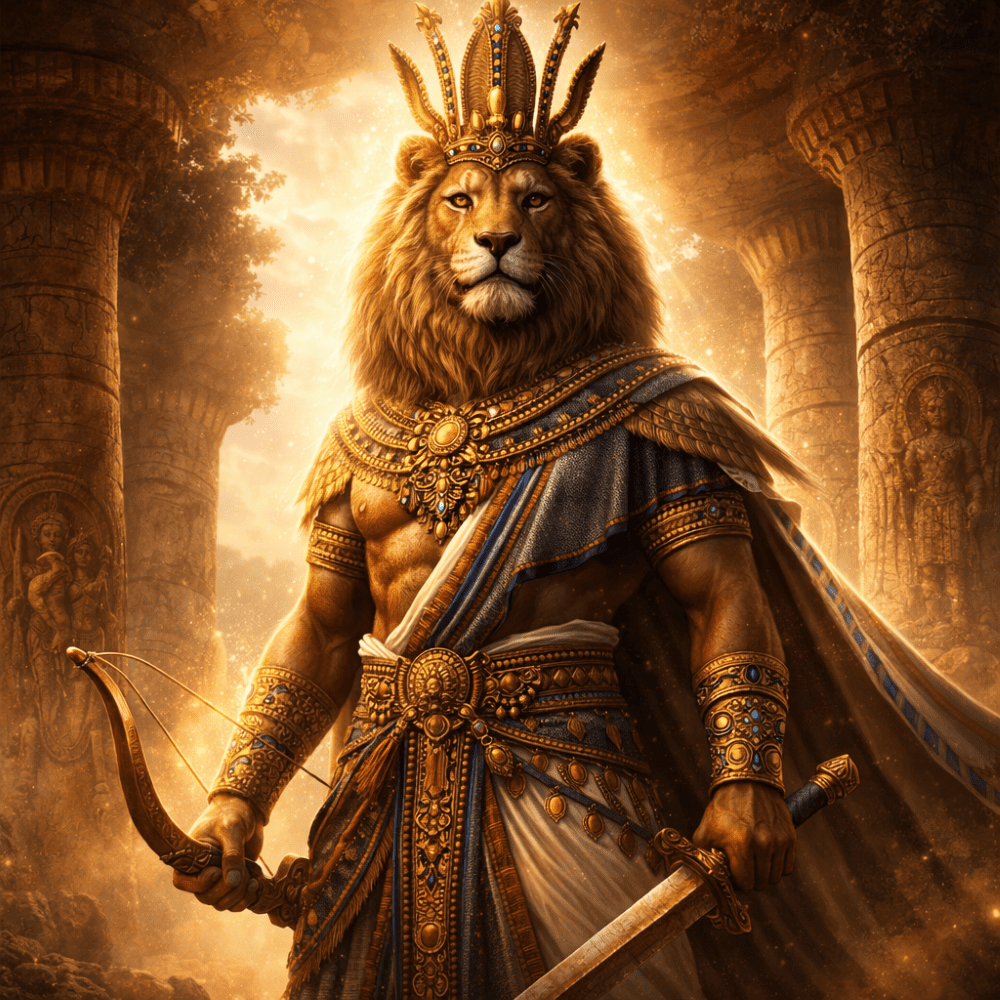
Apedemak’s iconography is among the most striking in ancient African religious art. He is most commonly depicted with the body of a man and the head of a lion, symbolizing unmatched strength, courage, and ferocity. This lion-headed form immediately connects him to the raw power of nature and the battlefield. In temple reliefs, he often wears the elaborate hemhem crown, a complex headdress associated with divine authority and triumph. These visual elements reinforce his role as both a warrior and a kingmaker.
However, Apedemak’s representations are not limited to a single form. In Naqa, he appears in highly unusual and symbolic variations, including a three-headed lion god with four arms. This rare depiction likely emphasizes his omnipotence and ability to act in multiple realms simultaneously. Another form presents him as a lion-headed serpent emerging from a lotus, a powerful image blending themes of creation and dominance.
At Musawwarat es-Sufra, he is shown in dynamic scenes of combat, wearing armor and wielding weapons such as bows and swords. In some carvings, he is depicted overpowering enemies or holding captives, visually reinforcing his identity as a divine warrior. These artistic variations are not random but intentional, each highlighting a different aspect of his authority and supernatural nature.
Family
Apedemak’s most widely recognized consort is Amesemi, a goddess often associated with protection and lunar symbolism. She is typically depicted with a distinctive crown featuring a crescent moon, complementing Apedemak’s solar and martial characteristics. Together, they represent a balance between power and protection, as well as masculine and feminine divine forces within Nubian belief systems.
Unlike many other ancient pantheons, Apedemak’s family structure is not extensively detailed in surviving records. There are no consistently attested children directly linked to him in a purely Nubian context. However, in some instances influenced by Egyptian religious interaction, he is loosely associated with figures like Isis and Horus. These associations appear to be symbolic rather than canonical, reflecting cultural overlap rather than original theology.
Apedemak’s role in divine relationships is less about lineage and more about function. He is frequently depicted alongside other deities such as Sebiumeker and Arensnuphis, forming a triad of protective and warrior-like gods. These groupings emphasize collective divine authority rather than familial hierarchy.
Other names
The name Apedemak, also written as Apademak or Apedemek, originates from the Meroitic language. Due to the limited understanding of this script, the exact pronunciation remains uncertain. Some scholars suggest a possible meaning linked to kingship, interpreting elements of the name as “father” and “king,” which aligns with his role as a divine patron of rulers.
In Egyptian inscriptions, his name was adapted into hieroglyphic forms, often interpreted as “the one who grants protection.” This translation reflects how neighboring cultures understood and integrated his identity into their own frameworks. Despite these variations, the core identity of Apedemak remains distinctly Nubian, and his name has not undergone the same extensive transformation seen in other ancient deities.
Powers and Abilities
Apedemak’s primary domain is warfare, but his influence extends far beyond the battlefield. He is depicted as a god who actively participates in combat, striking down enemies and ensuring victory for Kushite armies. His association with the lion reinforces his image as a relentless and dominant force.
He is also closely tied to kingship. In several temple reliefs, Apedemak is shown in scenes of royal investiture, physically interacting with rulers in ways that symbolize the transfer of divine authority. This act establishes him as a legitimizer of power, ensuring that kings rule with divine approval.
Beyond war and kingship, Apedemak possesses aspects of fertility and creation. Some depictions show him connected to agricultural abundance, holding plants or appearing in contexts that suggest nourishment and life-giving energy. This dual role highlights a broader understanding of power in Nubian thought, where destruction and creation are intertwined.
His protective nature is another defining characteristic. Apedemak is invoked as a guardian against enemies, chaos, and unseen threats. This protective function extends to both the kingdom and its people, reinforcing his role as a central figure in maintaining order.
Modern Day Influence
Although the worship of Apedemak declined with the fall of the Kushite Kingdom, his legacy continues through archaeology and scholarship. Sites such as Naqa and Musawwarat es-Sufra remain important cultural landmarks, offering insight into the religious and artistic achievements of ancient Nubia.
Modern research has increasingly highlighted Apedemak as a symbol of African cultural identity, challenging older narratives that overly focused on Egyptian influence. His distinctly Nubian origins make him a key figure in understanding the diversity of ancient Nile Valley civilizations.
In contemporary discussions, Apedemak appears in academic studies, documentaries, and digital reconstructions. While he has not yet become a major figure in global popular culture, his unique iconography and symbolism make him an emerging subject of interest in comparative mythology and historical storytelling.
Related Images

Source
Žabkar, L. V. (1975). Apedemak, lion god of Meroe: A study in Egyptian-Meroitic syncretism. Aris & Phillips.
Wikipedia. (2026). Apedemak. https://en.wikipedia.org/wiki/Apedemak
Henadology. (2009). Apedemak. https://henadology.wordpress.com/theology/netjeru/apedemak/
Mystery in History. (n.d.). Apedemak: Lion-headed war god of Nubia and Meroe. https://mysteryinhistory.com/apedemak/
EBSCO. (2021). Apedemak. https://www.ebsco.com/research-starters/religion-and-philosophy/apedemak
World History Encyclopedia. (2012). Apedemak temple. https://www.worldhistory.org/image/888/apedemak-temple/
World Mythos. (2024). Apedemak. https://worldmythos.com/apedemak/
Simple Wikipedia. (2025). Apedemak. https://simple.wikipedia.org/wiki/Apedemak
Frequently Asked Questions
Who was Apedemak?
Apedemak was a lion-headed war god worshipped in ancient Nubia, especially during the Meroitic period, associated with kingship and protection.
What does Apedemak represent?
He represents war, royal authority, protection, and in some contexts, fertility and creation.
Where was Apedemak worshipped?
He was primarily worshipped in Nubian regions such as Naqa and Musawwarat es-Sufra in present-day Sudan.
Is Apedemak an Egyptian god?
No, Apedemak is a uniquely Nubian deity, although he shows some influence from Egyptian religious traditions.
Why is Apedemak depicted as a lion?
The lion symbolizes strength, dominance, and ferocity, qualities that align with his role as a war god and protector.