
Amun of Napata : The Hidden God Who Crowned the Kings of Kush
At a glance
| Description | |
|---|---|
| Origin | Kushite Mythology |
| Classification | Gods |
| Family Members | Mut (Wife), Khonsu (son) |
| Region | Sudan |
| Associated With | Kingship, Creation, Oracles, Protection, Sacred mountains, Fertility |
The Mythlok Perspective
In Mythlok’s Perspective, Amun of Napata is far more than the Kushite version of the Egyptian god Amun. Much like how Zeus represents divine authority in Greek mythology or Odin guides the destiny of kings in Norse legend, Amun of Napata became the living source of royal legitimacy in Kush. What makes him unique is that an entire mountain, Jebel Barkal, was believed to be his earthly home, making the landscape itself part of his divine identity. His story reminds us that power is strongest when it is rooted in faith, culture, and the shared beliefs of a people rather than force alone.
Amun of Napata
Introduction
Amun of Napata was the supreme deity of the ancient Kingdom of Kush and the divine protector of its kings. Although his worship originated in Egypt, the Kushites transformed him into a distinctly local god whose authority centered on the sacred mountain of Jebel Barkal near the city of Napata in present-day Sudan. From around the eighth century BCE onward, his temple became the religious heart of the Kushite kingdom and the place where rulers sought divine approval before ascending the throne.
Unlike the Egyptian cult of Amun at Thebes, the Kushite tradition placed extraordinary importance on Jebel Barkal, a sandstone mountain believed to be the earthly home of the god. The mountain was revered as the “Pure Mountain,” where Amun’s presence could be experienced through sacred rituals and oracles. Kushite kings believed they ruled not by inheritance alone but because Amun himself had chosen them.
This belief became especially significant during the Twenty-fifth Dynasty, when Kushite rulers conquered Egypt and ruled as pharaohs. By presenting themselves as the chosen servants of Amun of Napata, these kings justified their authority over both Kush and Egypt. As a result, Amun became more than a creator or sky god—he became the spiritual foundation of Kushite kingship and one of the most influential deities in African antiquity.
Physical Traits
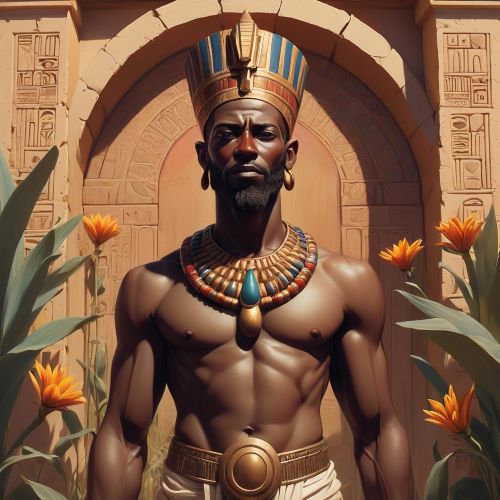
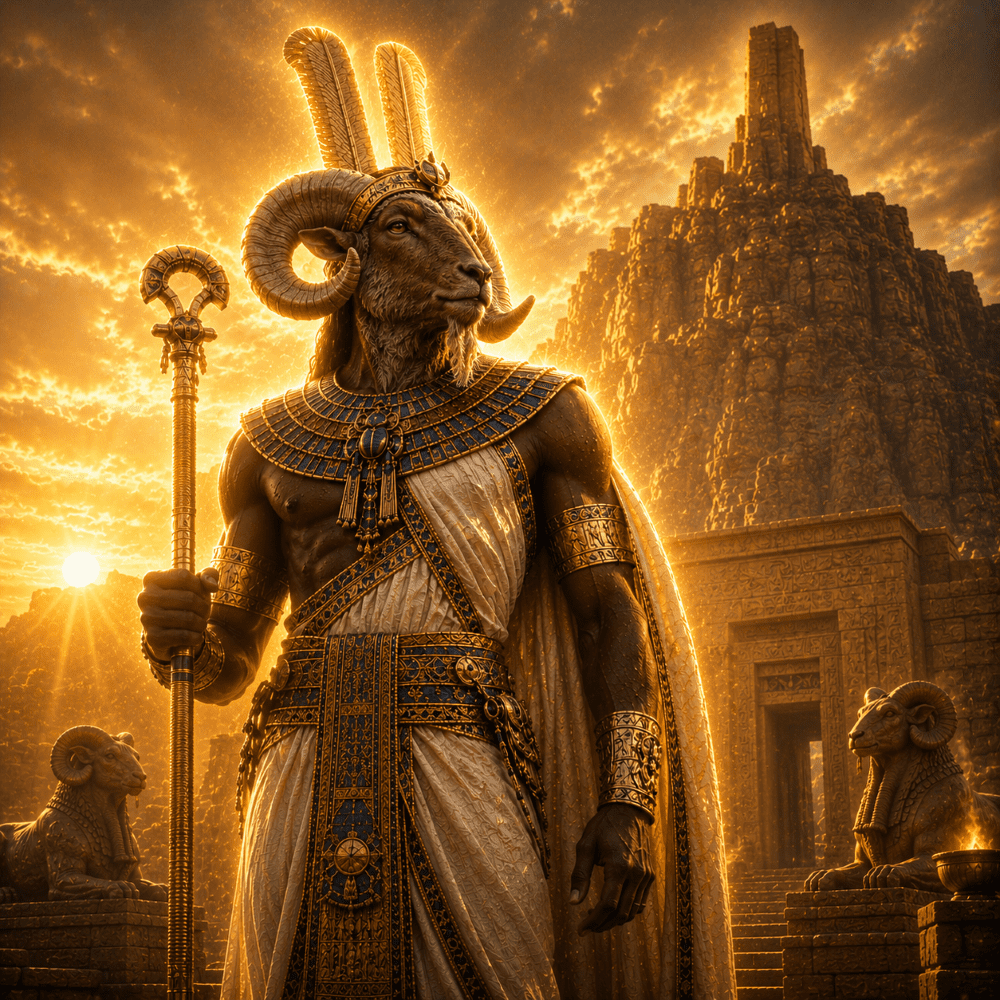
Amun of Napata retained many features of traditional Egyptian iconography while also developing characteristics unique to the Kushite world. He was most commonly portrayed as a man wearing the distinctive double-plumed crown associated with Amun, symbolizing divine authority and hidden power. Temple reliefs frequently depict him seated upon a throne, receiving offerings from Kushite rulers who acknowledged him as their divine patron.
Another important form of Amun was that of a ram or a ram-headed deity. Rams represented fertility, strength, and creative energy throughout Nubia and Egypt, making this form particularly meaningful in Kushite religion. Archaeological discoveries suggest that the ram imagery may also reflect the integration of older Nubian religious traditions into the worship of Amun.
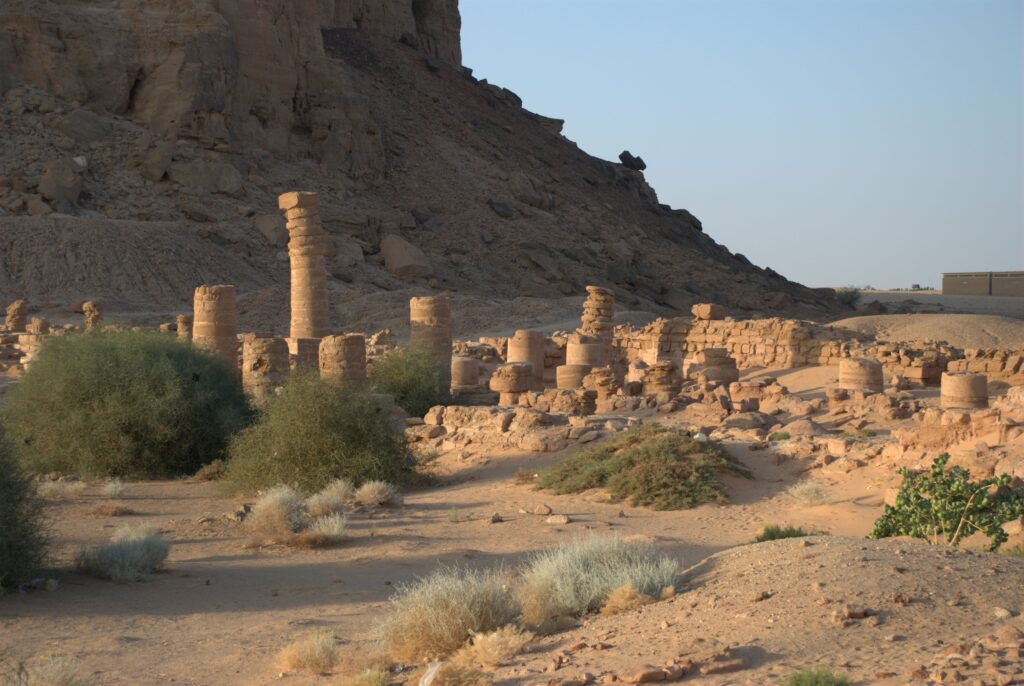
The landscape itself played an important role in his appearance. At Jebel Barkal, a towering natural rock pinnacle resembles a rearing cobra, or uraeus, the royal symbol of protection. Ancient Kushites interpreted this striking formation as a visible manifestation of Amun’s divine presence. Temple art even portrays the god enthroned within the mountain, reinforcing the belief that Jebel Barkal was not merely sacred ground but the actual dwelling place of the deity.
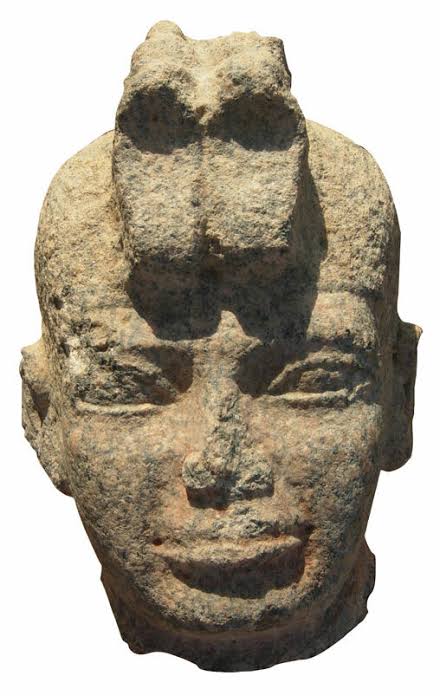
Kushite artists also introduced subtle regional features into their sculptures, including distinctive proportions and local styles of dress, giving Amun of Napata a uniquely Kushite identity while preserving his connection to Egyptian tradition.
Family
The divine family of Amun of Napata closely followed the well-established theology of Egypt rather than introducing an entirely new Kushite genealogy. His principal consort was Mut, the great mother goddess associated with protection, queenship, and motherhood. Together they formed one of the most important divine partnerships in ancient northeastern Africa.
Their son was Khonsu, the moon god, completing the famous Theban Triad. Temples dedicated to these three deities existed not only in Egypt but also at Kushite religious centers, demonstrating how the rulers of Kush embraced Egyptian religious traditions while adapting them to their own political and cultural identity.
Rather than emphasizing an expanded divine family, Kushite inscriptions focus on the special relationship between Amun and the king. Royal monuments repeatedly describe rulers as the “Beloved of Amun,” highlighting that their authority flowed directly from the god’s favor. This relationship became one of the defining features of Kushite religion.
In later periods, especially during the Meroitic Kingdom, indigenous deities such as Apedemak gained greater prominence alongside Amun. Even then, Amun remained the symbolic father of Kushite kingship and retained his position as one of the kingdom’s most revered gods.
Other Names
Amun of Napata was known by several titles that reflected both his sacred residence and his role as the protector of the Kushite state. The most common designation was Amun of Napata, distinguishing him from the better-known Amun worshipped at Karnak in Egypt. Another widely used title was Amun of Jebel Barkal, directly linking the deity to the mountain believed to be his earthly home.
Ancient inscriptions also refer to him as the Dweller in the Pure Mountain, emphasizing the holiness of Jebel Barkal and its importance as the center of royal ceremonies. In contexts where his solar nature was emphasized, he appeared as Amun-Ra, combining his identity with the Egyptian sun god Ra to represent supreme cosmic authority.
Some religious texts also associate him with Kamutef, meaning “Bull of His Mother,” a title representing his self-generating creative power. These various names illustrate how Amun of Napata combined Egyptian theology with distinctly Kushite religious beliefs.
Powers and Abilities
Amun of Napata was regarded as the highest divine authority in the Kingdom of Kush. His most important power was the ability to grant legitimate kingship. Every Kushite ruler depended upon his approval, and royal coronations were closely tied to ceremonies performed at his temple near Jebel Barkal.
His oracle held immense political influence. Priests interpreted the god’s will, guiding decisions about succession, governance, and major affairs of the kingdom. This made Amun not only a religious figure but also a central force in Kushite government.
Like his Egyptian counterpart, Amun was considered a creator deity associated with the hidden forces that sustained the universe. His very name is commonly translated as “The Hidden One,” reflecting an invisible yet ever-present divine power working behind the visible world.
He was also believed to protect the Nile Valley, ensuring prosperity, stability, and agricultural abundance. Since the Nile was essential to life in both Egypt and Kush, Amun’s blessings were thought to guarantee the continued well-being of the kingdom.
His connection to Jebel Barkal further reinforced his role as the guardian of sacred territory. The mountain symbolized permanence, divine protection, and the eternal bond between the god and the Kushite monarchy.
Modern-Day Influences
The legacy of Amun of Napata remains visible through the remarkable archaeological monuments of ancient Kush. His great temple at Jebel Barkal continues to attract historians, archaeologists, and visitors seeking to understand one of Africa’s greatest ancient civilizations.
Jebel Barkal and the surrounding archaeological sites were designated a UNESCO World Heritage Site because of their exceptional cultural significance. They provide valuable insight into how the Kingdom of Kush developed its own religious identity while building upon Egyptian traditions.
Modern scholarship increasingly recognizes Amun of Napata as a distinctly Kushite deity rather than simply an extension of Egyptian religion. Researchers now emphasize how Kushite rulers reshaped the cult of Amun to support their own political authority and cultural identity.
Museum collections around the world, including those displaying artifacts from Jebel Barkal, continue to showcase statues, temple reliefs, and ceremonial objects connected with his worship. These discoveries have helped restore global awareness of the Kingdom of Kush and its remarkable achievements.
Popular media has also introduced wider audiences to Kushite history. While portrayals often take creative liberties, they have sparked renewed interest in the civilization that revered Amun of Napata as its supreme guardian. Today, he stands as one of the most important symbols of ancient Sudanese heritage and the enduring legacy of Kushite mythology.
Related Images




Source
Gabolde, L. (1993). The Amun cult and its development in Nubia. In K. A. Kitchen & E. Wente (Eds.), The world of Ancient Egypt (pp. 1–22). Oxford University Press. Retrieved from https://hal.science/hal-03250821v1/file/Gabolde%20L.%2093.%20Amun%20Cult%20Nubia%20oxfordhb-9780190496272-e-19.pdf.
Cavillier, G. (2021). Amun of Thebes and Amun of Napata: Comparing two priestly organizations in the New Kingdom. 15th International Conference for Nubian Studies. Retrieved from https://nubianstudies2022.uw.edu.pl/amun-of-thebes-and-amun-of-napata-comparing-two-high-priests-organizations-in-new-kingdom/.
Kendall, T. (2021). Jebel Barkal: “Karnak” of Kush. In The Oxford Handbook of Egyptian Iconography. Oxford University Press. Retrieved from https://academic.oup.com/edited-volume/35472/chapter/303802327?guestAccessKey=.
Museum of Fine Arts, Boston. (n.d.). Sandstone omphalos (model of Gebel Barkal). Collections online. Retrieved from https://collections.mfa.org/objects/144530.
Egypt Museum. (2023). Amulet of the god Amun. Egypt-Museum.net. Retrieved from https://egypt-museum.com/amulet-of-the-god-amun/.
Jones, D. (2026). The Kingdom of Napata (from the 8th century to the 4th century BCE). Nofi Media. Retrieved from https://www.nofi.media/en/2026/04/the-kingdom-of-napata-from-the-8th/99679.
Rabie, H. M. (n.d.). Nubian royal and religious inscriptions. Journal of Egyptian and Nubian Studies. Retrieved from https://jguaa.journals.ekb.eg/article_2795_bb191a8cdc56d99d251e4aa71e492d76.pdf.
Kerma Swiss Archaeological Mission. (2004). Napata and Meroe. Kerma.ch. Retrieved from https://kerma.ch/staticj/www.kerma.ch/index/index-32.html?option=com_content&task=view&id=5&Itemid=44.
Török, L. (1997). The Kingdom of Kush: Handbook of the Napatan-Meroitic Civilization. Leiden: Brill.
Morkot, R. (2000). The Black Pharaohs: Egypt’s Nubian Rulers. London: Rubicon Press.
Kendall, T. (1986). Napata and the Kushite Empire: The Archaeology of Jebel Barkal. Boston: Museum of Fine Arts.
Welsby, D. A. (1996). The Kingdom of Kush: The Napatan and Meroitic Empires. Princeton: Markus Wiener Publishers.
O’Connor, D. (1993). Ancient Nubia: Egypt’s Rival in Africa. Philadelphia: University of Pennsylvania Museum.
Frequently Asked Questions
Who was Amun of Napata?
Amun of Napata was the supreme god of the Kingdom of Kush, worshipped at Jebel Barkal and regarded as the divine protector who granted legitimacy to Kushite kings.
Is Amun of Napata different from the Egyptian god Amun?
Yes. While they share the same origins, Amun of Napata evolved into a distinctly Kushite form of the deity, centered on Jebel Barkal and closely tied to Kushite kingship and identity.
Why was Jebel Barkal sacred to Amun?
The Kushites believed Jebel Barkal was the earthly home of Amun. Its unique rock formations were seen as manifestations of the god, making it the kingdom’s most important religious site.
What powers did Amun of Napata possess?
He was believed to create and sustain the world, legitimize kings, guide rulers through oracles, protect the Nile Valley, and safeguard the Kingdom of Kush.
Why is Amun of Napata important today?
Amun of Napata remains a symbol of ancient Sudanese heritage and Kushite civilization. His temples at Jebel Barkal continue to be studied as some of Africa’s most significant archaeological and religious sites.