

Haukim : The Wise God of Law and Justice in Ancient Arabia
At a glance
| Description | |
|---|---|
| Origin | Arabian Mythology |
| Classification | Gods |
| Family Members | N/A |
| Region | Yemen |
| Associated With | Law, Justice, Wisdom |
The Mythlok Perspective
In Mythlok’s Perspective, Haukim occupies a role similar to Ma’at in Egyptian mythology or Forseti in Norse tradition, where justice is viewed as a divine force rather than a human invention. What makes Haukim unique is that he survives almost entirely through inscriptions instead of elaborate myths, allowing us to see how religion directly supported governance in ancient Arabia. His legacy reminds us that civilizations are sustained not only by powerful warriors or creator gods, but also by the enduring ideals of wisdom, fairness, and responsible leadership.
Haukim
Introduction
Long before Islam unified much of the Arabian Peninsula under a single faith, southern Arabia was home to thriving kingdoms with rich religious traditions. Among them was the Kingdom of Qataban in present-day Yemen, where Haukim was revered as a divine guardian of law, justice, and wise judgment. Although he is not as widely known as famous deities from Greek or Egyptian mythology, Haukim played an important role in maintaining social order within one of Arabia’s most influential ancient civilizations.
Unlike gods associated with war, fertility, or storms, Haukim represented the principles that held society together. Ancient South Arabian inscriptions repeatedly connect him with legal authority, arbitration, and wise decision-making, often alongside the deity Anbay. Most of what historians know about Haukim comes from archaeological discoveries rather than surviving myths, making him a fascinating example of how religion and governance were closely intertwined in pre-Islamic Arabia.
Physical Traits
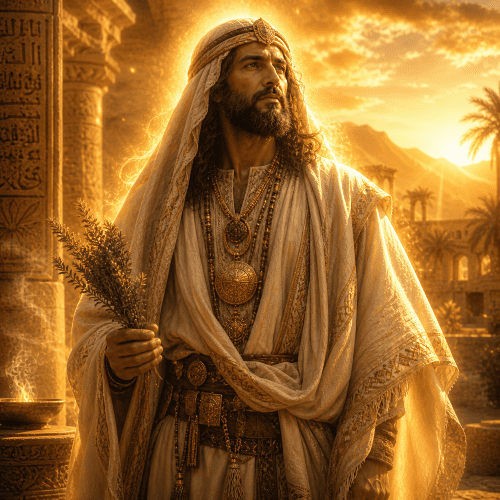
Very little is known about Haukim’s physical appearance. Unlike many mythological figures whose stories describe distinctive clothing, weapons, or divine features, no surviving South Arabian inscription provides a detailed description of his form.
This absence is not unusual for deities from ancient South Arabia. Religious inscriptions from Qataban focused primarily on the functions of the gods rather than their appearance. Temples, altars, and dedicatory texts were more concerned with recording offerings, prayers, and legal matters than preserving elaborate myths or artistic portraits.
Archaeological discoveries from Yemen and neighboring regions include symbolic carvings and religious icons, but none can be confidently identified as Haukim. As a result, modern scholars generally view him as a deity whose authority was expressed through wisdom and justice rather than through a recognizable physical image.
Family
The surviving historical evidence does not identify Haukim’s parents, spouse, or children. Unlike many mythological pantheons where divine family relationships explain a god’s role, the religious records of Qataban rarely preserve detailed genealogies.
Instead, Haukim is most commonly associated with Anbay, another deity linked to judgment, command, and legal authority. The two gods frequently appear together in inscriptions, suggesting that they worked as complementary divine protectors of justice within the Qatabanian religious system.
Some scholars have proposed that certain South Arabian deities may have originated as respected historical figures who were later elevated to divine status. However, there is no evidence to support this theory specifically for Haukim. Based on current archaeological knowledge, he is best understood through his role in society rather than through family connections.
Other names
The deity’s name appears in several scholarly spellings, including Haukim, Hawkam, and the transliterated form Ḥawkam. These variations arise because ancient South Arabian inscriptions were written using scripts that primarily recorded consonants, allowing multiple modern interpretations of the same name.
Most linguists connect the name to the ancient Semitic root ḥ-k-m, meaning “to judge,” “to rule wisely,” or “to possess wisdom.” This same linguistic root eventually gave rise to the Arabic word hakim, meaning “wise” or “judge.”
Although the linguistic connection is clear, it is important not to confuse Haukim with later Islamic titles such as Al-Hakim, one of the names attributed to God in Islam. Haukim belongs specifically to the religious traditions of pre-Islamic South Arabia and represents a distinct historical deity.
Powers and Abilities
Haukim’s influence centered on justice, governance, and the orderly functioning of society. Rather than controlling natural forces, his authority lay in ensuring that communities operated according to accepted laws and fair decisions.
Ancient inscriptions associate him with arbitration, legal rulings, and the execution of official decisions. Together with Anbay, he appears to have served as a divine protector of judicial processes, particularly in matters involving tribal agreements, public administration, and conflict resolution.
His association with wisdom also suggests that he was regarded as a source of sound judgment. In a society built around tribal alliances and commercial networks, impartial decision-making would have been essential for maintaining stability. Haukim therefore represented more than legal authority alone; he embodied the ideal that justice should be guided by wisdom rather than power.
Unlike many gods who were invoked for military victories or agricultural abundance, Haukim’s role reflected the sophisticated legal culture that existed within the Kingdom of Qataban. His presence demonstrates that ancient Arabian religion also valued governance, ethics, and social responsibility alongside more familiar aspects of divine worship.
Modern Day Influence
Haukim no longer has an active religious following, but he remains an important figure for historians studying pre-Islamic Arabia. Archaeological excavations and the ongoing study of South Arabian inscriptions continue to improve our understanding of his role within the Qatabanian pantheon.
His greatest legacy lies in demonstrating that ancient Arabian civilizations possessed complex legal and administrative traditions supported by religious institutions. Rather than serving only as supernatural beings, deities like Haukim reinforced the values that allowed kingdoms to govern effectively.
Modern interest in Haukim comes primarily from archaeology, epigraphy, and the study of ancient Semitic languages. Researchers continue to examine inscriptions discovered across Yemen, offering new insights into the beliefs, political systems, and legal traditions of South Arabia before the rise of Islam.
Although Haukim has not entered popular culture in the same way as figures like Zeus or Odin, his historical importance continues to grow as new discoveries shed light on one of Arabia’s least understood religious traditions. His story reminds us that justice was considered sacred long before modern legal systems emerged.
Related Images






Source
Britannica. (n.d.). Ḥawkam | Arabian deity. Retrieved July 6, 2026, from https://www.britannica.com/topic/Hawkam
Britannica. (n.d.). Arabian religion: Pre-Islamic deities. Retrieved July 6, 2026, from https://www.britannica.com/topic/Arabian-religion/Pre-Islamic-deities
Haukim. (n.d.). In Wikipedia. Retrieved July 6, 2026, from https://en.wikipedia.org/wiki/Haukim
Anbay. (n.d.). In Wikipedia. Retrieved July 6, 2026, from https://en.wikipedia.org/wiki/Anbay
List of pre-Islamic Arabian deities. (n.d.). In Wikipedia. Retrieved July 6, 2026, from https://en.wikipedia.org/wiki/List_of_pre-Islamic_Arabian_deities
Robin, C. J., & others. (n.d.). Works on South Arabian religion and inscriptions as reflected in encyclopedia and reference discussions of pre-Islamic Arabian deities
The religion and rituals of the nomads of pre-Islamic Arabia. (2022). GoodReads record of published book listing. Retrieved July 6, 2026, from https://www.goodreads.com/book/show/61133569-the-religion-and-rituals-of-the-nomads-of-pre-islamic-arabia
The Book of Idols / related academic and reference discussions on pre-Islamic Arabian deities. Retrieved July 6, 2026, from https://www.academia.edu/102875504/Pre_Islamic_Beliefs_and_Tribal_Arabic_Deities_Contents
Frequently Asked Questions
Who is Haukim in Arabian mythology?
Haukim is a pre-Islamic Arabian god worshipped in the Kingdom of Qataban. He was primarily associated with law, justice, wisdom, and arbitration.
What powers did Haukim have?
Haukim was believed to oversee justice, legal decisions, arbitration, and wise governance. His influence focused on maintaining social order rather than controlling natural forces.
Was Haukim worshipped across Arabia?
Current evidence suggests Haukim was mainly worshipped in the ancient South Arabian Kingdom of Qataban, located in present-day Yemen.
Is Haukim related to Anbay?
While no familial relationship is recorded, Haukim is frequently paired with the god Anbay in South Arabian inscriptions, indicating they shared responsibilities connected with justice and decision-making.
Why is Haukim important today?
Haukim provides valuable insight into the sophisticated legal, political, and religious systems of ancient South Arabia, making him an important figure in the study of pre-Islamic Arabian civilization.