
Moralltach : The Irish Sword That Never Missed a Kill
At a glance
| Description | |
|---|---|
| Mythology | Irish Mythology |
| Type | Carried |
| Power | 08/10 |
Mythlok Perspective
In Mythlok’s Perspective, Moralltach represents more than a magical sword. It reflects the Celtic idea that weapons could carry destiny within them. The blade was not simply powerful because it cut deeply. It was feared because it made outcomes unavoidable. In many ways, Moralltach resembles legendary weapons from other cultures that embody fate itself rather than physical strength alone. Its closest parallels can be seen in weapons like the Indian Brahmastra or the Japanese Kusanagi-no-Tsurugi, where divine authority and cosmic power become inseparable from the hero wielding them. Yet Moralltach remains uniquely Irish because of its tragic undertone. Even the greatest weapon could not save Diarmuid from destiny. In Celtic tradition, fate ultimately stood above power, and Moralltach serves as a perfect reminder of that belief.
Moralltach
Introduction
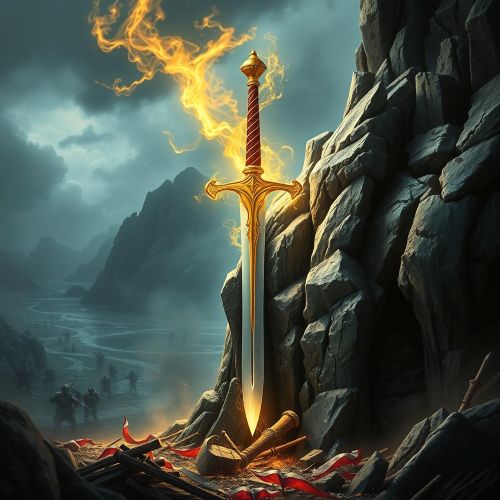
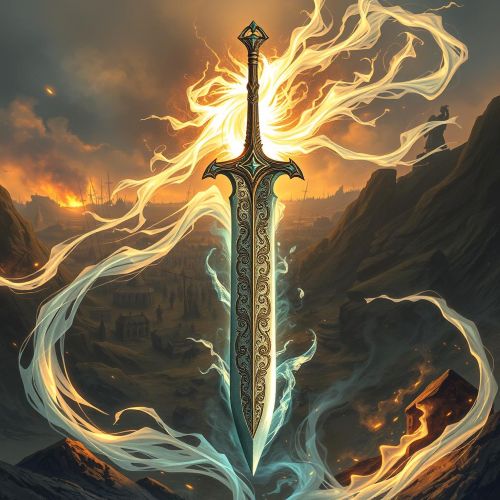
Moralltach, whose name translates to “Great Fury” in Irish, is one of the deadliest weapons in Irish legend. The magical sword appears in stories connected to the Fenian Cycle, a major body of medieval Irish tradition centered around the Fianna and their legendary warriors. Unlike ordinary weapons forged by mortal blacksmiths, Moralltach carried divine origins and supernatural power. It was believed that no strike from the blade could fail once properly delivered, giving the sword a fearsome reputation throughout Irish storytelling.
The weapon is most closely associated with the hero Diarmuid Ua Duibhne, one of the greatest warriors of the Fianna. In Irish tradition, Diarmuid was admired not only for his skill in combat but also for his tragic destiny and complicated relationship with Fionn mac Cumhaill and Gráinne. Moralltach became a symbol of Diarmuid’s unmatched prowess in battle, representing the thin line between heroic glory and inevitable doom. Across surviving tales, the sword stands as more than a magical artifact. It reflects the Celtic belief that powerful weapons carried spiritual significance and were deeply connected to fate, honor, and the Otherworld.
Origins
The origins of Moralltach begin with Manannán mac Lir, the powerful sea deity of Irish mythology and one of the most mysterious members of the Tuatha Dé Danann. Manannán was associated with the sea, magic, and the Otherworld, and many legendary treasures were said to belong to him. Among these magical objects were enchanted cloaks, self-moving ships, invincible spears, and deadly swords. Moralltach was one of the greatest weapons connected to his name.
According to Irish tradition, Manannán gave the sword to Aengus Óg, the youthful god associated with love, poetry, and inspiration. Aengus himself was an important figure among the Tuatha Dé Danann and was deeply connected to Brú na Bóinne, the sacred complex linked to Newgrange in Ireland. Aengus later became the foster father of Diarmuid Ua Duibhne, creating one of the strongest relationships found in Irish heroic literature.
Fosterage held enormous importance in early Irish society. Foster parents often shared bonds with children that were considered equal to or even stronger than blood ties. Because of this relationship, Aengus eventually passed Moralltach to Diarmuid along with another magical sword called Beagalltach, meaning “Little Fury.” The two blades formed a legendary pair, though Moralltach was always considered the more powerful weapon.
The divine origin of Moralltach gave the blade extraordinary prestige. In Celtic tradition, weapons created or gifted by supernatural beings were not merely tools of war. They acted as extensions of cosmic power and often connected mortal heroes to the Otherworld itself.
Powers
Moralltach’s reputation came from its terrifying magical abilities. The sword was famously described as leaving “no stroke nor blow unfinished at the first trial.” In practical terms, this meant that once the blade struck successfully, the attack could not fail. Enemies cut by Moralltach were doomed, regardless of armor, strength, or resistance.
Stories surrounding the weapon emphasize its incredible cutting power. Some traditions describe the blade as capable of slicing completely through opponents with a single strike. Other accounts suggest that even accidental contact with the sword could prove fatal. The supernatural force within the weapon made it seem less like steel and more like an unstoppable extension of fate itself.
Moralltach was also linked to Diarmuid’s exceptional battlefield abilities. Irish tales often portray him cutting through groups of enemies with remarkable speed and precision while wielding the sword. Unlike many magical weapons that required spells or rituals, Moralltach’s power appeared to function naturally as part of its divine enchantment.
The sword was frequently paired with Diarmuid’s magical spears, Gáe Dearg and Gáe Buidhe. These weapons carried deadly properties of their own, particularly the ability to inflict wounds that could not easily heal. Together, they formed one of the most feared arsenals in Irish mythology. However, Diarmuid traditionally reserved Moralltach for the gravest dangers and life-or-death encounters, while using the smaller Beagalltach for lesser conflicts.
The name “Great Fury” perfectly captured the sword’s nature. Moralltach was not portrayed as noble or ceremonial. It embodied raw destructive force, reflecting the harsh and violent realities of heroic warfare in Celtic tradition.
Owners/Users
Moralltach passed through only a small number of owners, each connected to major figures in Irish mythology. The first known owner was Manannán mac Lir, the sea god and guardian of magical treasures. His association with the sword established its divine status and tied it directly to the supernatural world of the Tuatha Dé Danann.
The blade was then given to Aengus Óg, who became both protector and foster father to Diarmuid Ua Duibhne. Aengus played a crucial role in Diarmuid’s life, repeatedly assisting him during moments of danger and tragedy.
The most famous wielder of Moralltach was undoubtedly Diarmuid Ua Duibhne himself. Diarmuid was one of the greatest warriors of the Fianna, renowned for his speed, beauty, and martial skill. He is particularly remembered for his role in the story of The Pursuit of Diarmuid and Gráinne, where he fled across Ireland with Gráinne after she rejected her arranged marriage to Fionn mac Cumhaill.
Diarmuid’s reputation as a nearly unbeatable warrior was strengthened by his magical weapons. Moralltach represented the peak of his power in combat and became inseparable from his legendary status. Some later traditions attempted to connect the sword to other mythological or Arthurian figures, but the strongest and most widely accepted association remains with Diarmuid and the Fenian Cycle.
Instances used
Moralltach appears most prominently in stories connected to Tóraigheacht Dhiarmada agus Ghráinne, known in English as The Pursuit of Diarmuid and Gráinne. This tale survives in several medieval and early modern Irish manuscripts and remains one of the most famous romances in Irish literature.
During the story, Diarmuid and Gráinne flee across Ireland while being pursued by Fionn and the Fianna. Throughout these adventures, Moralltach serves as Diarmuid’s ultimate weapon against overwhelming odds. The blade symbolizes his ability to survive impossible encounters and defend himself against superior numbers.
One important detail repeated in the tradition is Diarmuid’s careful distinction between his weapons. Moralltach and the spear Gáe Dearg were reserved for the deadliest threats, while Beagalltach and Gáe Buidhe were used for lesser conflicts. This division reinforced the idea that Moralltach represented his highest level of martial force.
The sword also gains significance because of its absence during Diarmuid’s final adventure. Before the famous boar hunt at Benn Gulbain, warnings were given that danger awaited him. Despite this, Diarmuid chose not to carry Moralltach. Instead, he brought the lesser Beagalltach. During the hunt, Diarmuid was mortally wounded by a magical boar. Although he managed to kill the creature, the injury ultimately led to his death.
This moment transformed Moralltach into a symbol of lost protection and tragic fate. Irish mythology frequently emphasizes that heroes cannot escape destiny forever, even when armed with divine weapons. Diarmuid’s decision to leave Moralltach behind became one of the most tragic details in the Fenian Cycle.

Source
Koch, J. T. (Ed.). (2006). Celtic culture: A historical encyclopedia. ABC-CLIO.
MacKillop, J. (1998). Dictionary of Celtic mythology. Oxford University Press. https://doi.org/10.1093/acref/9780198609674.001.0001
Nicholls, K. (Trans.). (2018). Tóraigheacht Dhiarmada agus Ghráinne: The pursuit of Diarmuid and Gráinne. Leabhar Breac.
Ó hÓgáin, D. (2002). The sacred isle: Belief and religion in pre-Christian Ireland. Boydell Press.
Ó Súilleabháin, S., & Danish, K. (1977). Irish folklore and customs. Mercier Press.
Williams, M. (2021). Ireland’s immortals: A history of the gods of Irish myth. Princeton University Press. https://doi.org/10.2307/jj.1054274
Wikipedia. (n.d.). Aengus. In Wikipedia. Retrieved May 28, 2026, from https://en.wikipedia.org/wiki/Aengus
Wikipedia. (n.d.). Diarmuid Ua Duibhne. In Wikipedia. Retrieved May 28, 2026, from https://en.wikipedia.org/wiki/Diarmuid_Ua_Duibhne
Wikipedia. (n.d.). The Pursuit of Diarmuid and Gráinne. In Wikipedia. Retrieved May 28, 2026, from https://en.wikipedia.org/wiki/The_Pursuit_of_Diarmuid_and_Gr%C3%A1inne
firstage.org. (n.d.). The Fenian Cycle. The First Age. https://thefirstage.org/wiki/the-fenian-cycle/
Frequently Asked Questions
What is Moralltach in Irish mythology?
Moralltach is a magical sword from Irish legend known as “Great Fury,” famous for never failing to kill with a true strike.
Who wielded Moralltach?
The sword was most famously wielded by Diarmuid Ua Duibhne, a heroic warrior of the Fianna in the Fenian Cycle.
Who created Moralltach?
Moralltach was originally owned or forged by Manannán mac Lir, the Irish sea god associated with the Otherworld.
What powers did Moralltach possess?
The sword was believed to leave no strike unfinished, making every successful blow deadly and unstoppable.
Why is Moralltach important in Irish legend?
Moralltach symbolizes divine power, heroic warfare, and tragic destiny within the stories of the Fenian Cycle.