
Khonsu : The Egyptian God of the Moon and Healing
At a glance
| Description | |
|---|---|
| Origin | Egyptian Mythology |
| Classification | Gods |
| Family Members | Amun (Father), Mut (Mother) |
| Region | Egypt |
| Associated With | Moon, Healing |
Mythlok Perspective
In Mythlok’s Perspective, Khonsu stands apart from many lunar gods because his mythology makes the Moon an active force rather than a distant celestial symbol. His journey through the night connects movement with protection, while his healing traditions give his lunar nature a practical purpose. Like the Greek Selene, he embodies the Moon’s presence in the night, but Khonsu goes further by becoming a guardian and healer within the darkness.
Khonsu
Introduction
Khonsu is an ancient Egyptian god primarily associated with the Moon, whose journey across the night sky gave him connections with time, movement, protection, and renewal. His name is commonly understood as meaning “traveler,” reflecting the Moon’s passage through the heavens. Unlike some Egyptian deities whose identities changed dramatically across different periods, Khonsu retained a strong lunar character throughout his worship, although his other functions developed over time.
Khonsu was especially important at Thebes, where he formed part of the Theban Triad with Amun and Mut. His temple at Karnak, built principally during the reign of Ramesses III and expanded by later rulers, remains one of the clearest surviving monuments dedicated to him.
Khonsu was not simply a distant celestial deity. Egyptians also appealed to him as a protector and healer. His ability to ward off harmful supernatural forces made him an important figure in religious healing, while his association with the Moon connected him to the rhythms of night and the measurement of time. One of the best-known stories illustrating his healing powers is recorded on the Bentresh Stela, where Khonsu is called upon to cure a foreign princess believed to be afflicted by a hostile spirit.
Through these different roles, Khonsu occupied a distinctive position in Egyptian religion: he was a youthful lunar god whose movement through the heavens was linked with protection, healing, and the continuing cycles of existence.
Physical Traits
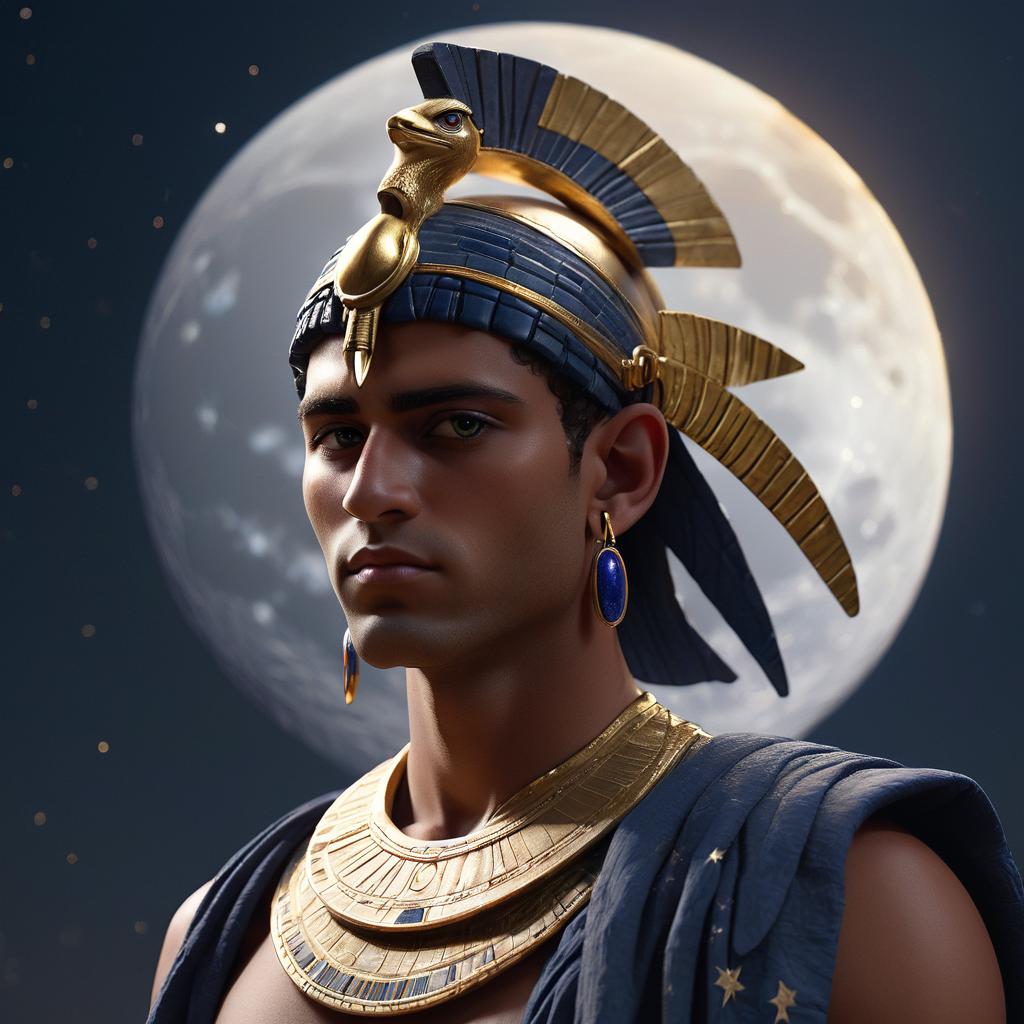
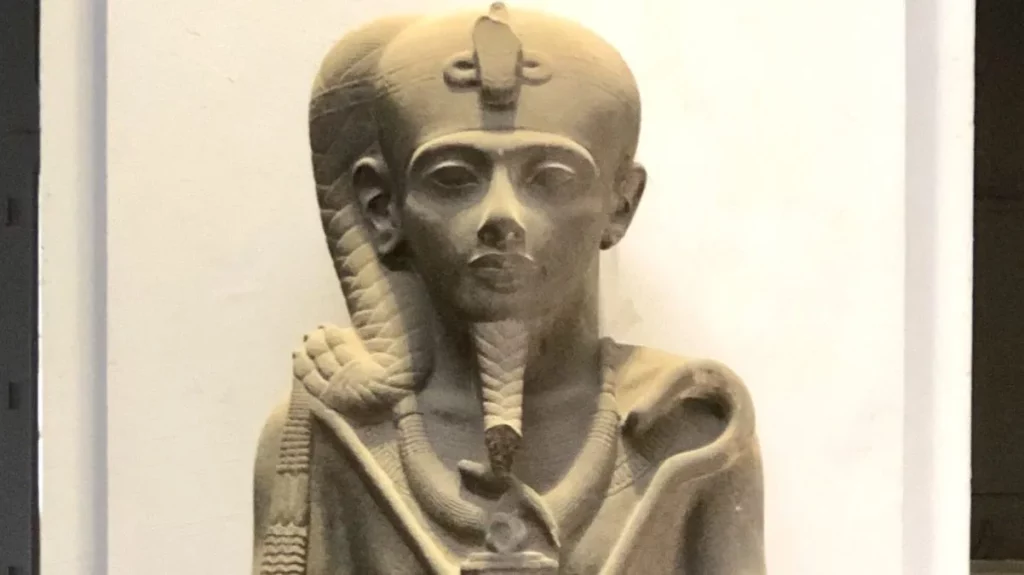
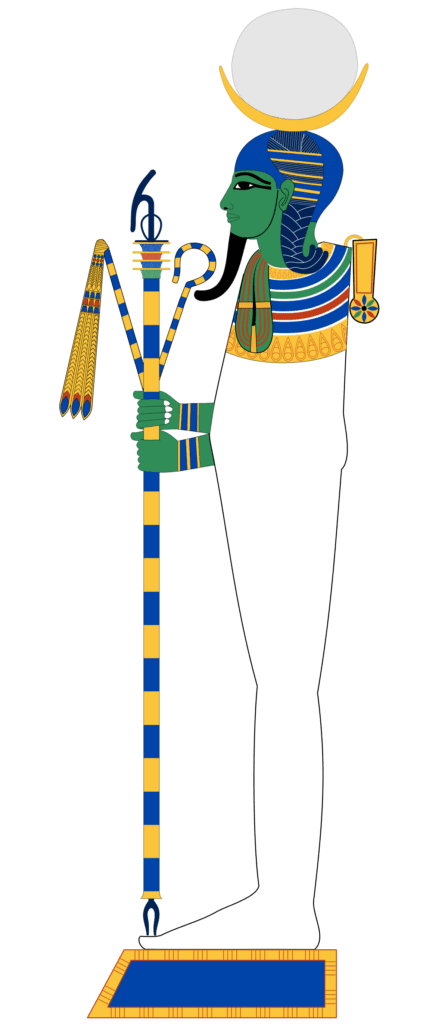
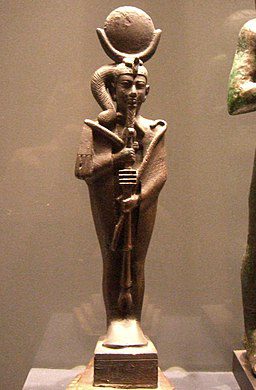
Khonsu was most commonly represented as a young, mummiform man, wrapped closely in a garment that left only his head and hands visible. His youthful appearance was emphasized by the sidelock of youth, a traditional Egyptian artistic feature associated with childhood.
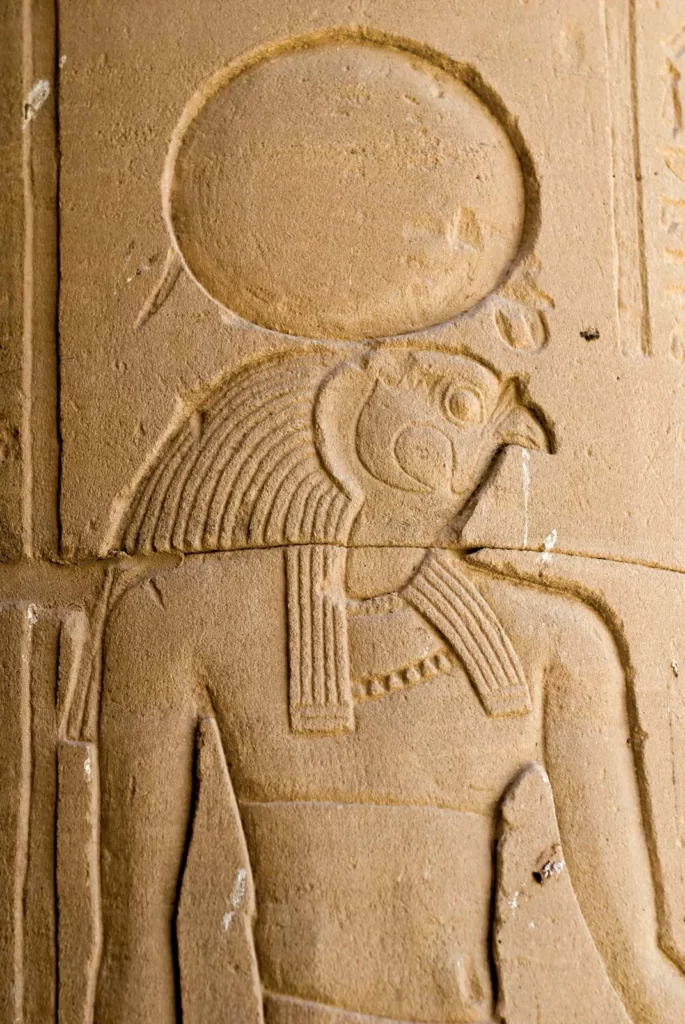
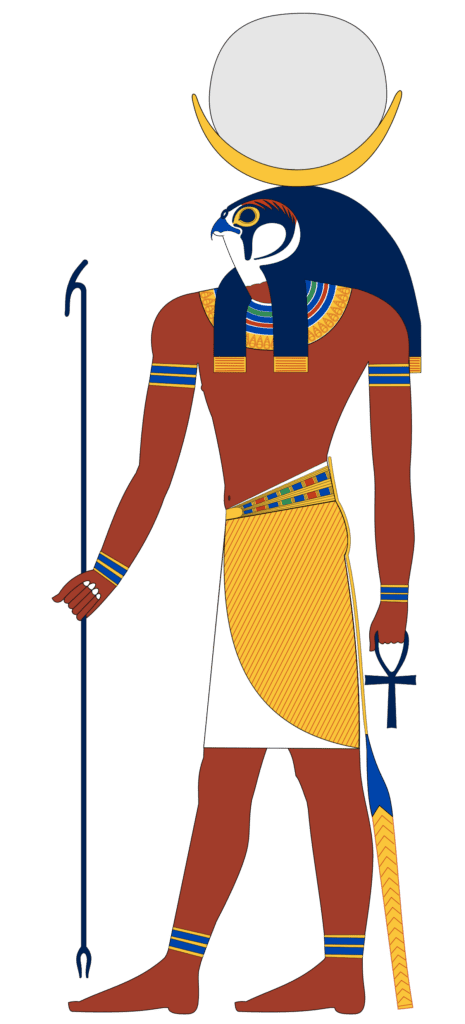
His most recognizable feature was his lunar headdress. He generally wore a crescent Moon supporting a full lunar disk, making his celestial identity immediately apparent. In some representations, Khonsu appears with the head of a falcon, emphasizing his connection with the sky and other Egyptian deities associated with celestial power.
His hands could hold divine symbols such as the crook and flail, while other representations show him with religious or royal insignia. Some images also portray him standing or walking rather than in his characteristic wrapped form. The combination of youth, the lunar crown, and the mummiform body gave Khonsu a distinctive visual identity. His youthful appearance was particularly significant because it connected him with renewal and the recurring cycles represented by the Moon.
Family
Khonsu was an important member of the Theban Triad, a divine family worshipped especially at Thebes. His parents were Amun, one of Egypt’s most powerful gods, and Mut, a major mother goddess associated with kingship, motherhood, and divine protection. Khonsu therefore occupied the position of their divine son. Together, Amun, Mut, and Khonsu formed a family unit that became central to religious life at Thebes, particularly during the New Kingdom.
Their relationship was reflected architecturally at the vast Karnak temple complex. Separate temples and sacred spaces honored members of the Theban Triad, while religious festivals brought their cults together. Khonsu’s own temple stands within the Karnak complex and is one of the best-preserved monuments associated with his worship.
Khonsu’s relationship with Amun also demonstrates how Egyptian gods could gain prominence through local religious traditions. As Thebes grew in political and religious importance, so too did the gods associated with the city. Khonsu’s position as the son of Amun and Mut helped establish him as one of the principal deities of Theban religion.
Other Names
Khonsu was known by several names and epithets in ancient Egyptian religious traditions. His name appears in forms such as Khons, Khonsu, and Khonshu, with transliterations varying according to language and Egyptological convention.
One important form was Khonsneferhotep, commonly translated in connection with ideas of being “beautiful” or “perfect” and “satisfied” or “peaceful.” He was also known as Khonspakhered, meaning Khonsu the Child, emphasizing his youthful nature. Another extended form, Khonsemwasetneferhotep, combined his name with additional royal and religious elements.
These names and epithets were not simply alternative labels. Egyptian gods could possess different manifestations and titles that emphasized particular aspects of their nature. In Khonsu’s case, such names could highlight his youth, benevolence, or specific cultic identity.
Powers and Abilities
Khonsu’s most fundamental power came from his identity as a lunar deity. His movement across the night sky was associated with the recurring phases of the Moon and, more broadly, with the passage of time. Ancient Egyptian religion frequently connected celestial cycles with concepts of renewal and continuity, making Khonsu a natural figure for these ideas.
His lunar nature also gave him a role as a protector of travellers at night. As the Moon moved through the darkness, Khonsu was associated with safe passage and protection from dangers encountered after sunset. This function fits closely with the traditional interpretation of his name as “traveler.”
Khonsu was also renowned as a healer. Egyptians could appeal to him when illness was understood to have supernatural causes, particularly when harmful spirits or hostile forces were believed to be responsible. His power was therefore not limited to physical healing; it could also involve driving away dangerous supernatural influences.
The Bentresh Stela provides one of the clearest examples. The text tells of a foreign princess who becomes ill and is believed to be afflicted by a spirit. A manifestation of Khonsu is sent to her, and the god is credited with overcoming the hostile supernatural force. The story presents Khonsu as a powerful healer capable of confronting spiritual threats.
Khonsu’s protective and healing powers made him particularly relevant to ordinary concerns about illness, danger, and survival. His connection with the Moon added another dimension, associating him with recurring cycles rather than a single moment of divine intervention.
In some religious traditions, Khonsu could also be connected with fertility, renewal, and the broader regenerative qualities of lunar cycles. These associations, however, were secondary to his fundamental identity as a lunar deity and should not be treated as his principal domain.
Modern Day Influence
Khonsu remains one of the more recognizable lunar gods of ancient Egypt, although his modern presence is largely the result of archaeological discoveries, Egyptological scholarship, museum collections, and popular culture rather than an uninterrupted continuation of his ancient cult.
The Temple of Khonsu at Karnak is particularly important to his modern legacy. Constructed largely under Ramesses III, the temple preserves inscriptions and architectural features that provide valuable evidence for understanding Khonsu’s worship. Its survival allows modern visitors and scholars to examine the physical environment in which his cult was practiced.
Khonsu also appears in ancient Egyptian objects preserved in museums around the world. Statues, reliefs, amulets, and other religious artifacts provide evidence of how Egyptians represented the god and understood his role. These objects continue to contribute to the study of Egyptian religion and iconography.
His distinctive lunar imagery has also made Khonsu an appealing figure in modern literature, comics, television, games, and other forms of popular culture. Contemporary portrayals sometimes reinterpret him as a mysterious moon deity or supernatural protector, although these versions frequently combine ancient Egyptian elements with modern fictional ideas.
The continued fascination with Khonsu reflects the broader endurance of Egyptian mythology. His crescent-and-disk crown, youthful appearance, and association with the night make him visually distinctive, while his roles as healer and protector give his mythology a human dimension that remains easy to understand today.
Khonsu ultimately represents more than the Moon itself. His mythology reflects the Egyptian fascination with celestial cycles, the dangers of darkness, the possibility of healing, and the idea that divine powers could accompany humanity through the night. From the temples of ancient Thebes to modern museums and popular culture, Khonsu continues to embody the enduring mystery of the Egyptian night sky.
Related Images



Sources
British Museum. (n.d.). Khons. British Museum. https://www.britishmuseum.org/collection/term/BIOG54225
Global Egyptian Museum. (n.d.). Khons. Global Egyptian Museum.
https://www.globalegyptianmuseum.org/glossary.aspx?id=212
Digital Karnak Project. (n.d.). Digital Karnak. University of California, Santa Cruz.
https://digitalkarnak.ucsc.edu/
Ministry of Tourism and Antiquities. (n.d.). Khonsu Temple. Discover Egypt’s Monuments.
https://egymonuments.gov.eg/en/monuments/khonsu-temple/
Hart, G. (2005). The Routledge dictionary of Egyptian gods and goddesses. Routledge.
Pinch, G. (2002). Handbook of Egyptian mythology. ABC-CLIO.
Wilkinson, R. H. (2003). The complete gods and goddesses of ancient Egypt. Thames & Hudson.
Bohleke, B. (1997). An oracular amuletic decree of Khonsu in the Cleveland Museum of Art. The Journal of Egyptian Archaeology, 83, 155–167.
Frequently Asked Questions
Who is Khonsu in Egyptian mythology?
Khonsu is the ancient Egyptian god of the Moon, known for his connection with lunar cycles, healing, protection, and safe travel through the night.
What powers did Khonsu have?
Khonsu was associated with lunar power, healing, protection, and the ability to drive away harmful supernatural forces believed to cause illness.
Who were Khonsu’s parents?
Khonsu was the son of Amun and Mut. Together, the three formed the Theban Triad, one of ancient Egypt’s important divine families.
What did Khonsu look like?
Khonsu was usually shown as a youthful, mummiform man wearing a crescent Moon and full lunar disk on his head, sometimes with a falcon’s head.
Why was Khonsu worshipped in ancient Egypt?
Khonsu was worshipped as a lunar deity, healer, and protector. Egyptians also associated him with the Moon’s journey and protection during nighttime travel.
