


Yankirri : The Emu Ancestor of Warlpiri Tradition
At a glance
| Description | |
|---|---|
| Origin | Warlpiri Mythology |
| Classification | Animals |
| Family Members | N/A |
| Region | Australia |
| Associated With | Emus, Ancestral journeys, Country, Water sources, Bush raisins |
The Mythlok Perspective
In Mythlok’s Perspective, Yankirri demonstrates how ancestral animals can preserve ecological knowledge and cultural law through storytelling. Like Coyote in Native American traditions, whose actions often explain aspects of the natural world while exposing human flaws, Yankirri’s conflict with Wardilyka connects rivalry to the landscape and traditional food practices. However, Yankirri’s significance is particularly rooted in Warlpiri relationships with Country, where ancestral narratives sustain custodianship, ceremony, and collective memory. Both traditions reveal how animal figures can teach through their actions rather than through supernatural power alone.
Yankirri
Introduction
Yankirri is the Warlpiri word for the emu (Dromaius novaehollandiae), a large flightless bird that holds cultural significance in the Indigenous traditions of Central Australia. Within Warlpiri Jukurrpa, commonly translated as Dreaming, Yankirri is associated with ancestral narratives that connect animals, landscapes, cultural knowledge, and the responsibilities of particular communities. The emu is therefore more than a familiar bird: its ancestral presence is expressed through stories, ceremonial practices, and artworks that preserve relationships between people and Country.
One of the best-documented traditions is the Yankirri Jukurrpa, or Emu Dreaming, associated with Ngarlikurlangu, approximately 50 kilometres north of Yuendumu in Australia’s Northern Territory. This narrative describes the ancestral emu’s interactions with Wardilyka, identified in this account as the Australian bustard, also known as the bush turkey. Their dispute over bush raisins explains the significance of particular landscape features while preserving knowledge about traditional food preparation. The story remains visible in Warlpiri art and ceremonial life, demonstrating how ancestral narratives continue to shape cultural identity.
Physical Traits
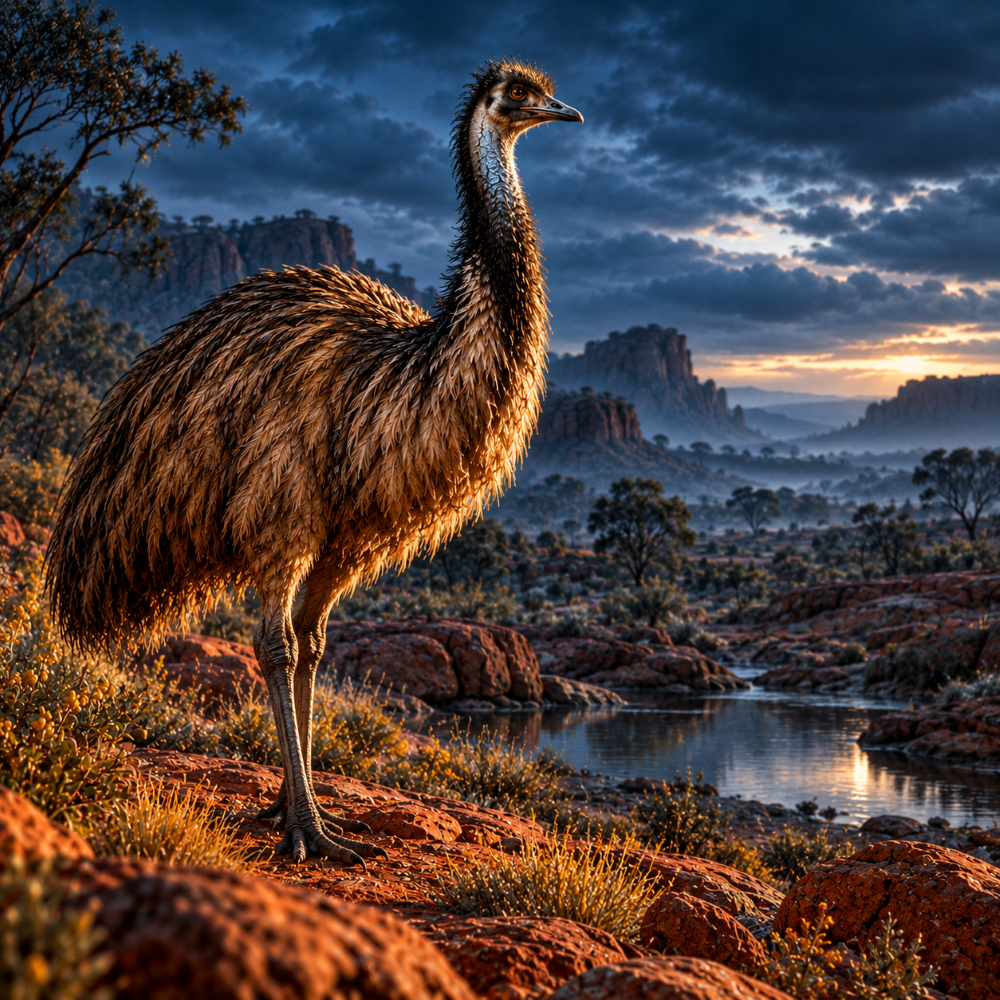
Yankirri takes the form of an emu, a powerful, flightless bird native to Australia. Emus have long legs, a broad body, shaggy brown-grey plumage, and a long neck that allows them to move through open woodland, grassland, and scrub. Although these are the characteristics of the living species, the documented Warlpiri tradition does not require Yankirri to possess extraordinary physical features.
The emu’s movements are particularly important in artistic representations of the Dreaming. Warlpiri paintings commonly depict Yankirri through wirliya, or footprints, represented as arrow-like shapes. These marks communicate the bird’s movements across Country and connect its journey to particular locations.
Such designs are not merely decorative illustrations of an animal. They can communicate relationships between ancestral activity, geographical features, and culturally significant places. The precise arrangement and interpretation of these motifs depend on the artwork and its cultural context. Yankirri’s identity is thus conveyed through both its recognisable animal form and the tracks associated with its ancestral journey.
Family
The documented Ngarlikurlangu narrative does not establish a biological family for Yankirri. Instead, its central relationship is with Wardilyka, the Australian bustard. Their story is one of rivalry and conflict rather than kinship.
The tradition is also connected to Warlpiri kinship structures through the people who hold responsibility for the Dreaming. The Ngarlikurlangu Yankirri Jukurrpa is associated with Nangala and Nampijinpa women and Jangala and Jampijinpa men. These are Warlpiri subsection, or skin-group, designations that identify culturally significant relationships and responsibilities. They should not be confused with Yankirri’s biological relatives.
This distinction matters because Warlpiri ancestral traditions are not simply collections of stories about individual characters. They also establish relationships between people, places, and inherited cultural knowledge. The custodianship associated with Yankirri Jukurrpa forms part of this broader system of responsibility. Accordingly, Yankirri is best understood through its documented relationships with Wardilyka, Country, and the relevant Warlpiri custodians rather than through an invented family tree.
Other names
Yankirri is the Warlpiri word for emu. The expression Yankirri Jukurrpa refers to the associated Emu Dreaming tradition, while Jukurrpa describes a broader Indigenous understanding of ancestral narratives, cultural law, and continuing relationships with Country. The name Ngarlikurlangu identifies the location associated with the well-documented Emu Dreaming narrative. The place name also appears in variant spellings, including Ngarlikirlangu, in artwork descriptions and other English-language records. These spelling differences do not necessarily indicate separate traditions.
Several additional Warlpiri terms are important to understanding the story. Wardilyka refers to the Australian bustard in this account. Yakajirri is the bush raisin (Solanum centrale), a native Australian plant whose fruit is central to the narrative. Kapurdu refers to the fruit balls prepared for storage. Wirliya describes the emu’s footprints as represented in the relevant artistic tradition. Together, these names preserve the connections between the ancestral characters, native food resources, and the landscape in which the narrative unfolds.
Powers and Abilities
Yankirri is not documented as possessing a conventional set of supernatural powers. The significance of the ancestral emu lies instead in its actions and their continuing cultural meaning. In the Ngarlikurlangu narrative, Yankirri travels across Country, seeks water, gathers bush raisins, and becomes involved in a dispute with Wardilyka. These events connect the bird to specific locations and provide the narrative framework for interpreting features of the surrounding landscape.
The story also preserves knowledge of traditional food storage. Bush raisins were collected, dried, ground using a stone in a coolamon, mixed with water, and formed into balls. The resulting kapurdu were covered with red ochre to help preserve them. This practice demonstrates how the narrative incorporates practical knowledge about food resources and preparation.
Yankirri’s wider significance therefore rests on its role within Jukurrpa. Its ancestral journey connects geographical knowledge, cultural responsibility, artistic representation, and ceremonial practice. These functions are more firmly supported by documented Warlpiri accounts than claims that the emu controls the weather, changes shape, or possesses magical invulnerability.
Modern Day Influence
Yankirri continues to feature prominently in contemporary Warlpiri art. Artists associated with Warlukurlangu Artists, an Aboriginal-owned art centre in Yuendumu, produce paintings that represent the Emu Dreaming and its connection to Ngarlikurlangu. These works use traditional visual conventions to express relationships between ancestral narratives, Country, and cultural identity.
The significance of this tradition also extends into public cultural collections. Works depicting Yankirri Jukurrpa have entered Australian art institutions, including the Parliament House Art Collection. Such collections demonstrate the recognition of Warlpiri artistic traditions beyond their immediate community, although the cultural meaning of each work remains rooted in its particular context and custodianship.
Ceremony provides another important connection between the ancestral emu and contemporary Warlpiri life. The Ngarlikurlangu account records a dance associated with Yankirri Jukurrpa performed during men’s initiation ceremonies. This practice links the narrative to cultural transmission and community responsibilities.
The landscape remains equally important. The documented story associates round, red rocks at Ngarlikurlangu with the broken kapurdu from the ancestral conflict. Within the tradition, these features connect the remembered events to a tangible place. Yankirri’s contemporary significance is therefore not simply a matter of preserving an old story. Through art, ceremony, and relationships with Country, the Emu Dreaming remains part of a living cultural tradition.
Related Images

Source
Australian Parliament House. (n.d.). Ormay Nangala Gallagher’s Yankirri Jukurrpa (Emu Dreaming).
https://www.aph.gov.au/Visit_Parliament/Art/Icons/Animals_Ormay_Emu
Gallagher, M. J. (n.d.). Emu Dreaming – Ngarlikirlangu [Painting description]. Aboriginal Art Australia.
https://www.aboriginal-art-australia.com/artworks/michael-jangala-gallagher-emu-dreaming-ngarlikirlangu-2528-21ny/
Turpin, M., & Ross, A. (2019). Central Australian Aboriginal songs and biocultural knowledge: Evidence from women’s ceremonies from Lajamanu, Bundjalung and Arrernte. Journal of Ethnobiology, 39(3), 354–374.
https://bioone.org/journals/journal-of-ethnobiology/volume-39/issue-3/0278-0771-39.3.354/Central-Australian-Aboriginal-Songs-and-Biocultural-Knowledge–Evidence-from/10.2993/0278-0771-39.3.354.pdf
Patrick, J. J. (2010). Emu Dreaming. Lajamanu, Australia. https://researchportalplus.anu.edu.au/en/publications/emu-dreaming/
Warlukurlangu Artists. (2023, April 20). History. https://warlu.com/about/history/
Warlukurlangu Artists. (2025, July 30). Sarah-Jane Nampijinpa Singleton. https://warlu.com/artist/sarah-jane-nampijinpa-singleton/
Yallingup Aboriginal Art. (n.d.). Margaret Nangala Gallagher: Yankirri Jukurrpa (Emu Dreaming) – Ngarlikirlangu. https://yallingupaboriginalart.com.au/artists/margaret-nangala-gallagher/margaret-nangala-gallagher-yankirri-jukurrpa-emu-dreaming-ngarlikirlangu/
Meggitt, M. J. (1962). Desert people: A study of the Walbiri Aborigines of Central Australia. Angus and Robertson. https://archive.org/details/yimikirliwarlpir0000unse
Frequently Asked Questions
Who is Yankirri in Warlpiri tradition?
Yankirri is the Warlpiri word for emu and is associated with Yankirri Jukurrpa, or Emu Dreaming, an ancestral tradition connecting the bird to Country and cultural knowledge.
What is the Yankirri Jukurrpa story about?
The Ngarlikurlangu account describes a conflict between Yankirri, the emu, and Wardilyka, the Australian bustard, over bush raisins and stored fruit balls.
Where is the Yankirri Jukurrpa located?
The documented Yankirri Jukurrpa is associated with Ngarlikurlangu, approximately 50 kilometres north of Yuendumu in Australia’s Northern Territory.
What does Yankirri symbolise in Warlpiri culture?
Yankirri connects ancestral journeys, Country, traditional food knowledge, and cultural responsibilities. Its footprints also feature in artistic representations of the Emu Dreaming.
Does Yankirri have supernatural powers?
Documented accounts emphasise Yankirri’s ancestral role and cultural significance rather than specific magical powers such as shapeshifting, weather control, or immortality.


