
Yacumama : The Mother of Waters in Amazonian Lore
At a glance
| Description | |
|---|---|
| Origin | Amazonian Mythology |
| Classification | Spirits |
| Family Members | N/A |
| Region | Peru, Brazil |
| Associated With | Rivers, Aquatic life, Creation, Destruction, |
The Mythlok Perspective
In Mythlok’s Perspective, Yacumama is less a creature and more an elemental consciousness of water itself. She reflects humanity’s instinctive understanding that rivers sustain life but can just as easily take it away. Unlike Western dragon myths that emphasize conquest, Yacumama represents coexistence and caution. This idea finds parallels in other cultures. The Mesopotamian Tiamat embodies primordial water chaos, while the African Mami Wata reflects both seduction and danger in aquatic form. Even the Nāga of Indian traditions share this dual nature of guardianship and threat. Across cultures, water is never neutral, and Yacumama stands as one of its most powerful expressions.
Yacumama
Introduction
Yacumama is one of the most fascinating and feared figures in Amazonian folklore, deeply rooted in the traditions of Indigenous communities across Peru, Brazil, Colombia, Ecuador, and Bolivia. The name comes from the Quechua language, where yaku means water and mama means mother, giving it the powerful title “Mother of Waters.” This alone captures the essence of the being, a primordial force believed to govern rivers, lakes, and lagoons throughout the Amazon basin.
Rather than being a simple monster, Yacumama represents the living spirit of water itself. For many Indigenous cultures, rivers are not just physical features but sacred entities that sustain life while also demanding respect. Yacumama embodies this dual nature. She is both creator and destroyer, nurturing aquatic life while punishing those who approach her domain without caution.
Stories about Yacumama have been passed down through generations, often serving as warnings about the dangers of deep or unfamiliar waters. Rituals such as blowing a conch shell before entering a river are still remembered in oral traditions, believed to either appease the spirit or reveal her presence.
Physical Traits
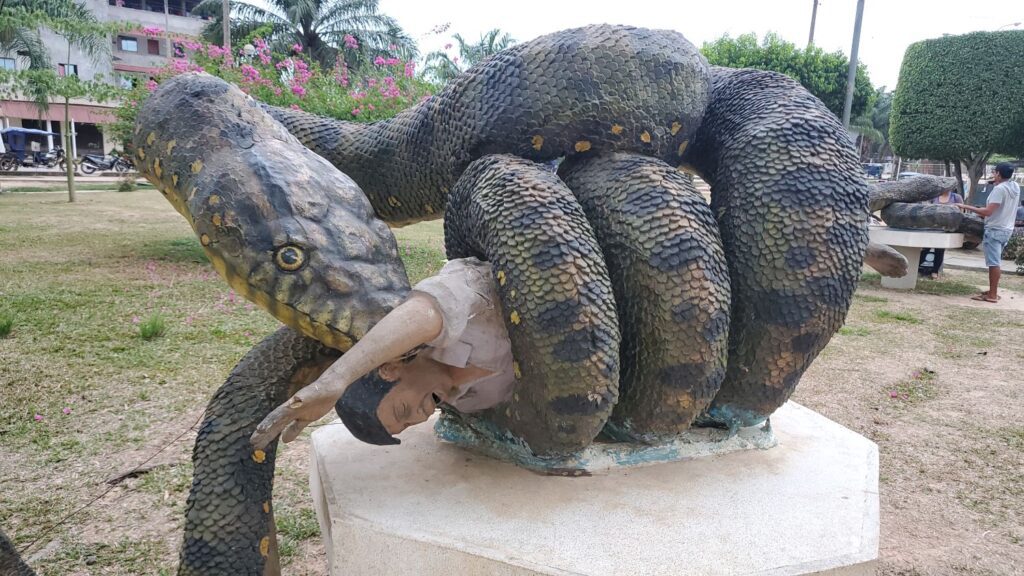
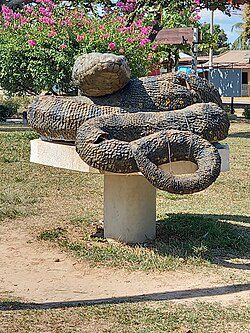
Descriptions of Yacumama consistently portray her as a colossal serpent, often compared to an anaconda but vastly larger than any known species. Most accounts place her length between 49 to 60 meters, making her an almost unimaginable presence beneath the water’s surface.
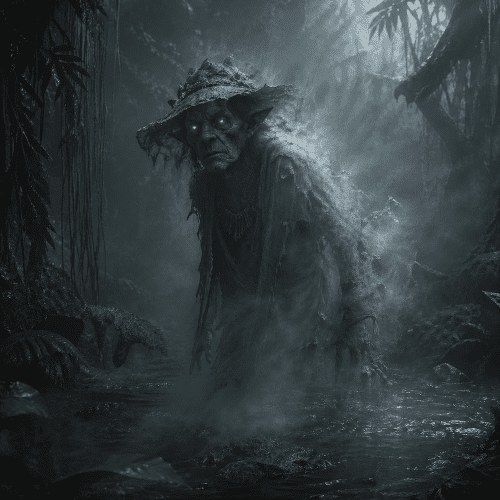
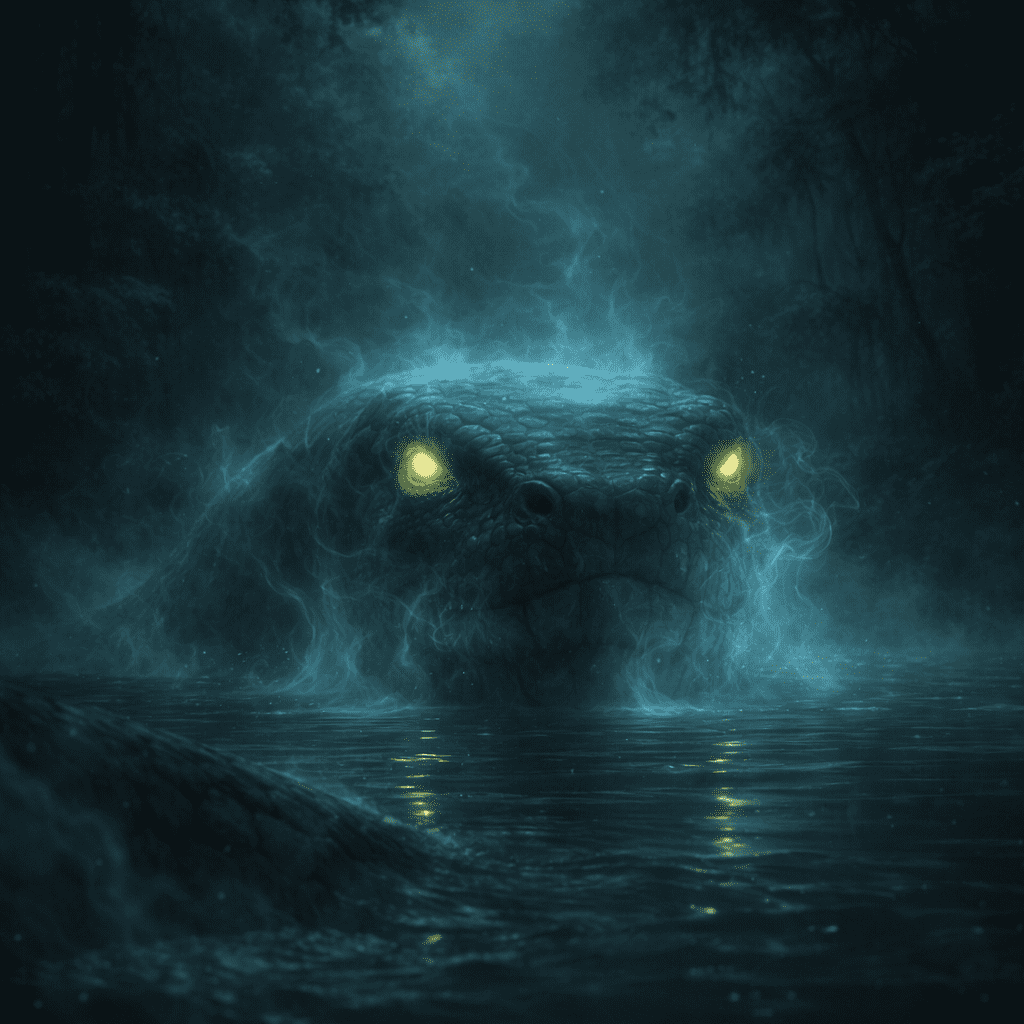
Her body is said to be thick and muscular, capable of displacing water with immense force. Some traditions describe her scales as dark green or blue with a faint iridescence, allowing her to blend into the murky depths of the Amazon while still appearing otherworldly. Her eyes are often depicted as glowing, sometimes compared to distant lights on a river at night, reinforcing the idea that she watches silently from below.
What makes her truly terrifying is not just her size, but her interaction with the environment. Legends claim that her movement can uproot vegetation, alter small waterways, and create sudden disturbances in otherwise calm waters. In some versions, her mouth is so vast that she can swallow boats or large animals whole, while other stories emphasize her ability to draw prey toward her from a distance.
Family
Yacumama is not typically placed within a traditional family structure like many mythological beings. Instead, she exists as a primordial mother figure, often described as the origin of all aquatic life. Fish, amphibians, and other river creatures are considered her offspring, reinforcing her identity as a life-giving force within the ecosystem.
However, in Amazonian cosmology, she is sometimes associated with other powerful serpent beings. One of the most notable is Sachamama, the “Mother of the Forest,” who governs the land in the same way Yacumama governs water. Together, they form a symbolic balance between earth and water, representing two essential pillars of life in the Amazon.
In some traditions, Yacumama is also counted among a group of ancient “snake mothers,” a set of primal beings that collectively sustain and control different aspects of the natural world. These relationships are not familial in a biological sense but are better understood as interconnected forces within a shared spiritual system.
Other names
While Yacumama is the most widely recognized name, variations exist across the Amazon due to linguistic diversity. Spellings such as Yakumama and Yacumaman appear in different regions, reflecting local pronunciations.
In Brazilian folklore, similar creatures are known as Boiúna or Cobra Grande, both describing massive serpents that inhabit rivers and lakes. Although the names differ, the core concept remains consistent: a giant, supernatural snake that embodies the power of water.
In broader Andean traditions, Yacumama may also overlap with other serpent archetypes, including Amaru, a sacred serpent associated with water and the underworld. These variations highlight how the myth adapts across cultures while preserving its central identity as the “Mother of Waters.”
Powers and Abilities
Yacumama’s abilities are closely tied to her role as a guardian and ruler of aquatic environments. She is believed to have complete dominion over rivers, lakes, and lagoons, with the power to influence water levels, currents, and even weather patterns.
One of the most widely repeated traits is her ability to draw in prey from a distance. Some legends claim that anything within roughly 100 meters can be pulled toward her, either through suction or a powerful current generated by her movement. This ability reinforces the idea that entering unknown waters without caution can be fatal.
In addition to her predatory strength, Yacumama is also seen as a creator. Some stories suggest she shaped parts of the Amazon’s waterways or even contributed to the formation of rivers themselves. In this sense, she is not just a creature within the environment but a force that helped define it.
Other abilities attributed to her include shapeshifting, weather manipulation, and a hypnotic gaze that immobilizes prey. She is also believed to control storms, fog, and whirlpools, using these phenomena as extensions of her will. When respected, she may bless communities with abundant fish and stable waters, but when angered, she becomes a destructive force capable of capsizing boats and swallowing entire groups.
Modern Day Influence
Even today, the legend of Yacumama remains deeply embedded in Amazonian culture. In many communities, her story continues to serve as both a spiritual belief and a practical warning about the dangers of rivers.
The ritual of sounding a horn or conch before entering unfamiliar waters still appears in oral traditions, symbolizing respect for unseen forces. These practices reflect a broader worldview in which nature is alive and must be approached with humility.
Beyond Indigenous culture, Yacumama has gained attention in modern media and cryptozoology. Some researchers and explorers have speculated that sightings of unusually large snakes may have inspired the myth, occasionally linking it to extinct species like Titanoboa. While no scientific evidence supports the existence of such a creature today, the comparison highlights how myth and natural history often intersect.
In contemporary storytelling, Yacumama is sometimes portrayed as the Amazon’s equivalent of a “river monster,” appearing in books, documentaries, and speculative fiction. At the same time, environmental narratives increasingly use her as a symbol of ecological balance, reminding people that the Amazon is not just a resource but a living system that demands respect.
Related Images

Source
BigSnakes.Info. (n.d.). Folklore: Sachamama and Yacumama. BigSnakes.Info. https://www.bigsnakes.info/folklore.html
Goddess and Monster Archive. (2024, September 29). Yacumama: Serpent guardian of the waters. Gods and Monsters. https://godsandmonsters.info/yacumama/
Horror Yearbook. (2025, July 2). Yacumama: The serpent spirit of the Amazon. Horror Yearbook.
https://horroryearbook.com/yacumama-the-serpent-spirit-of-the-amazon/
Lockett, C. (2024, November 20). The urban legend of Yacumama [Presentation]. Prezi. https://prezi.com/p/jzf2fo5rdmea/the-urban-legend-of-yacumama/
Mitologia.Wiki. (2024, June 4). Sachamama: Espíritu inca de la selva y los árboles en la mitología amazónica. Mitologia.Wiki. https://mitologia.wiki/otras-mitologias/mitologia-inca/sachamama-espiritu-inca-de-la-selva-y-los-arboles-en-la-mitologia-amazoni
Te Amo Pucallpa. (2024, December 29). La Yacumama: Leyenda de la serpiente madre del agua. Te Amo Pucallpa. https://teamopucallpa.com/la-yacumama/
Untold Stories for You. (2016, November 11). The legendary Yacumama: The largest snake eats human beings? Untold Stories for You Blog. http://untoldstoriesforyou.blogspot.com/2014/06/the-legendary-yacumama-largest-snake.html
Frequently Asked Questions
What is Yacumama in mythology?
Yacumama is a gigantic serpent spirit from Amazonian folklore, known as the “Mother of Waters” and believed to rule rivers and aquatic life.
How big is Yacumama said to be?
Legends describe Yacumama as reaching lengths of up to 49–60 meters, far larger than any real snake.
Is Yacumama based on a real animal?
Some theories suggest the myth may be inspired by large anacondas or extinct snakes like Titanoboa, but there is no scientific evidence supporting its existence.
What powers does Yacumama have?
She is believed to control water, create storms, summon whirlpools, and draw in prey from a distance.
Why did people blow conch shells before entering water?
This ritual was believed to show respect and alert Yacumama, reducing the risk of angering the spirit.