


Walhowak : The Silent Cosmic Force of the Dani People
At a glance
| Description | |
|---|---|
| Origin | Dani Mythology |
| Classification | Gods |
| Family Members | N/A |
| Region | Indonesia (Papua, Baliem Valley) |
| Associated With | Cosmic balance, Creation |
The Mythlok Perspective
In Mythlok’s Perspective, Walhowak represents a rare form of divinity that exists beyond personality and mythic drama, embodying pure cosmic order rather than narrative presence. This places it closer to abstract principles like Brahman in Indian thought or the Dao in Chinese philosophy than to gods who intervene in human affairs. Unlike Zeus or Odin, Walhowak does not rule through action but through existence itself. Its significance lies in its silence, reflecting a worldview where balance matters more than divine will.
Walhowak
Introduction
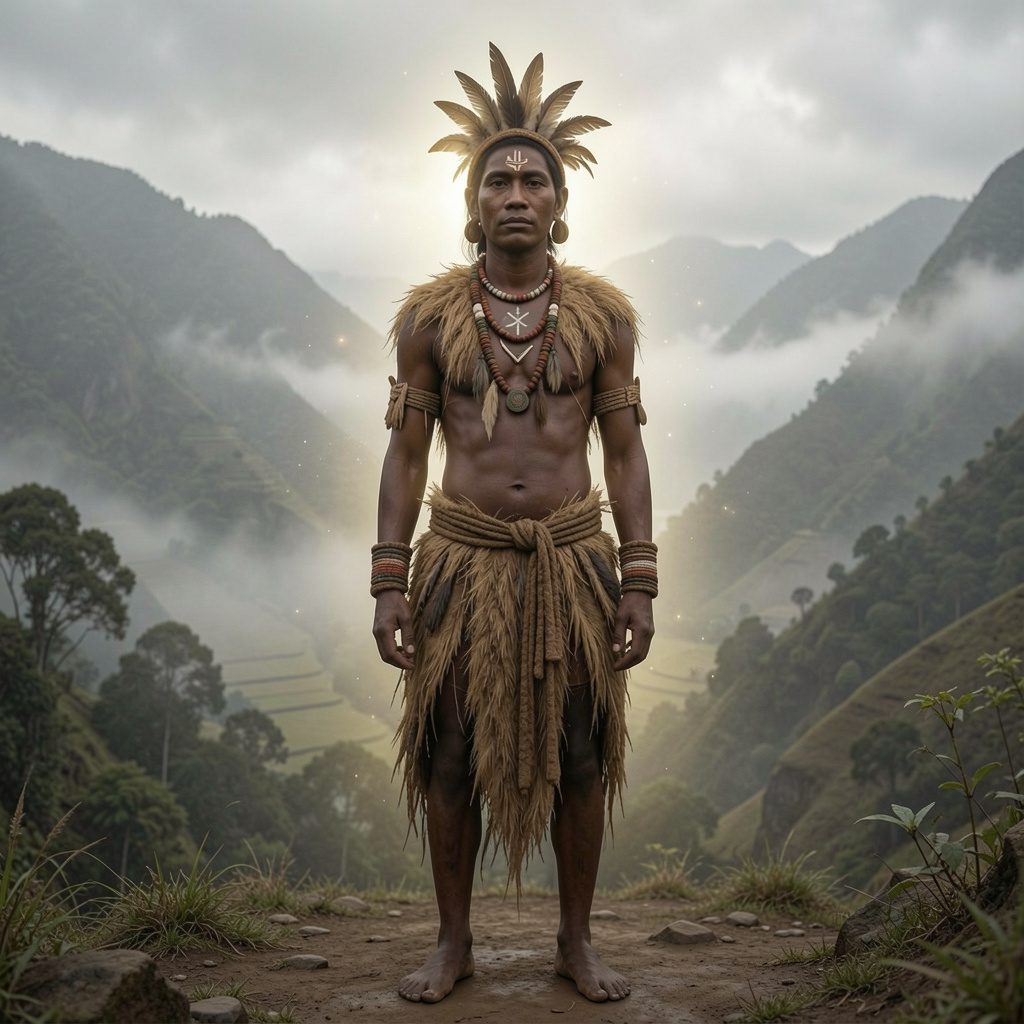
Walhowak, also known as Nyopase Kain, is the Dani people’s concept of a supreme cosmic reality that exists beyond the visible world. The Dani, who live in the Baliem Valley of Papua in present-day Indonesia, follow an animistic worldview where nature, ancestors, and unseen forces are deeply interconnected. Within this system, Walhowak is not a god in the familiar storytelling sense but a distant, foundational presence that underlies existence itself.
Unlike mythological figures who act, speak, or intervene, Walhowak represents an ultimate source of power that governs both spiritual and physical realms without direct involvement. Anthropological studies often describe Walhowak as a “high god” or “absolute reality,” emphasizing its abstract nature. This is why Dani traditions focus more on ancestral spirits and cultural heroes rather than narratives centered on Walhowak. Even so, the idea of Walhowak quietly shapes how the Dani understand life, balance, and the unseen structure of the universe.
Physical Traits
Walhowak does not possess a physical form, gender, or recognizable features. In Dani belief, it is entirely non-anthropomorphic, meaning it is not imagined as human or animal-like. Instead, its presence is inferred through the natural world, especially powerful landscapes such as mountains, rivers, and sacred stones.
Rather than being seen, Walhowak is understood. The Dani interpret its existence through the order and continuity of life, not through visual representation. Ceremonial language sometimes refers to Walhowak as the “Source of all sources” or the “King of heaven and earth,” but these are symbolic expressions rather than literal descriptions. This reinforces the idea that Walhowak exists beyond physical perception, functioning as a cosmic principle rather than a visible being.
Family
In Dani cosmology, Walhowak does not belong to a divine family structure. There are no myths describing parents, consorts, or offspring. This absence is important because it distinguishes Walhowak from the layered genealogies seen in many world traditions.
Instead, Walhowak exists at the highest level of a spiritual hierarchy that includes ancestral spirits and localized nature forces. These entities are not considered its children in a biological or mythological sense. Rather, they operate within the broader cosmic order that Walhowak represents.
Figures such as ancestral heroes play a far more active role in Dani storytelling and identity, especially in clan lineage systems. Walhowak remains separate from these relational frameworks, reinforcing its position as an impersonal and foundational force rather than a familial deity.
Other names
Walhowak is also referred to as Nyopase Kain, a name used interchangeably in ethnographic and cultural contexts. These dual names reflect different linguistic or interpretive layers within Dani belief rather than entirely separate entities.
Some sources also mention variations such as Elalin Walhasikhe, though these are less widely documented and may reflect localized or interpretive adaptations. Across these names, the core idea remains consistent: Walhowak is an ultimate, unknowable source of existence.
In more recent history, especially with the arrival of Christianity in Papua, Walhowak has sometimes been equated with the Christian God. This comparison is part of a syncretic process where indigenous concepts are used to understand introduced religious ideas. However, traditionally, Walhowak was never a personal deity in the way the Christian God is described, making this association more interpretive than original.
Powers and Abilities
Walhowak’s “powers” are not expressed through actions or mythological events but through its role as the underlying structure of reality. It represents the force that maintains cosmic balance, linking the natural world, human life, and the spiritual realm.
In Dani belief, harmony between people, land, and spirits is essential. When imbalance occurs, it is not seen as punishment from Walhowak but as a disruption of the natural order that Walhowak embodies. Rituals, including offerings and communal ceremonies, are therefore aimed at restoring balance rather than seeking favor from a deity.
Walhowak is also associated with the origin of life and ancestral continuity. While it does not directly intervene, its presence is reflected in cycles such as birth, death, and renewal. This makes Walhowak less of an active ruler and more of an ever-present foundation that gives meaning to existence itself.
Modern Day Influence
Today, the concept of Walhowak continues to influence how the Dani interpret spirituality, even as Christianity has become widespread in the Baliem Valley. For many Dani communities, Walhowak serves as a bridge between traditional beliefs and newer religious frameworks.
Some local interpretations align Walhowak with the Christian idea of a creator, allowing continuity between old and new systems of thought. However, the original concept of Walhowak as an impersonal cosmic force remains distinct. It emphasizes balance and interconnectedness rather than individual morality or divine judgment.
Walhowak is no longer central to storytelling but persists as a philosophical foundation. It shapes cultural identity, ecological respect, and the understanding that humans are part of a larger, unseen order. In this way, Walhowak continues to exist not as a character in myth, but as a concept that quietly endures in both tradition and modern interpretation.
Related Images

Source
Mawikere, M. C. S., Hura, S., Mawikere, J. C. R., & Mawikere, D. B. M. (2024). Ethnotheological studies on the substance of folk religion as local theology among the Dani ethnic group in Baliem Village, Papua: Towards a contextual ministry. Limmud: Journal of Ethnotheology and Contextual Ministry, 1(1), 1–28.
https://journal.gknpublisher.net/index.php/limmud/article/download/138/105
Mawikere, M. C. S., Hura, S., Mawikere, J. C. R., & Mawikere, D. B. M. (2025). A study of the worldview in the mythology of the Dani ethnic group in Papua and its ethical implications through the lens of Christian perspective. Padamara: Jurnal Ilmiah, 2(1), 13–30. https://konselorgkn.com/index.php/padamara-jurnal-ilmiah/article/download/51/41
Susanto‑Sunario, A. (Ed.). (1994). Papua: Kebudayaan, agama, dan masyarakat (2nd ed.). Jakarta: BPK Gunung Mulia.
Alua, A. (2006). Agama dan budaya orang Papua: Kajian etnologi dan teologi lokal. Jakarta: BPK Gunung Mulia.
Giay, B. (1986). Agama dan adat di Papua. Jayapura: Lembaga Studi Masyarakat dan Adat Papua.
Vision Project. (n.d.). Dani tribesmen. Vision Project. https://www.visionproject.org/galleries/dani_tribesmen.html
Young Pioneer Tours. (2025, January 28). The Dani tribe aka the penis tribe of Papua. Youngpioneertours.com.
https://www.youngpioneertours.com/dani-tribe-aka-penis-tribe/
Frequently Asked Questions
Who is Walhowak?
Walhowak is the Dani people’s concept of a supreme cosmic force that governs both the visible and invisible worlds without direct intervention.
Is Walhowak a personal god?
No, Walhowak is considered an impersonal and abstract reality rather than a deity with human-like traits or emotions.
Where is Walhowak worshipped?
Walhowak is part of the traditional belief system of the Dani people in the Baliem Valley of Papua, Indonesia.
Does Walhowak appear in myths or stories?
Walhowak rarely appears in narrative myths. Dani traditions focus more on ancestors and cultural heroes.
How is Walhowak understood today?
Today, Walhowak is often interpreted alongside Christian beliefs, acting as a bridge between traditional Dani spirituality and modern religion.
