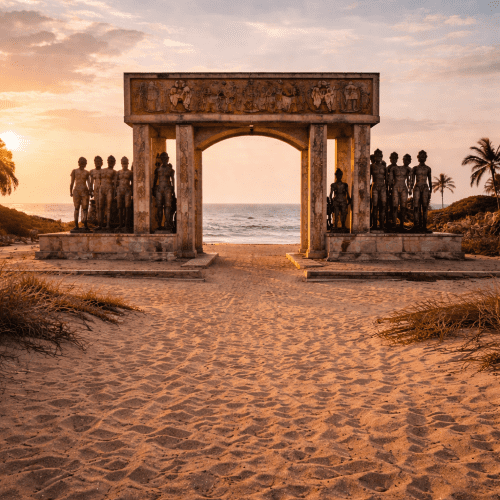


Temple of Pythons : Sacred Snake Shrine of Benin
At a glance
| Description | |
|---|---|
| Mythology | Vodun Mythology |
| Country | Benin |
| Closest airport | Cadjehoun Airport (COO) |
| Type | Constructed |
| Accessibility | 07/10 |
Mythlok Perspective
In Mythlok’s Perspective, the Temple of Pythons stands as one of the clearest examples of how mythology can remain fully alive within everyday society. The sacred pythons are not relics of forgotten stories but active symbols of protection, balance, and ancestral memory. The temple transforms fear of snakes into reverence, showing how different cultures assign radically different meanings to the natural world. Similar serpent symbolism appears in many civilizations, from the Nāgas of Indian tradition to the rainbow serpent beliefs of Indigenous Australia. Across cultures, serpents often represent hidden wisdom, cosmic cycles, and the connection between earth and spirit. The Temple of Pythons preserves this ancient archetype in one of its most authentic living forms.
Temple of Pythons
Introduction
The Temple of Pythons in Ouidah, Benin, is one of the most unusual religious sites in Africa. Unlike museums or reconstructed heritage attractions, this temple remains an active center of Vodun worship where sacred pythons are protected, respected, and woven into daily spiritual life. Visitors entering the shrine quickly realize that the snakes are not displayed as curiosities. Instead, they are treated as divine symbols connected to protection, balance, and ancestral belief.
Located in the historic coastal town of Ouidah, the temple has become one of Benin’s best-known cultural landmarks. The structure itself is relatively modest, featuring a clay-tiled roof and simple walls, yet its spiritual significance far outweighs its physical appearance. Inside, dozens of royal pythons rest freely around the sanctuary, often moving calmly through the temple under the supervision of priests and caretakers.
For travelers interested in mythology, African spirituality, and living traditions, the Temple of Pythons offers something rare. It is a place where ancient beliefs continue to shape modern community life, creating an experience that feels both historical and deeply alive.
Connection with Mythology
The mythology surrounding the Temple of Pythons is closely connected to Vodun, one of West Africa’s oldest spiritual traditions. In Fon belief systems, the serpent deity Dan, also called Dangbe or Dan Aido-Hwedo, represents cosmic balance, protection, fertility, and spiritual continuity. The python is viewed as the earthly manifestation of this sacred force.
According to regional mythology, Dan played a role in the creation of the world by supporting cosmic order and linking the spiritual and earthly realms. The rainbow itself is sometimes interpreted as the visible path of the serpent deity across the sky. Because of this connection, snakes are not seen as creatures of fear in Ouidah. Instead, they symbolize harmony between humanity, nature, and the divine.
The temple is also tied to the legend of King Kpassè, a ruler associated with the Kingdom of Ouidah during the early eighteenth century. Local tradition states that during a conflict, sacred pythons protected the king while he escaped through the forests surrounding the region. In gratitude, the sanctuary was established to honor the snakes and preserve their sacred role within the community.
Even today, harming a python in Ouidah is considered taboo. Historically, severe punishments existed for killing one of the sacred snakes, and purification rituals are still performed if such an act occurs accidentally. These traditions highlight how mythology continues to influence local customs and social values in Benin.
Ways to Get There
The Temple of Pythons is located in the center of Ouidah, approximately 40 kilometers west of Cotonou, Benin’s largest city and primary international gateway. Most international travelers arrive through Cadjehoun Airport in Cotonou before continuing toward Ouidah by road.
The journey from Cotonou generally takes between one and a half to two hours depending on traffic conditions. Private taxis are the fastest and most comfortable option for visitors, while shared taxis and minibuses provide a more affordable alternative. Many travelers also choose organized heritage tours that combine the Temple of Pythons with other important sites in Ouidah, including the Route des Esclaves and the Door of No Return memorial.
Once inside Ouidah, the temple is relatively easy to reach. It sits near several important religious and historical landmarks, making it accessible by foot for travelers already exploring the town center. Motorbike taxis, locally called zemidjans, are another common transport option for short distances. The roads connecting Cotonou and Ouidah are generally accessible throughout the year, although travel becomes slower during heavy rainy periods between April and July.
What to Look For
The first thing visitors notice at the Temple of Pythons is the calm atmosphere surrounding the snakes themselves. Around fifty to sixty royal pythons live within the shrine, moving freely around the temple interior and occasionally being carried by priests during demonstrations or blessings. These snakes are non-venomous and are accustomed to human presence, which allows visitors to observe them from a close distance.
The temple also contains sacred ritual objects connected to Vodun worship. White cloths, ceremonial symbols, offerings, and spiritual markings reflect the continuing religious role of the site rather than a staged tourist performance. Priests and guides often explain the meaning of the pythons within local cosmology and discuss the relationship between Vodun spirituality and community traditions.
One of the most striking features of the area is the religious coexistence visible in Ouidah itself. Directly across from the temple stands the Basilica of the Immaculate Conception, creating a symbolic contrast between Christian and Vodun traditions existing side by side within the same town.
Visitors may also notice worshippers with ritual facial markings or ceremonial clothing associated with Vodun practice. Nearby attractions such as the Sacred Forest of Kpassè further deepen the mythological atmosphere surrounding the temple and provide additional insight into Benin’s spiritual heritage.
Importance in cultural history
The Temple of Pythons holds immense cultural significance because it preserves a living expression of traditional African spirituality in a rapidly modernizing world. Ouidah itself played a major role during the era of the transatlantic slave trade, and many enslaved Africans carried Vodun beliefs across the Atlantic to places such as Haiti, Brazil, and Cuba. As a result, the spiritual traditions practiced in the temple influenced religions like Haitian Vodou and Brazilian Candomblé.
Despite centuries of colonial suppression and outside misunderstanding, Vodun survived in Benin through oral traditions, ceremonies, and sacred spaces like this temple. Today, Benin officially recognizes Vodun as an important part of national cultural identity, and annual festivals celebrate its continuing influence.
The Temple of Pythons has therefore become more than a religious shrine. It represents resilience, continuity, and the preservation of indigenous belief systems that survived enormous historical change. For many travelers, visiting the temple challenges stereotypes about “voodoo” by revealing a sophisticated spiritual tradition rooted in community, symbolism, and reverence for nature. The site also contributes significantly to cultural tourism in Benin, attracting visitors interested in mythology, anthropology, religion, and African history.
Best time to travel
The best time to visit the Temple of Pythons is during Benin’s dry season, particularly between November and March. During these months, temperatures remain warm but manageable, and road conditions are generally better for travel between Cotonou and Ouidah.
January is especially important because it coincides with the annual Vodun Festival held around January 10. This celebration is one of the largest traditional religious festivals in West Africa and features music, ritual dances, processions, ceremonial costumes, and spiritual performances. Visiting during this period provides a much deeper understanding of the role Vodun continues to play in Beninese culture.
Another pleasant travel window occurs between late July and early September, when the coastal climate becomes slightly cooler and less humid compared to the intense rainy season. Travelers should avoid peak rainfall months between April and July, as storms can disrupt transportation and outdoor exploration.
Morning visits are usually the most comfortable, allowing travelers to experience the temple before midday heat intensifies. Early visits also provide more time to explore Ouidah’s other historical landmarks throughout the day.



Source
Atlas Obscura. (2017, August 29). The Temple of Pythons in Ouidah. https://www.atlasobscura.com/places/the-temple-of-pythons-ouidah-benin
Visit Benin. (n.d.). Temple of Pythons. https://visitbeninrepublic.com/portfolio/temple-of-pythons/
Evendo. (n.d.). The spiritual haven of Python Temple. https://evendo.com/locations/benin/atlantique/attraction/python-temple
Evendo. (n.d.). The serene majesty of Pythons Temple in Ouidah. https://evendo.com/locations/benin/plateau/landmark/pythons-temple
Visit Benin. (2026). Temple of Pythons. Retrieved from https://visitbenin.org/temple-of-pythons
Mythic Grounds. (2026). Python Temple of Ouidah — Vodun Serpent Shrine in Benin. Retrieved from https://mythicgrounds.com/python-temple-ouidah
Must See Spots. (2026). Pythons Temple in Ouidah: A Voodoo Sanctuary Guide. Retrieved from https://mustseespots.com/benin/python-temple-ouidah
UNESCO. (2025). Ouidah and the Vodun Tradition. Retrieved from https://unesco.org/ouidah-vodun
Frequently Asked Questions
Why is the Temple of Pythons famous?
The Temple of Pythons is famous for its sacred royal pythons and its role as an active Vodun religious shrine in Benin.
Where is the Temple of Pythons located?
The temple is located in Ouidah, a historic coastal town in southern Benin, West Africa.
Are the snakes inside the Temple of Pythons dangerous?
The temple’s royal pythons are non-venomous and are generally calm around visitors and worshippers.
What religion is connected to the Temple of Pythons?
The temple is connected to Vodun, a traditional West African spiritual belief system centered on spirits and sacred forces.
When is the best time to visit the Temple of Pythons?
The best time to visit is during the dry season between November and March, especially around the January Vodun Festival.