

Sinlaku : The Breadfruit Goddess of Kosraean Tradition
At a glance
| Description | |
|---|---|
| Origin | Kosraean Mythology |
| Classification | Gods |
| Family Members | Nosrunsrap (Husband) |
| Region | Micronesia |
| Associated With | Breadfruit, Fertility, Sacred landscapes, Storms, Food abundance |
The Mythlok Perspective
In Mythlok’s Perspective, Sinlaku represents one of the clearest examples of how ancient island cultures viewed nature as a living spiritual force rather than a separate environment to control. Her role as both provider and destroyer mirrors the fragile balance that many oceanic societies experienced while depending entirely on seasonal harvests and weather patterns. Unlike heavily anthropomorphic deities from larger civilizations, Sinlaku feels deeply tied to the land itself, almost becoming an embodiment of Kosrae. Her connection to breadfruit and sacred geography resembles agricultural deities such as Demeter from Greek tradition or the Andean earth spirit Pachamama. Yet Sinlaku remains uniquely Micronesian because her power is inseparable from island ecology, ritual spaces, and ancestral memory.
Sinlaku
Introduction
Sinlaku, sometimes written as Sinlaka, is one of the most intriguing spiritual figures in Kosraean tradition. Originating from the island of Kosrae in the Federated States of Micronesia, she is remembered as a powerful goddess tied to food abundance, sacred landscapes, and ritual worship. Ancient Kosraeans believed that her favor could ensure plentiful breadfruit harvests, while her anger could bring storms, famine, and hardship. Because breadfruit was one of the island’s most important food sources, Sinlaku occupied a vital place in everyday life and survival.
Her worship was strongly connected to sacred locations, especially the Menke Valley, where ritual structures and temple complexes were believed to honor her presence. Oral traditions describe people traveling to these sacred areas to leave offerings and seek blessings for prosperity, protection, and fertility. Unlike many mythological deities who are defined by grand battles or divine courts, Sinlaku’s power was deeply rooted in the natural world and the survival of the community.
The arrival of Christianity during the nineteenth century dramatically changed Kosraean religious practices, leading to the decline of traditional temple worship. However, Sinlaku did not disappear from cultural memory. Stories about her continue to survive through oral traditions, archaeological studies, and local identity. Today, she remains an important figure for understanding pre-Christian Micronesian spirituality and the sacred relationship between people and the environment.
Physical Traits
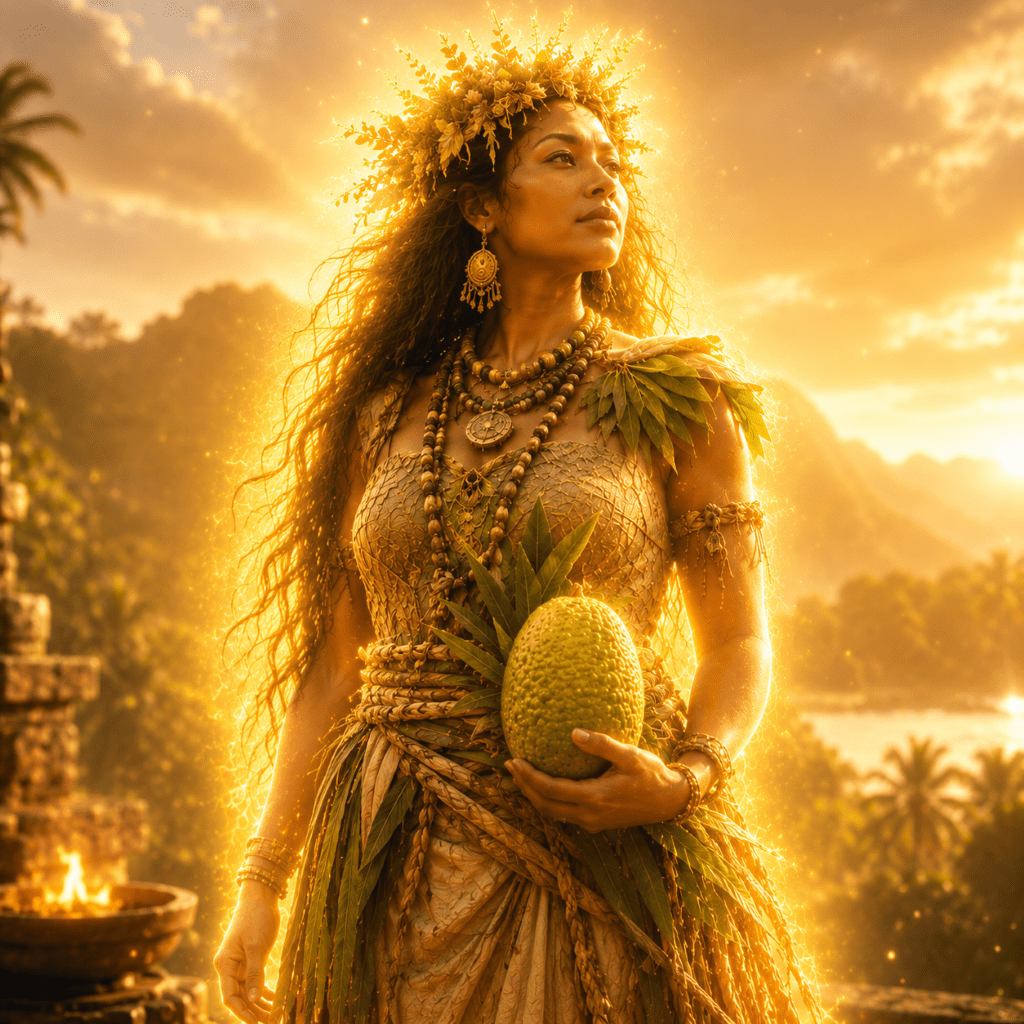
Traditional stories about Sinlaku rarely focus on a detailed physical appearance. Unlike many gods and goddesses from larger mythological systems, she was not consistently described as a human-like figure with specific clothing, weapons, or ornaments. Instead, Kosraean traditions present her as a spiritual force connected to sacred landscapes, temples, and invisible power.
Many accounts suggest that Sinlaku and her attendants were hidden from ordinary human sight. Her presence was believed to be felt rather than directly seen, which reinforced her mysterious and divine status. Sacred stone structures, ritual spaces, and temple sites often served as physical representations of her influence. Archaeological studies of the Menke region have revealed ceremonial layouts and ritual environments associated with ancient worship practices connected to Sinlaku.
Some oral traditions portray her as a guardian spirit watching over fertile lands and breadfruit groves. In these stories, nature itself becomes an extension of her identity. The forests, valleys, and agricultural spaces linked to her worship symbolized her unseen presence. This lack of a fixed visual form makes Sinlaku unique among Oceanian spiritual beings because her identity is defined more by sacred geography and divine influence than by appearance.
Family
Kosraean mythology does not provide a detailed divine genealogy for Sinlaku. Unlike mythological traditions that include extensive family trees of gods, Kosraean beliefs often focused more on ancestral spirits, sacred places, and community rituals. Because of this, Sinlaku appears primarily as an independent deity connected directly to the island and its people.
Some ethnographic accounts associate Sinlaku with a male spiritual counterpart named Nosrunsrap, a thunder deity linked to turtles and storm power. Their connection may represent a symbolic balance between fertility, weather, and environmental forces within Kosraean cosmology. Rather than functioning as a traditional married couple in mythological storytelling, they seem to represent complementary spiritual powers influencing the island’s wellbeing.
Other figures occasionally appear in traditions connected to Sinlaku’s sacred sites. One of these is Sikaus, who is described as a prophet, caretaker, or intermediary associated with taboo areas and temple rituals. Such individuals were believed to communicate with spiritual forces and maintain sacred customs. These relationships highlight how Kosraean spirituality blended divine beings, ritual specialists, and ancestral traditions into a unified sacred system.
Other names
Sinlaku is sometimes recorded as Sinlaka in academic and historical sources. These variations mainly result from differences in spelling and the challenges of translating Kosraean pronunciation into English-language records. Both versions refer to the same goddess and are widely accepted in ethnographic discussions.
The Menke Valley is also closely associated with Sinlaku’s identity. In some contexts, the sacred site itself became almost synonymous with her worship because of the temple complexes and ritual practices located there. The cultural importance of Menke helped preserve Sinlaku’s legacy long after formal worship declined.
Interestingly, the name Sinlaku later gained international recognition through Pacific storm-naming systems. The name was selected for a western Pacific typhoon, introducing the ancient Kosraean goddess to a global audience. While this modern usage does not represent active religious worship, it demonstrates how traditional Micronesian cultural references continue to survive in contemporary contexts.
Powers and Abilities
Sinlaku was primarily associated with breadfruit production, fertility, and food abundance. Breadfruit was essential to life on Kosrae, making her one of the most important spiritual figures connected to survival and prosperity. Communities believed that respecting sacred customs and rituals would earn her favor and lead to healthy harvests.
At the same time, Sinlaku was also feared for her ability to punish disrespect and taboo violations. Oral traditions describe storms, crop destruction, and famine as possible consequences of angering the goddess. In this way, she represented both creation and destruction, reflecting the unpredictable power of nature itself.
Sinlaku was also believed to possess hidden spiritual abilities. Stories describe her granting requests during the night or providing resources during periods of scarcity. Some accounts mention tobacco magically appearing during agricultural crises, reinforcing the belief that divine assistance could emerge through unseen means.
Her influence extended beyond agriculture into weather and environmental control. Through her connection with storms and natural forces, Sinlaku became a deity whose emotions directly affected the island’s wellbeing. This connection between divine favor and environmental stability reflects a broader Micronesian worldview in which nature and spirituality were inseparable.
Modern Day Influence
Although Christianity replaced much of Kosrae’s traditional religious system, Sinlaku continues to survive through oral history, archaeology, and cultural identity. The Menke archaeological site remains one of the most important physical reminders of her worship. Researchers studying ancient Kosraean religion frequently reference Sinlaku when examining temple architecture, ritual practices, and sacred landscapes.
Local storytelling traditions also preserve memories of the goddess. Narratives shared through community storytelling continue to connect modern Kosraeans with their ancestral heritage. These stories help maintain awareness of the island’s spiritual history even in predominantly Christian communities.
Internationally, the name Sinlaku became more widely recognized after being used for a western Pacific typhoon. This unexpected modern connection drew attention to the cultural origins of the name and indirectly introduced aspects of Kosraean mythology to global audiences.
Academic interest in Sinlaku has also grown in recent decades. Scholars studying Micronesian history and Oceanian spirituality often use her as an example of how island societies understood fertility, ecology, and sacred geography. Through archaeology and oral tradition, Sinlaku continues to represent the resilience of Kosraean cultural memory.
Related Images



Source
Beardsley, R. (2019). Temple architecture in the sacred site of Menke [PDF]. LaVerne Academy. Retrieved from https://laverne.edu/academy/wp-content/uploads/sites/7/2019/02/beardsley-temple-architecture-of-menka.pdf.
“The ancient goddess Sinlaku.” (n.d.). College of Micronesia‑FSM Cultural & Historical Materials. Retrieved from http://www.comfsm.fm/~dleeling/ub/2003/merlynstory.html.
“Tinson Luey — The Sleeping Lady and her four children.” (n.d.). College of Micronesia‑FSM CIS. Retrieved from http://www.comfsm.fm/~dleeling/cis/23/tinson.html.
Kirch, P. V. (2011). The religion of Kosrae. In P. V. Kirch (Ed.), Pacific island religious traditions (chapter abstract). University Press/Academic. https://academic.oup.com/hawaii-scholarship-online/book/18329/chapter-abstract/176365711?redirectedFrom=fulltext.
The Archaeology Channel. (2020, January 19). Menke (video guide and summary). Retrieved from https://www.archaeologychannel.org/video-guide-summary/2341-menke.
Britannica, T. Editors of Encyclopaedia. (2026, April 16). Super Typhoon Sinlaku. In Encyclopaedia Britannica. Retrieved from https://www.britannica.com/event/Super-Typhoon-Sinlaku.
CIMSS Satellite Blog. (2026, April 11). Sinlaku intensifies to Category 5, threatens the Marianas and Guam. Cooperative Institute for Meteorological Satellite Studies. Retrieved from https://cimss.ssec.wisc.edu/satellite-blog/archives/69847.
Zoom Earth. (2026). Super Typhoon Sinlaku 2026 [storm imagery and tracking]. Retrieved from https://zoom.earth/storms/sinlaku-2026/.
Petersen, G. (2009). Traditional Micronesian religion and cosmology. Pacific Studies, 32(2), 45–67.
Rubinstein, D. (1992). Pacific histories: Kosrae and Micronesian traditions. University of Guam Press.
Barnett, H. G. (1949). Micronesian religion and ritual. American Anthropologist, 51(3), 325–339.
Kirch, P. V. (2017). On the road of the winds: An archaeological history of the Pacific Islands. University of California Press.
Frequently Asked Questions
Who is Sinlaku in Kosraean mythology?
Sinlaku is a sacred goddess or spirit from Kosrae associated with breadfruit, fertility, storms, and ritual worship.
What was Sinlaku worshipped for?
People prayed to Sinlaku for food abundance, successful harvests, protection, and environmental balance.
Where was Sinlaku worshipped?
Her worship was strongly connected to the Menke Valley and sacred temple sites on Kosrae Island.
Is Sinlaku still worshipped today?
Formal worship largely disappeared after Christianity spread through Kosrae, though her stories survive in cultural memory.
What powers did Sinlaku have?
Sinlaku was believed to control breadfruit harvests, storms, fertility, and spiritual protection for the island community.
