
Odomankoma : The Akan Creator Who Shaped the Universe
At a glance
| Description | |
|---|---|
| Origin | Ashanti Mythology |
| Classification | Gods |
| Family Members | N/A |
| Region | Ghana |
| Associated With | Creation, Cosmic design, Intelligence, Wisdom |
The Mythlok Perspective
From the Mythlok perspective, Odomankoma represents creation as intelligence rather than authority. He is less a ruler and more a principle of design, echoing philosophical creator concepts found across cultures. In Yoruba tradition, Olodumare similarly exists beyond form, delegating function while remaining the source of order. In ancient Egyptian thought, Ptah creates through thought and speech rather than force. Odomankoma stands among these figures as a reminder that creation, across civilizations, is often imagined not as conquest but as careful, intentional craft.
Odomankoma
Introduction
In Akan and Ashanti cosmology, Odomankoma stands at the very foundation of existence as the principle through which the universe was shaped, ordered, and given purpose. Rather than functioning as a distant sky deity, Odomankoma is understood as the active intelligence behind creation itself, working through intention and craft. Akan oral philosophy often explains the universe through a sacred triad in which Nyame represents the expansive, revolving cosmos, Nyankopon embodies the life-giving spiritual force, and Odomankoma serves as the divine artisan who gives form to all that exists. This layered understanding allows creation to be both cosmic and intimate, governed by design rather than accident.
Akan proverbs frequently affirm this role, most notably in the phrase “Odomankoma bɔɔ adeɛ,” meaning Odomankoma made the world or the ‘thing’ that exists. Unlike many supreme beings who remain untouched by narrative conflict, Odomankoma’s myths include struggle, experimentation, and even death. In one well-known tradition, he creates Owuo, the force of death, only to later confront and outwit it through knowledge and antidote. These stories frame creation as an ongoing process shaped by wisdom, consequence, and balance, rather than a single completed act.
Physical Traits
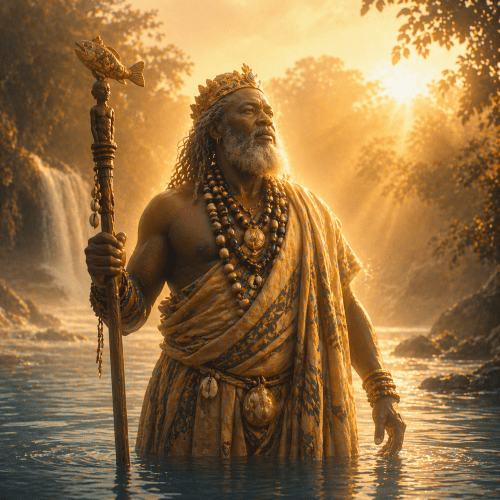
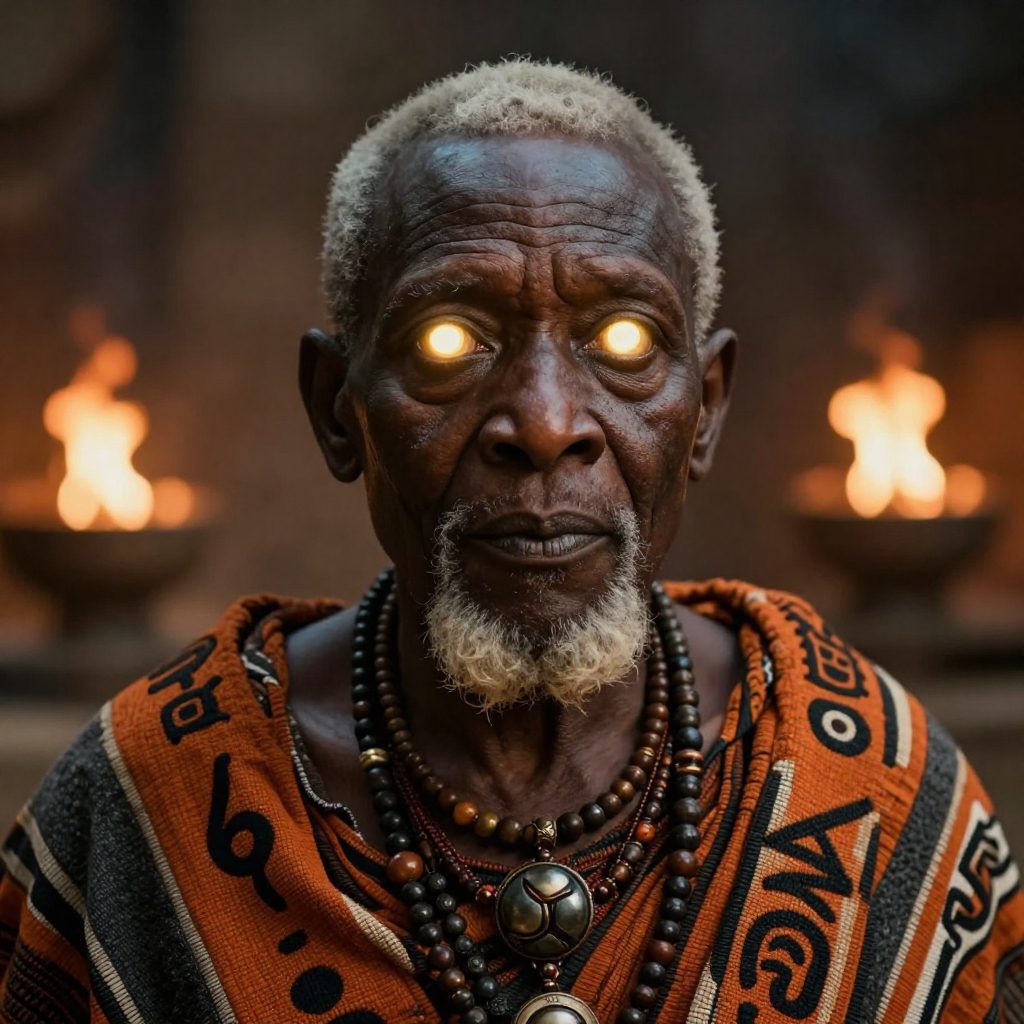
Odomankoma is not described with a fixed physical form in Akan tradition. He is understood as an abstract, omnipresent presence that cannot be confined to human likeness or animal shape. This absence of anthropomorphic imagery reflects Akan philosophical thought, which holds that the ultimate creative force transcends material limitation. Rather than being seen, Odomankoma is recognized through evidence of order, pattern, and intentional design within the natural world.
Symbolically, storytellers sometimes associate Odomankoma with the spider, drawing on the spider’s ability to design complex webs from nothing. Titles such as Ananse Kokuroku, meaning the great designer, emphasize intelligence and craftsmanship rather than physical appearance. Sacred natural sites, including rock formations known as Odomankoma Nsa or the fingerprint of God, are believed to carry traces of his creative touch. These locations reinforce the idea that Odomankoma’s presence is imprinted onto creation itself rather than embodied within a visible form.
Family
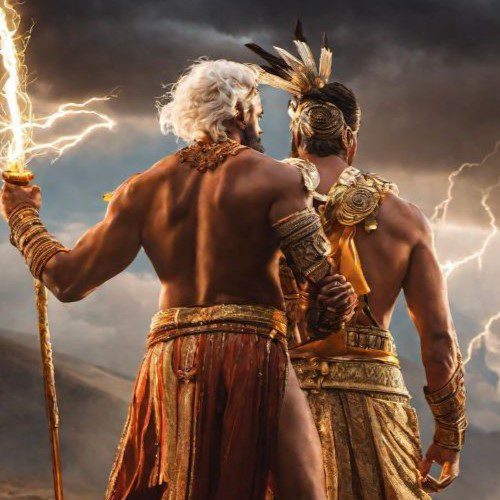
Odomankoma occupies a unique position within Akan theology, where divinity is often expressed through functional unity rather than genealogical hierarchy. He is most commonly understood as part of a supreme triadic principle alongside Nyame and Nyankopon. In this structure, Odomankoma shapes the physical universe, Nyame governs the cosmic expanse, and Nyankopon animates existence with kra, the spiritual life force. These are not separate gods in conflict but complementary aspects of supreme divinity.
Some traditions describe Odomankoma withdrawing after his symbolic death, entrusting the governance of creation to Nyame and Nyankopon before later returning through renewal. Other narratives place Asase Yaa, the Earth Mother, at the center of divine-human interaction, while Odomankoma remains the original creative intelligence behind all beings, including the abosom or nature spirits. Rather than functioning as a father figure with offspring, Odomankoma exists as the source from which all spiritual and material relationships flow.
Other names
Odomankoma is known by several epithets across Akan-speaking regions, each emphasizing a different dimension of his creative authority. Borebore, often translated as the Absolute Architect, highlights his role as the one who carved existence out of formlessness. Oboadee simply identifies him as the creator, while Ananse Kokuroku links his intelligence to the spider’s symbolic mastery of design.
Other names such as Twereduampon, meaning the dependable one, express trust in his sustaining power. In philosophical usage, the combined expression Nyame–Nyankopon–Odomankoma is sometimes invoked to convey the unity of cosmic order, life force, and creative intelligence as a single divine reality rather than separate beings.
Powers and Abilities
Odomankoma’s primary power lies in creation through intellect and craftsmanship. Akan tradition emphasizes that the universe was first conceived in thought before being shaped into form, presenting creation as a deliberate and rational act. He is credited with forming matter, establishing natural laws, and embedding kra within living beings so that life continues beyond physical death.
One of the most distinctive elements of Odomankoma’s mythology is his relationship with death. By creating Owuo, he introduces mortality into the world, yet he also transcends it through knowledge, restoring himself through antidote and wisdom. This cycle establishes death not as an enemy of creation but as a necessary counterpart to renewal. Through this act, Odomankoma affirms balance rather than dominance, reinforcing Akan beliefs in continuity rather than finality.
Modern Day Influence
Despite centuries of religious change, Odomankoma remains deeply embedded in Akan cultural consciousness. His name continues to appear in proverbs, libations, and philosophical expressions that frame life as purposeful and designed. Sacred sites associated with his creative presence are still visited, and many communities attribute healing or spiritual clarity to these locations.
In academic discourse, Odomankoma is frequently cited as a cornerstone of African metaphysical thought, illustrating indigenous understandings of causality, destiny, and moral responsibility. Within the African diaspora, elements of his identity persist in syncretic traditions and comparative theology, where he is often discussed alongside other supreme creator concepts. Contemporary artists and writers draw upon Odomankoma to explore themes of origin, resilience, and cultural memory, ensuring that his legacy continues to evolve rather than remain confined to the past.
Related Images

Source
Busia, K. A. (1954). The Akan doctrine of God. (Scholarly publication on Akan theology).
Danquah, J. B. (1944). The Akan doctrine of God: A fragment of gold coast ethics and religion. Asia Press.
Gyekye, K. (1995). An essay on African philosophical thought: The Akan conceptual scheme. Temple University Press. (Referenced in Akan studies).
Opoku, A. A. (1978). West African traditional religion. FEP International Publishers. (Covers Akan deities).
Platvoet, J. (2016). Nyame ne Aberewa: Towards a history of Akan religion. (PDF publication).
Rattray, R. S. (1930). Akan-Ashanti folk-tales. Oxford University Press.
Talk Africana. (2025, March 15). Odomankoma: The omnipotent creator of all things according to the Akan. https://talkafricana.com/odomankoma-the-omnipotent-creator-of-all-things-according-to-the-akan/
Wikipedia. (2024). Nyankapon-Nyame-Odomankoma. https://en.wikipedia.org/wiki/Nyankapon-Nyame-Odomankoma
Frequently Asked Questions
Who is Odomankoma in Akan belief?
Odomankoma is the supreme creative intelligence in Akan cosmology, responsible for shaping the universe and giving form to existence. He functions as the divine architect rather than a distant sky ruler.
Is Odomankoma the same as Nyame?
They are closely connected but not identical in function. Nyame represents the cosmic expanse, Nyankopon embodies life force, and Odomankoma shapes the physical and material world. Together they form a unified divine principle.
Did Odomankoma create death?
Yes, Akan traditions state that Odomankoma created Owuo, the force of death, but later transcended it through wisdom, establishing death as part of cosmic balance rather than final destruction.
Why is Odomankoma associated with the spider?
The spider symbolizes intelligence, design, and creative mastery. Odomankoma is sometimes called Ananse Kokuroku, reflecting his role as the master designer of existence.
Is Odomankoma still worshipped today?
While not worshipped in temples, Odomankoma remains central to Akan philosophy, proverbs, libations, and spiritual worldview, continuing to influence cultural identity and ethics.