


Nehanda : The Legendary Spirit of Shona Resistance
At a glance
| Description | |
|---|---|
| Origin | Shona Mythology |
| Classification | Spirits |
| Family Members | Mutota (Father) |
| Region | Zimbabwe |
| Associated With | Ancestral guidance, Royal authority, Land, Fertility, Rainfall, Resistance |
The Mythlok Perspective
In Mythlok’s Perspective, Nehanda can be compared with Morrígan from Irish mythology, as both are powerful female figures associated with conflict, prophecy and the fate of their people. Yet their authority comes from different traditions: the Morrígan is a divine figure who operates within the supernatural hierarchy of Irish mythology, while Nehanda is an ancestral mhondoro whose authority is rooted in lineage, land and community. That distinction makes Nehanda a particularly powerful example of how spiritual leadership can become national resistance.
Nehanda
Introduction
In Shona religious tradition, Nehanda is a powerful mhondoro, a high-ranking ancestral spirit associated with royal lineage, territorial guardianship and communication between the living community and the spiritual world. The name is also closely connected with Nyamhita, traditionally described as a daughter of Mutota, the founder of the Mutapa state. Over generations, Nehanda came to represent more than a single ancestral figure: the spirit became associated with the protection of land, spiritual authority and the wellbeing of communities in parts of present-day Zimbabwe.
Nehanda’s historical importance became especially pronounced in the nineteenth century through Charwe Nyakasikana, the spirit medium known as Mbuya Nehanda. During the First Chimurenga of 1896–1897, Charwe became one of the most prominent spiritual leaders of resistance to British colonial rule. She was captured, tried and executed in 1898. The records of her trial, preserved with those of the Kaguvi medium, were inscribed on UNESCO’s Memory of the World Register in 2015.
Because the name Nehanda refers both to an enduring spirit and, in popular historical usage, to its famous nineteenth-century medium, the two should not be treated as identical. The distinction is central to understanding Nehanda within Shona cosmology and Zimbabwean history.
Physical Traits
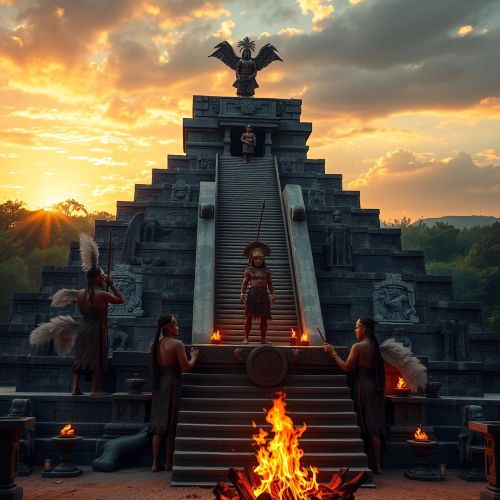
Nehanda does not have a fixed physical appearance in Shona religious tradition. As a mhondoro, she is understood as an ancestral spirit whose presence can be experienced through a human medium rather than as a permanently embodied supernatural being. The term mhondoro is commonly associated with the lion, an image that conveys ancestral authority, power and guardianship, but this does not mean that Nehanda is simply imagined as a literal lion.
The physical form most firmly associated with Nehanda in historical records is that of Charwe Nyakasikana, the nineteenth-century woman who served as the principal medium of the Nehanda spirit during the First Chimurenga. Accounts of her capture and trial therefore describe a historical woman and spirit medium, rather than establishing a canonical physical appearance for the Nehanda spirit itself.
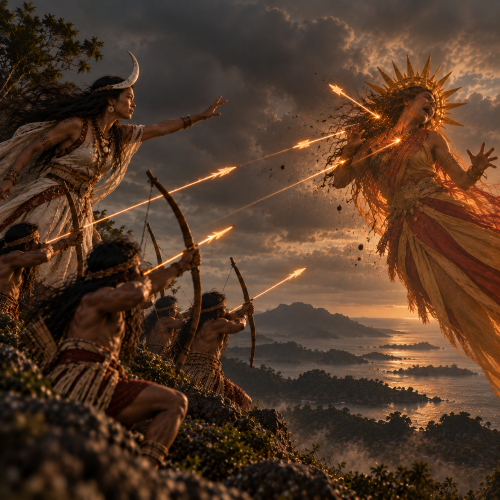
This distinction is particularly important when Nehanda is represented visually. A depiction of the spirit may draw upon royal Shona symbolism, the lion imagery associated with mhondoro, or the historical appearance of Charwe, but these represent different layers of the tradition. Nehanda’s identity is ultimately defined more by spiritual authority, ancestry and territorial guardianship than by physical characteristics.
Family
Nehanda’s traditional genealogy is connected to the Mutapa royal lineage. One influential tradition identifies the original Nehanda with Nyamhita, the daughter of Mutota, the founder of the Mutapa state. This places the ancestral spirit within an important royal genealogy and helps explain her elevated status as a mhondoro.
Different Shona traditions preserve variations in Nehanda’s genealogy and relationship to other ancestral figures, so these accounts should not be presented as a single universally agreed family tree. Chaminuka, another important Shona ancestral spirit, is sometimes described within traditions as a sibling or closely connected spiritual figure. Such relationships are significant because Shona ancestral traditions often connect political legitimacy, territory and spiritual authority.
The family of the Nehanda spirit is therefore broader than biological descent. As a royal ancestral spirit, Nehanda represents a continuing relationship between ancestors, land and living communities. The later history of the spirit also demonstrates this distinction: Charwe Nyakasikana was a historical woman who served as a medium for Nehanda, rather than being the same person as the ancestral figure identified with Nyamhita.
Charwe herself belonged to the Hwata lineage in the Mazowe region and had a family of her own. Her biography should therefore be distinguished from the mythological genealogy of Nehanda. This separation helps prevent the common mistake of treating every historical detail about Charwe as though it were part of the ancient Nehanda tradition.
Other names
Nehanda is known through several names and titles that reflect different aspects of her spiritual and historical identity. Mbuya Nehanda, meaning Grandmother Nehanda, is one of the most familiar forms of address and expresses respect for the spirit as an elder ancestral presence.
Nehanda is also associated with Nyamhita, the name given in traditions concerning the royal ancestor from whom the spirit is believed to descend. The historical medium is commonly identified as Charwe Nyakasikana, while the combination Mbuya Nehanda is frequently used when referring to her role as the medium through whom the spirit became especially prominent during the colonial period.
The classification mhondoro is also important. Rather than being a personal name, it describes the type of powerful ancestral spirit Nehanda represents. The association with the lion reflects the status, authority and protective character traditionally attributed to such spirits.
The historical Nehanda is also closely associated with the term svikiro, meaning a spirit medium. This distinction matters because Nehanda is the spirit, while Charwe was the human medium through whom that spirit was understood to communicate.
Powers and Abilities
The powers attributed to Nehanda arise from her position within Shona spiritual life rather than from a catalogue of fantasy-style supernatural abilities. As a mhondoro, Nehanda is associated with ancestral authority, territorial protection and communication between spiritual and human communities.
One of the most important aspects of her role is spiritual mediation. High-ranking ancestral spirits are traditionally understood as intermediaries through whom communities can seek guidance concerning matters affecting collective wellbeing. Nehanda’s authority is therefore connected to the relationship between the community, its ancestors and Mwari, the supreme deity in Shona religious thought.
Nehanda is also associated with land, fertility and rainfall. In traditional Shona religious systems, environmental wellbeing cannot be completely separated from spiritual and social relationships. A spirit such as Nehanda could therefore be approached in matters concerning the welfare of a territory and its people.
Her most historically significant association is resistance to colonial rule. Through Charwe Nyakasikana, the Nehanda spirit became one of the major spiritual forces associated with the First Chimurenga. UNESCO describes Nehanda and Kaguvi as key spirit mediums who helped inspire and unite resistance to colonial rule.
Nehanda’s legacy also became prophetic in Zimbabwean nationalist memory. The famous tradition that her bones would rise again was later interpreted as a prophecy of liberation and became associated with the struggle that ultimately brought majority rule in 1980. It is important, however, to identify this as part of the later historical and nationalist interpretation of her legacy rather than present it as an independently verifiable supernatural prediction.
Modern Day Influence
Nehanda remains one of the most recognisable symbols of Zimbabwean resistance and cultural identity. Her importance extends beyond religious tradition because the story of the Nehanda spirit and Charwe Nyakasikana became deeply embedded in the history of the country’s struggle against colonial rule.
Her role in the First Chimurenga gave Nehanda a lasting place in Zimbabwean nationalist memory. The later liberation struggle drew heavily upon the memory of earlier resistance, and Nehanda became an enduring symbol of determination, indigenous authority and resistance to colonial domination. UNESCO describes the Nehanda and Kaguvi court records as important documentary evidence of this history and recognises their international significance through the Memory of the World Register.
Nehanda’s legacy is also visible in Zimbabwe’s public culture. Her name appears in commemorative works, literature, music and public institutions, while artistic representations have helped transform her from an ancestral figure into a national cultural icon. A major statue of Mbuya Nehanda was unveiled in Harare in 2021, further establishing her presence within the country’s public commemorative landscape.
Her importance also extends to discussions of women and political leadership. Charwe’s historical role challenges narratives that portray resistance movements primarily through male political and military leaders. As a woman who exercised considerable spiritual authority during a major anti-colonial uprising, she has become an important figure in discussions of gender, indigenous leadership and African history.
Nehanda therefore occupies several identities simultaneously: ancestral spirit, royal figure, religious authority, historical symbol and national icon. Her continuing influence demonstrates how mythology and history can overlap without becoming interchangeable. For Zimbabwe, Nehanda represents a living connection between ancestral memory, resistance and the continuing interpretation of national identity.
Related Images



Source
Beach, D. N. (n.d.). Nehanda Charwe Nyakasikana. In Oxford Research Encyclopedia of African History. Oxford University Press. https://oxfordre.com/africanhistory/display/10.1093/acrefore/9780190277734.001.0001/acrefore-9780190277734-e-1190
Britannica, T. E. of. (2014, August 16). Nehanda. Encyclopædia Britannica. https://www.britannica.com/topic/Nehanda
Britannica, T. E. of. (2014, August 15). Charwe. Encyclopædia Britannica. https://www.britannica.com/biography/Charwe
CIPDH. (2020, October 24). Nehanda and Kaguvi mediums’ judgment dockets. Centro de Información y Memoria de los Derechos Humanos. https://www.cipdh.gob.ar/memorias-situadas/en/lugar-de-memoria/expedientes-del-juicio-a-la-medium-nehanda-y-al-medium-kaguvi/
Encyclopaedia Africana. (2026, August 12). Nyakasikana, Nehanda. https://encyclopaediaafricana.com/nyakasikana-nehanda/
Smithsonian Magazine. (2021, May 26). Zimbabwe unveils statue of anti‑colonial leader Mbuya Nehanda. https://www.smithsonianmag.com/smart-news/zimbabwe-unveils-statue-anti-colonial-leader-mbuya-nehanda-180977835/
The Patriot. (n.d.). Nehanda: Tracing the roots of the great Shona spirit medium: Part Two. https://www.thepatriot.co.zw/old_posts/nehanda-tracing-the-roots-of-the-great-shona-spirit-medium-part-two/
Wikipedia contributors. (2005, December 4). Nehanda Charwe Nyakasikana. In Wikipedia. https://en.wikipedia.org/wiki/Nehanda_Charwe_Nyakasikana
Frequently Asked Questions
Who is Nehanda in Shona mythology?
Nehanda is a powerful mhondoro, or high-ranking ancestral spirit, in Shona religious tradition. She is traditionally connected with royal ancestry, territorial guardianship, spiritual guidance and the wellbeing of communities. Nehanda is also strongly associated with Zimbabwe’s anti-colonial history through the nineteenth-century spirit medium Charwe Nyakasikana.
Is Nehanda a goddess?
Nehanda is not best classified as a goddess. In Shona religious tradition, she is understood as a powerful ancestral spirit or mhondoro. Her authority comes from ancestral status and her relationship with the spiritual world rather than from being a separate supreme deity.
Who was Mbuya Nehanda?
Mbuya Nehanda refers to the Nehanda spirit and, particularly in historical discussions, to Charwe Nyakasikana, the nineteenth-century spirit medium associated with the First Chimurenga. Charwe became one of the most prominent spiritual leaders of resistance to colonial rule and was executed after her capture.
What does Nehanda have to do with Zimbabwe's First Chimurenga?
Through her medium Charwe Nyakasikana, Nehanda became one of the major spiritual figures associated with the First Chimurenga of 1896–1897. Nehanda and the Kaguvi medium helped inspire resistance to colonial rule, and their historical trial records are preserved as UNESCO Memory of the World documentary heritage.
Why is Nehanda important in Zimbabwe today?
Nehanda remains an important symbol of ancestral authority, resistance, cultural identity and national memory. Her story connects Shona spiritual tradition with the history of anti-colonial resistance, while Charwe Nyakasikana’s legacy has also made Nehanda an important figure in discussions of women’s leadership and Zimbabwean history.


