
Nai : The Sacred Sea God of the Ga People
At a glance
| Description | |
|---|---|
| Origin | Ga Adangbe Mythology |
| Classification | Gods |
| Family Members | N/A |
| Region | Ghana |
| Associated With | Sea, Protection, Fishing, |
The Mythlok Perspective
In Mythlok’s Perspective, Nai represents a form of divinity where the god is not separate from nature but fully embodied within it. Unlike figures such as Poseidon from Greek tradition or Njord from Norse belief, who rule over the sea, Nai is the sea itself in divine form. This aligns more closely with deities like Yemoja in Yoruba belief, yet Nai remains less personified and more elemental. His presence reflects a worldview where humans do not dominate nature but exist within its sacred balance.
Nai
Introduction
Nai is one of the most revered deities in Ga-Adangbe belief, particularly among the Ga people of coastal Ghana. Recognised as a powerful sea god within the Kpele religious system, Nai embodies the living force of the ocean and its direct influence on human life. In a culture where the sea defines livelihood, survival, and identity, Nai is not distant or abstract but actively present in everyday existence.
The Ga-Adangbe worldview places strong emphasis on natural forces as expressions of divine power. At the center of this system stands Ataa Naa Nyonmo, the supreme creator who governs both sky and sea. Beneath this supreme authority, gods like Nai operate as divine agents, shaping the world in tangible ways. Nai’s domain is the ocean, making him a central figure in maintaining balance between humans and the unpredictable forces of water.
At Nai We in Accra, the worship of Nai is formalised through priesthood, rituals, and sacred traditions. This institutional presence highlights Nai’s importance not just as a symbolic deity, but as a governing force within Ga society. His role extends beyond mythology into the practical and spiritual realities of coastal life.
Physical Traits
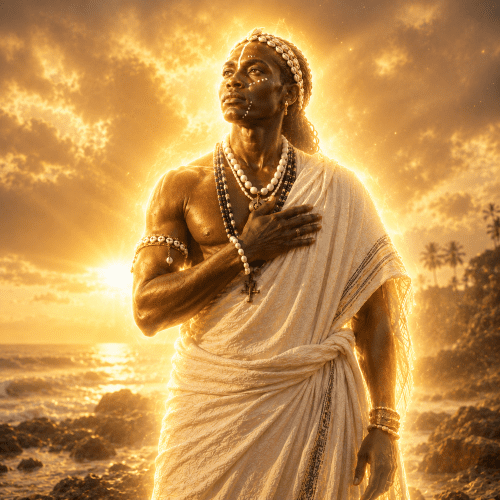
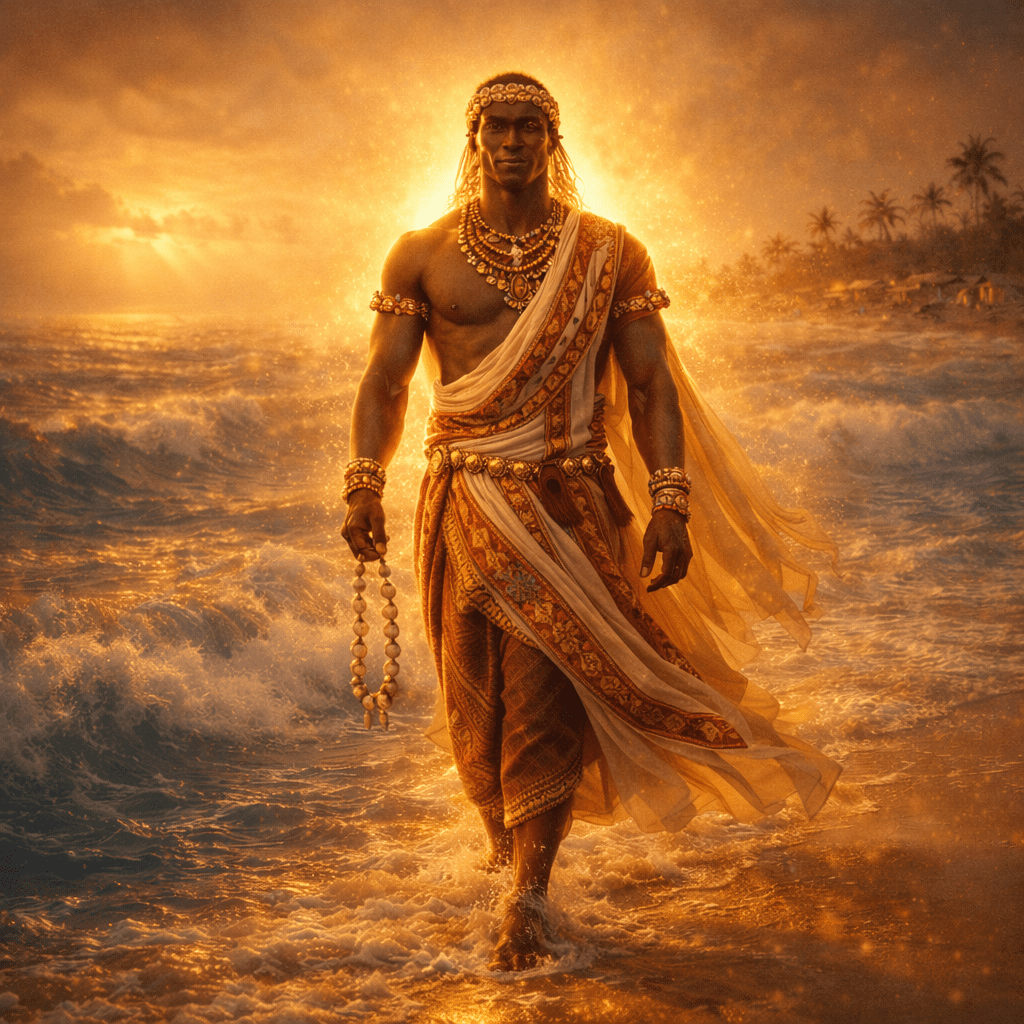
Nai is not defined by a fixed human-like form. As a sea god, his presence is expressed through the ocean itself rather than through a physical body. This reflects a broader Ga-Adangbe understanding of divinity, where gods are experienced through natural phenomena rather than visual representation.
The movement of waves, the rhythm of tides, and the vastness of the sea are all seen as manifestations of Nai. Calm waters are often interpreted as signs of favour and balance, while turbulent seas may signal warning or divine displeasure. In this way, Nai communicates not through appearance, but through the behavior of his domain.
During rituals, Nai may be represented symbolically or invoked through human mediums. Priests and priestesses enter trance states, allowing Nai’s presence to be expressed through speech and action. These moments bridge the gap between the divine and human worlds without reducing the god to a fixed form. This absence of anthropomorphic imagery emphasizes Nai’s power as an elemental deity. He is not separate from the sea; he is the sea in its divine form.
Family
Nai does not belong to a traditional divine family structure. In Ga-Adangbe belief, gods are not organised through genealogy but through function and domain. Nai exists within a network of deities, each responsible for different aspects of the natural world.
Among these are gods associated with rivers, lagoons, and land, such as Korle and Sakumo. While these deities share similar roles in governing natural forces, they are not described as relatives of Nai. Instead, they operate alongside him as part of a broader divine system.
All gods, including Nai, ultimately derive their authority from Ataa Naa Nyonmo, the supreme creator. Rather than being children or descendants, they are expressions of divine will, each tasked with maintaining order within their specific domain. Nai’s position within this structure is defined by his role as the sea god. His responsibility is to regulate the ocean’s interaction with human life, ensuring both provision and balance.
Other names
Nai is primarily known by this single name within Ga-Adangbe tradition, and there are no widely established alternative titles. This consistency reflects the strength of oral tradition among the Ga people, where names are preserved with clarity and continuity.
Some interpretations have suggested a possible symbolic link between Nai and large river systems such as the Nile, though this connection remains speculative and is not central to Ga belief. Within the cultural context of Accra, Nai’s identity is firmly rooted as the sea god of the Ga people. Unlike the supreme deity Ataa Naa Nyonmo, who carries multiple names reflecting duality and cosmic authority, Nai’s singular name reinforces his focused role within the divine order.
Powers and Abilities
As the sea god, Nai governs all aspects of the ocean and its relationship with human life. His powers are both practical and spiritual, directly influencing the survival and prosperity of coastal communities.
Fishermen depend on Nai for safety and success. Before venturing into the sea, rituals are performed to seek his protection and blessing. A favorable outcome, such as a plentiful catch or calm waters, is seen as evidence of Nai’s approval. Conversely, storms or poor yields may be interpreted as signs of imbalance or neglect of ritual obligations.
Nai also acts as a mediator between humans and the supreme creator. Through priests and priestesses known as Wọŋtśεmεi, Nai communicates guidance, warnings, and decisions that affect the community. These spiritual intermediaries play a crucial role in interpreting Nai’s will and maintaining harmony.
Libation rituals are central to Nai’s worship. Through spoken prayers and offerings, the community calls upon Nai alongside ancestral forces. These ceremonies reinforce moral order, gratitude, and respect for nature.
At a deeper level, Nai embodies balance. The sea can sustain life, but it can also destroy it. Nai governs both aspects, reminding humans that survival depends on respect for the natural world and adherence to spiritual practices.
Modern Day Influence
Nai continues to shape cultural identity and spiritual practice among the Ga people today. Even with the widespread influence of Christianity and Islam, traditional beliefs centered around Nai remain active and meaningful.
Festivals such as Homowo reflect the enduring relevance of Ga spirituality. While the festival commemorates historical survival, it also includes rituals that honour deities like Nai. Through these practices, the connection between the community and the sea is continuously reaffirmed.
The Nai Wulomo, the chief priest, plays a vital role in preserving these traditions. By leading rituals and interpreting divine guidance, the priesthood ensures that Nai’s presence remains integrated into modern life.
Beyond ritual, Nai influences how coastal communities interact with the environment. The sea is treated with reverence, not just as a resource but as a sacred entity. This perspective fosters a sense of responsibility and continuity. Nai’s legacy is therefore both spiritual and cultural. He remains a living part of Ga identity, bridging ancient belief systems with contemporary life in coastal Ghana.
Related Images
Source
Field, M. J. (1940). Social organization of the Ga people. Crown Agents for the Colonies.
Kudadjie, J. N. (2002). Ga and Dangme proverbs for preaching and teaching. Asempa Press.
Kilson, M. (1973). African traditional religion in contemporary Ghana. Luzac & Company.
Odamtten, H. N. K. (2012). Towards a theoretical canon on Ga-Adangbe gender studies. Scholar Commons. https://scholarcommons.scu.edu/cgi/viewcontent.cgi?article=1131&context=history
Kpɔkpatsewe Royal Family. (2011). Religion of the Ga people of Ghana. https://kpakpatseweroyalfamily.wordpress.com/2011/09/07/religion-of-the-ga-people-of-ghana/
Kweku-Darlington. (2013). Ga people: Ghana’s tribe that has maintained its traditional religion. https://kwekudee-tripdownmemorylane.blogspot.com/2013/01/ga-people-ghanas-tribe-that-has.html
Anyflip. (n.d.). God in Ga tradition and Christian mission. https://anyflip.com/mcuu/fupi/basic/51-100
Frequently Asked Questions
Who is Nai in Ga Adangbe belief?
Nai is the sea god of the Ga people, governing the ocean, protecting fishermen, and maintaining balance in coastal life.
Does Nai have a physical form?
No, Nai has no fixed form and manifests through the sea, waves, and natural ocean forces.
What powers does Nai have?
Nai controls sea conditions, ensures fishing success, protects communities, and communicates through rituals and priests.
Is Nai still worshipped today?
Yes, Nai remains important in Ga culture through rituals, festivals, and traditional priesthood practices.
What is Nai associated with?
Nai is associated with the sea, protection, abundance, balance, and the relationship between humans and nature.