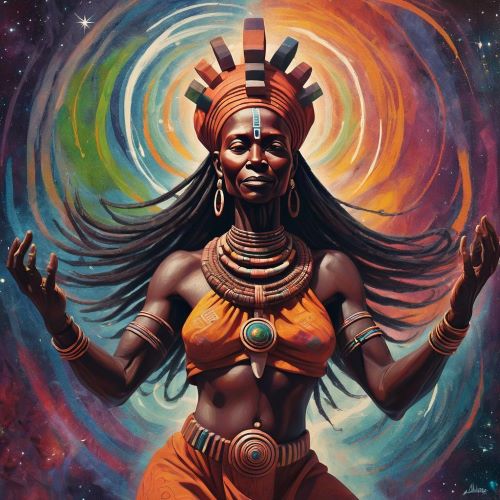

Lebe : The Dogon Serpent Ancestor and Earth Deity
At a glance
| Description | |
|---|---|
| Origin | Dogon Mythology |
| Classification | Gods |
| Family Members | N/A |
| Region | Mali |
| Associated With | Earth, Fertility, Agriculture, |
The Mythlok Perspective
In Mythlok’s Perspective, Lebe represents one of the most grounded forms of divinity, where the sacred is not above but beneath our feet. His identity as both ancestor and earth force places him closer to primal archetypes like the Egyptian Osiris, who embodies death and regeneration, and the Mesoamerican Quetzalcoatl in his serpent aspect linked to renewal and life cycles. Across cultures, such figures reveal a shared understanding that true power lies not in domination, but in transformation and continuity.
Lebe
Introduction
Lebe, also spelled Lébé or Lewe, is one of the most profound and foundational figures in Dogon belief from West Africa, particularly among the people of Mali. Unlike many deities who exist purely as divine beings, Lebe occupies a unique space as both an ancestor and a sacred force of nature. He is remembered as the first ancestor to die and be reborn, transforming into a serpent that became inseparable from the earth itself.
This transformation is not simply symbolic. In Dogon cosmology, Lebe represents the living cycle of death, regeneration, and agricultural fertility. His story explains not only the origin of mortality but also the renewal of life through the land. As a result, Lebe is central to the Dogon understanding of existence, where human life, soil, and ancestry are deeply interconnected.
The cult of Lebe is one of the four pillars of Dogon religion, alongside the worship of Amma, the Binou spirits, and the Awa mask society. Through these systems, Lebe becomes more than a mythological figure. He is a constant presence in ritual, agriculture, and social identity.
Physical Traits
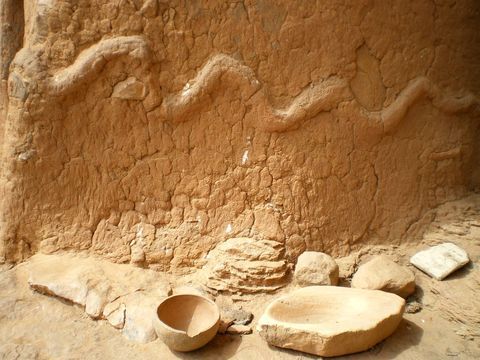
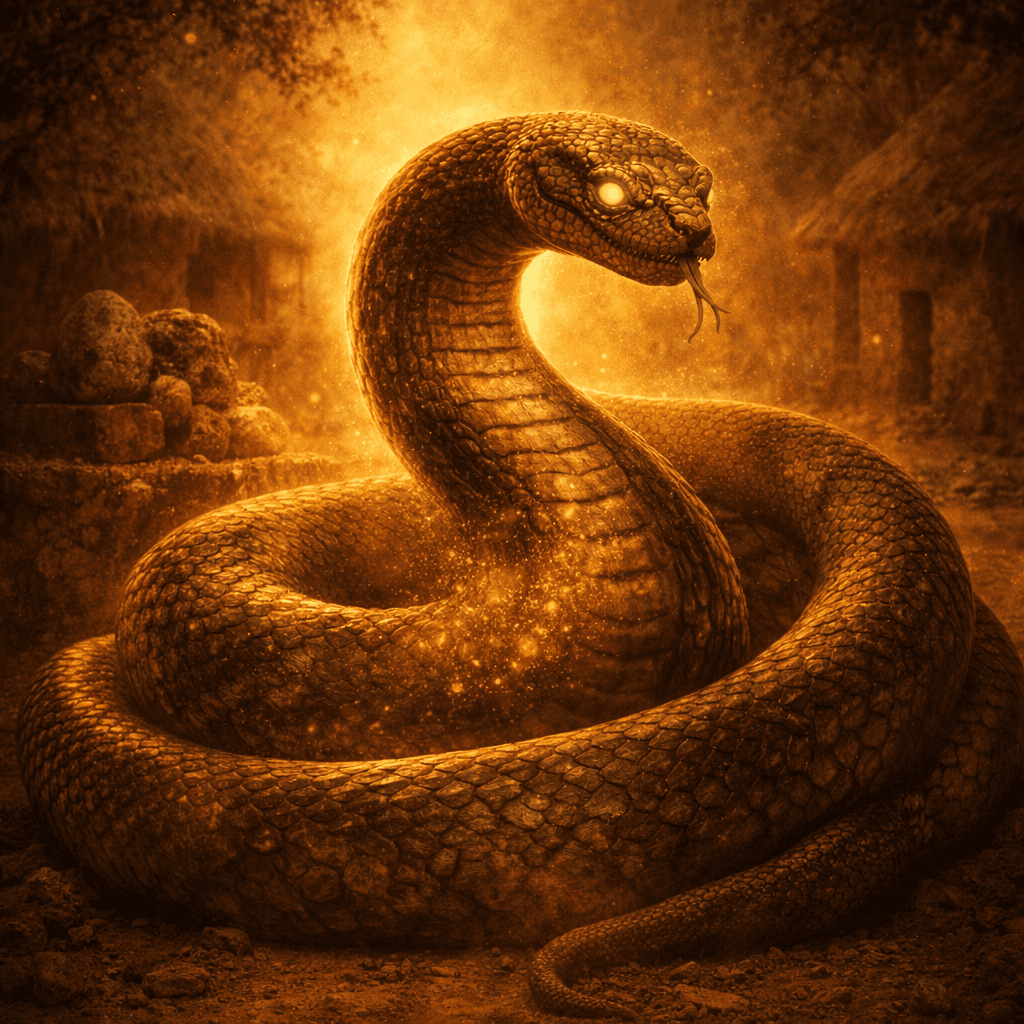
Lebe is most commonly represented as a serpent, often described as the “Serpent of the Earth.” This form is essential to understanding his role, as the snake embodies transformation, continuity, and renewal. Just as a serpent sheds its skin, Lebe symbolizes the cyclical nature of life, where death is not an end but a transition.
In Dogon belief, Lebe is not merely a symbolic serpent but a living presence within the soil. He is said to dwell beneath the earth, directly influencing its fertility and vitality. This connection makes him both visible and invisible, existing in the physical world while remaining deeply spiritual.
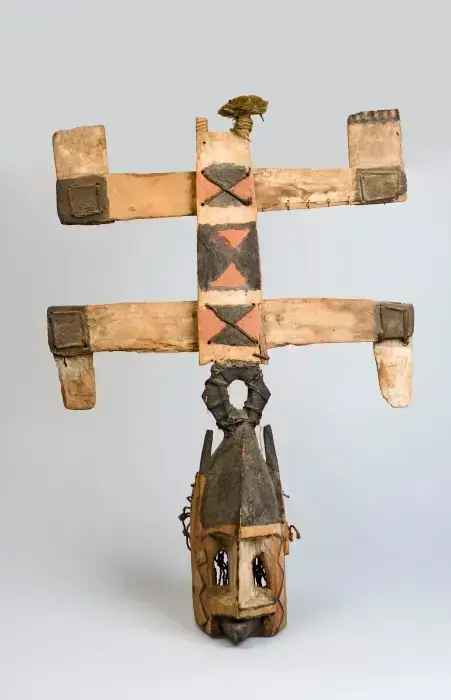
Ritually, Lebe is represented through shrines and sacred stones rather than detailed anthropomorphic images. These shrines are often constructed with soil taken from ancestral lands, reinforcing the idea that Lebe is inseparable from the earth itself. His presence is also believed to manifest through the Hogon, the village priest, whom Lebe visits in serpent form to purify and renew.
Family
Lebe’s identity is deeply rooted in ancestry rather than conventional divine lineage. He is considered the reincarnation of one of the earliest ancestors created by Amma, the supreme creator in Dogon cosmology. This places him at the very beginning of human existence.
His story is closely tied to the Nommo, powerful ancestral beings associated with order, water, and regeneration. According to Dogon tradition, the Nommo played a role in restoring Lebe after his death, allowing him to return in serpent form. This connection reinforces the theme of balance between destruction and renewal.
Lebe is also linked to Yurugu, the figure representing chaos and imbalance, though their relationship is indirect. Together with Amma and the Nommo, these figures form a cosmological system where order, disorder, and regeneration are constantly interacting. Rather than a family in the human sense, Lebe’s relationships reflect a cosmic structure, where each entity contributes to maintaining the balance of the universe.
Other names
Lebe is known by several variations, including Lébé and Lewe. These differences arise from the oral nature of Dogon traditions and the challenges of translating indigenous languages into written forms. Another important name is Lebe Seru, which refers to the original ancestor whose death and transformation gave rise to the serpent form. This name emphasizes his dual identity as both ancestor and deity. These variations are not separate identities but different expressions of the same figure, shaped by regional dialects and ritual contexts.
Powers and Abilities
Lebe’s powers are deeply connected to the earth and the continuity of life rather than dramatic displays of supernatural force. His influence is most clearly seen in agriculture, where he ensures the fertility of the soil and the success of harvests.
He embodies renewal and rebirth, representing the transformation that occurs after death. This makes him a central figure in explaining the cycle of existence, where life emerges from decay and continues through regeneration.
Lebe is also believed to have guided the Dogon people during their migration from the Mandé region to the Bandiagara cliffs. This journey is a crucial part of Dogon identity, and Lebe’s role as a guide reinforces his connection to both land and ancestry.
Another important aspect of his power is his role as a bridge between the living and the dead. Through rituals and shrines, Lebe connects present generations with their ancestors, ensuring continuity across time. His presence is not distant or abstract. It is embedded in the soil, in rituals, and in the everyday lives of the Dogon people.
Modern Day Influence
Lebe remains a living force in modern Dogon society. His cult continues to play a central role in agricultural and spiritual practices, particularly through the figure of the Hogon. The Hogon serves as the custodian of Lebe’s shrine and rituals, maintaining strict purity and acting as a direct link between the community and the earth deity. Every Dogon village contains a Lebe shrine, often built with sacred soil that symbolizes the continuity of ancestral land. These shrines are not relics of the past but active centers of ritual life.
Agricultural ceremonies still invoke Lebe to ensure fertile land and successful harvests. This reflects how Dogon spirituality is inseparable from daily survival, with mythological beliefs directly influencing practical life. Beyond the Dogon community, Lebe has gained recognition in anthropology and African studies as a powerful example of how myth, environment, and social structure can form a unified worldview.
Related Images


Source
Griaule, M., & Dieterlen, G. (1965). Conversations with Ogotemmêli: An introduction to Dogon religious ideas. International African Institute.
Heusch, L. de. (1985). Sacrifice in Africa: A structuralist approach (L. O’Brien & A. Morton, Trans.). Manchester University Press.
Imperato, P. J. (1978). Dogon cliff dwellers: The art of Mali’s mountain people. L. Kahan Gallery/African Arts.
Asante, M. K., & Mazama, A. (Eds.). (2009). Encyclopedia of African religion (Vol. 1). SAGE.
Insoll, T. (2004). Archaeology, ritual, religion. Routledge.
Dorey, S. (2013). The Nummo: The truth about human origins: Dogon religion. Elemental Expressions Ltd.
Wikipedia contributors. (2026). Lebe (Dogon). https://en.wikipedia.org/wiki/Lebe_(Dogon)
Damanhur Blog. (2020, August 18). Lebe the conscious ancestor. https://www.damanhurblog.com/spirituality/lebe-the-conscious-ancestor/
Frequently Asked Questions
Who is Lebe in Dogon belief?
Lebe is a primordial ancestor who was reborn as a serpent and became the earth deity associated with fertility and renewal.
Why is Lebe represented as a serpent?
The serpent symbolizes transformation, rebirth, and the continuous cycle of life and death.
What is the role of Lebe in agriculture?
Lebe ensures soil fertility and successful harvests, making him central to Dogon farming traditions.
How is Lebe worshipped today?
He is honored through shrines, rituals, and ceremonies led by the Hogon in Dogon villages.
Is Lebe a god or an ancestor?
Lebe is both, functioning as a deified ancestor and a sacred force connected to the earth.