

Old Javanese : The Language of Epics and Sacred Storytelling
| Description | |
|---|---|
| Culture | Java & Bali |
| Writing System | Pallava, Kawi script |
| Key Epics | Kakawin Ramayana, Mahabharata Kakawin |
| Symbolism | Cultural synthesis of Austronesian & Indian traditions |
| Age | 900 -1500 CE onwards |
Mythlok Perspective
In Mythlok’s View, Old Javanese is not just a linguistic system but a cultural transformer that reshaped imported myths into local realities. It stands alongside traditions like Classical Latin in Europe and Classical Chinese in East Asia, where language became a tool of civilizational identity. Much like how Greek myths evolved in Roman culture, Old Javanese reinterpreted Indian epics into a distinctly Southeast Asian worldview, proving that myths survive not by preservation alone, but by adaptation.
Old Javanese
Introduction
Old Javanese, often called Kawi, represents the earliest recorded stage of the Javanese language and stands as one of Southeast Asia’s most influential literary traditions. Emerging around the 9th century CE, it developed within the Hindu-Buddhist courts of Java and later flourished under powerful kingdoms such as Majapahit Empire. Unlike everyday speech, Old Javanese functioned as a refined literary register used in poetry, inscriptions, and sacred narratives.
What makes Old Javanese remarkable is its role as a bridge between cultures. It did not simply borrow from Indian traditions but reinterpreted them, adapting epics like the Ramayana and Mahabharata into distinctly local forms. These adaptations blended Indic cosmology with indigenous beliefs, creating a mythological landscape rooted in Java’s geography and spiritual worldview. As a result, Old Javanese became more than a language; it became a vessel for identity, memory, and sacred storytelling that continues to influence Bali and Java today .
Geographic Context
Old Javanese originated in Central and East Java, where early kingdoms such as Mataram nurtured its development. Over time, its influence expanded across regions including Bali, Madura, and Lombok. Through trade, political expansion, and cultural exchange, traces of Old Javanese reached other parts of Maritime Southeast Asia.
A major shift occurred between the 15th and 16th centuries, when the spread of Islam in Java led to the decline of Old Javanese in everyday use. However, Bali emerged as a crucial center for preservation. The island’s relative isolation allowed it to maintain Hindu-Buddhist traditions, safeguarding texts and rituals written in Old Javanese. Today, Bali remains one of the strongest living repositories of this linguistic heritage, where priests and scholars continue to study and recite ancient works .
This geographic journey reflects more than linguistic spread. It mirrors the movement of ideas, where myths traveled across islands and adapted to local landscapes. Mountains, volcanoes, and seas in Java were woven into epic narratives, grounding cosmic stories in familiar terrain.
Script/Writing System
Old Javanese was written using the Kawi script, a Brahmic writing system derived from South Indian scripts such as Pallava and Grantha. This script functioned as an abugida, where each character represented a consonant with an inherent vowel that could be modified through diacritics.
The earliest known complete Old Javanese inscription, the Sukabumi inscription from 804 CE, demonstrates the maturity of this writing system. Texts were inscribed on stone and copper plates for official purposes, while literary works were preserved on palm-leaf manuscripts known as lontar.
The script itself carried symbolic weight. Its flowing forms and structured patterns were not just practical tools but also aesthetic expressions suited for poetry. Over time, Kawi evolved into later scripts such as the modern Javanese and Balinese writing systems, ensuring continuity between ancient and contemporary traditions.
Mythological Texts Written
Old Javanese literature is best known for its kakawin, a genre of poetic works inspired by Sanskrit meters yet deeply localized in content. Among the most significant is the Kakawin Ramayana, which reimagines the Indian epic through a Javanese lens. While the core story of Rama remains intact, the narrative introduces new characters and themes that reflect local values and humor.
Similarly, adaptations of the Mahabharata, including works like Bharatayuddha, emphasize moral dilemmas and cosmic balance while embedding them in a Javanese worldview. These texts were not mere translations but creative reinterpretations, often incorporating indigenous figures such as Semar and the Punokawan, who added philosophical depth and social commentary.
Beyond epic retellings, Old Javanese literature also includes original mythological works like Tantu Pagelaran, which explains the cosmic origins of Java itself. Such texts reveal how language was used to anchor universal myths within local geography and belief systems, making them accessible and meaningful to regional audiences.
Transmission & Preservation
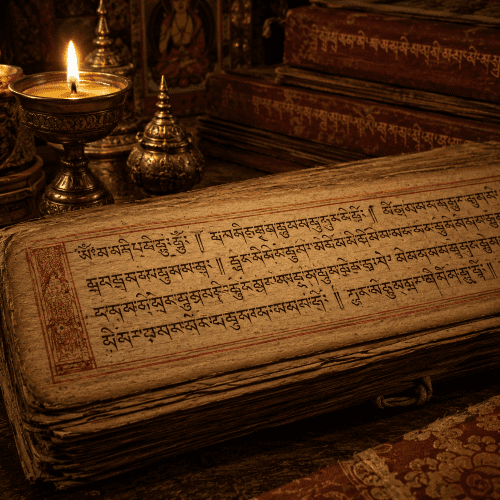
The survival of Old Javanese owes much to both written and oral traditions. Palm-leaf manuscripts served as the primary medium for preserving texts, carefully inscribed and maintained across generations. These manuscripts were often treated as sacred objects, reflecting their cultural importance.
Oral transmission played an equally vital role. Performances such as Wayang Kulit, the traditional shadow puppetry, brought these texts to life. Through storytelling, music, and visual symbolism, myths were passed down to audiences who may never have read the original manuscripts.
After the fall of Majapahit, Bali became the guardian of this heritage. Even today, many Old Javanese texts survive because of Balinese preservation efforts. Modern initiatives, including digitization projects and academic research, continue to protect and revive these works, ensuring that they remain accessible to future generations.
Symbolism & Cultural Role
Old Javanese represents a profound cultural synthesis. Its vocabulary includes a significant number of Sanskrit loanwords, reflecting Hindu-Buddhist influence, while its structure remains rooted in Austronesian linguistic traditions. This blend mirrors the broader cultural fusion that defines Javanese and Balinese identity.
In practice, Old Javanese functioned as a sacred language. It was used in rituals, temple ceremonies, and storytelling traditions, where its poetic form enhanced the spiritual atmosphere. Concepts such as dharma, cosmic balance, and ancestral reverence were expressed through its vocabulary, linking human life to a larger universal order.
Wayang performances further demonstrate this symbolic role. The language used by the puppeteer elevates the narrative, transforming entertainment into a spiritual experience. Through these performances, Old Javanese continues to shape moral and philosophical understanding in contemporary society.
Comparative Analysis
Old Javanese occupies a unique position among Southeast Asian languages. Compared to Old Malay, which absorbed a wider range of Indian linguistic influences, Old Javanese shows a more focused integration of Sanskrit vocabulary while maintaining its native grammatical structure.
When compared to Sanskrit itself, the differences are even more striking. Sanskrit preserves the original forms of Indian epics, while Old Javanese reshapes them into localized narratives. These adaptations often emphasize different themes, reflecting regional priorities and cultural values.
This process of adaptation, sometimes described as “Javanization,” highlights the creative agency of Old Javanese authors. Rather than simply inheriting myths, they transformed them, ensuring that the stories resonated with their own communities.
Modern Influence
The legacy of Old Javanese continues to shape modern culture, particularly in Bali and Java. In Bali, it remains a living language within religious contexts, used in rituals and ceremonial recitations. Wayang performances still draw heavily from Old Javanese texts, keeping ancient narratives alive in contemporary settings.
Scholars such as P. J. Zoetmulder have played a crucial role in preserving and studying the language, compiling dictionaries and translating texts that might otherwise have been lost.
In modern Indonesia, traces of Old Javanese appear in literature, national mottos, and artistic traditions. Its influence extends beyond language into identity, serving as a reminder of a shared cultural past that continues to inform the present.



Sources
Hunter, T. (2007). Introduction to Old Javanese language and literature. University of Michigan Library. https://library.oapen.org/bitstream/id/b3d7e2b3-a6dc-4009-a1c4-8988d2f43d20/9780472902187.pdf
Old Javanese. (2023, November 14). In Wikipedia. https://en.wikipedia.org/wiki/Old_Javanese
Javanese script. (2024, April 2). In Wikipedia. https://en.wikipedia.org/wiki/Javanese_script
Kawi script. (2024, December 30). In Wikipedia. https://en.wikipedia.org/wiki/Kawi_script
Mythology of Indonesia. (2023, February 26). In Wikipedia. https://en.wikipedia.org/wiki/Mythology_of_Indonesia
Kakawin Ramayana. (2024, October 16). In Wikipedia. https://en.wikipedia.org/wiki/Kakawin_Ramayana
Kreijveld, R. (2018). Old Javanese texts and the Balinese bhūtayajñas. Bulletin de l’École française d’Extrême-Orient, 104, 1-43. https://shs.hal.science/halshs-03895658/file/befeo_0336-1519_2018_num_104_1_6271.pdf
Frequently Asked Questions
What is Old Javanese?
Old Javanese is the earliest recorded form of the Javanese language, used mainly for literature, inscriptions, and sacred texts.
Is Old Javanese still spoken today?
It is no longer spoken conversationally but survives in Bali through rituals, literature, and traditional performances.
What script was used for Old Javanese?
Old Javanese was written in the Kawi script, derived from South Indian Brahmic writing systems.
Why is Old Javanese important?
It preserved and transformed major epics like the Ramayana and Mahabharata into local cultural narratives.
Where can Old Javanese texts be found today?
Many are preserved in Balinese palm-leaf manuscripts and modern digital archives maintained by scholars.